
1. Why Choosing a Dairy Free Milk Replacement Is Harder Than It Looks in 2026
You walk into the refrigerated aisle looking for one simple thing: a carton of milk your body, or your child’s body, can tolerate. Instead you face thirty-plus options. Oat, soy, almond, pea, coconut, rice, hemp, macadamia, and blends of several. Some are ‘barista’ editions, some are ‘unsweetened,’ and some are ‘original’ with several grams of added sugar. If you manage lactose intolerance, a milk allergy, or a household that simply avoids dairy, this is not a casual decision. A wrong pick can mean digestive misery, a ruined latte, a collapsed cake, or in the worst case an allergic reaction. That frustration is valid.
The clinical picture matters because ‘dairy free’ covers several different needs. Lactose intolerance is a digestive enzyme issue, and many people tolerate trace amounts. A true cow’s milk allergy is an immune reaction to milk proteins such as casein and whey, and it demands strict avoidance. Because milk is a major allergen, the FDA Food Allergen Labeling & Consumer Protection Act (FALCPA) requires it to be declared in plain language on packaged foods sold in the United States. That protection is real, but it does not answer every question a shopper has at the shelf.
Nutrition is the second layer. Cow’s milk delivers protein, calcium, vitamin D, and often vitamin B12 and iodine in one familiar package. Plant-based drinks vary widely. Fortified soy milk is nutritionally the closest match, with comparable protein. Many almond, rice, and coconut beverages contain a fraction of that protein unless fortified. The World Health Organization Guidelines on Healthy Diets & Saturated Fats encourage limiting free sugars and saturated fat. That is relevant when a sweetened oat drink or a rich coconut beverage becomes your daily default.
One safety note: plant drinks are not substitutes for breast milk or infant formula, and they should not be a toddler’s main drink without pediatric guidance. For everyone else, the goal is a product that fits your purpose (baking, coffee, or cereal and glass-sipping), your allergen needs, and your tolerance for additives. Meeting all three at once is what makes this category hard.
Scan Any Label for Hidden Additives and Allergens — Free
Never second-guess confusing grocery labels again. Download Food Scan Genius to uncover hidden additives, toxic dyes, and allergens for the whole household before you buy.


2. Sneaky Ingredients and Labeling Gaps Hiding in Plant-Based Milks
The front of the carton tells a story of simplicity: ‘creamy,’ ‘plant-powered,’ ‘barista.’ The ingredient list tells the real one. Here are the gaps and additives that most often catch shoppers off guard when choosing a dairy free milk replacement:
- ‘Non-dairy’ is not always milk-free. In the U.S., some ‘non-dairy’ creamers and coffee whiteners contain sodium caseinate, a milk-derived protein. It is declared as a milk allergen, but the bold ‘non-dairy’ claim can make a hurried reader assume otherwise. This matters most for coffee-oriented products.
- Precautionary ‘may contain milk’ statements. These are voluntary and not standardized under FALCPA. Some brands use them and others with similar shared-line risks do not, so the absence of a warning is not a guarantee for severe allergies.
- Added sugars and enzyme-treated oats. ‘Original’ and ‘vanilla’ versions often contain cane sugar or syrups. Oat drinks are typically made by enzymatically breaking starch into maltose, which can raise blood glucose quickly even when no sugar is added. ‘No added sugar’ does not mean low sugar.
- Added oils for mouthfeel. Many oat and barista blends include sunflower, rapeseed (canola), or other oils to mimic milk’s creaminess. If you avoid seed oils, you will not find this on the front panel.
- Gums, emulsifiers, and acidity regulators. Gellan gum, guar gum, carrageenan, and dipotassium phosphate keep drinks smooth and stop them splitting in hot coffee. Approved additives are regulated, and the European Food Safety Authority (EFSA) Additive Safety Regulations are a useful reference for how they are evaluated. Some people with sensitive digestion still prefer to avoid specific ones.
- Gluten cross-contact in oat milk. Oats are often grown and processed near wheat, barley, and rye. Unless the package is certified gluten-free, oat milk can be a problem for people with celiac disease.
There is also the processing question. Many shelf-stable plant milks, especially flavored or barista versions, contain enough refined ingredients and additives to qualify as ultra-processed. Research, including this PubMed Research on Ultra-Processed Foods & Gut Microbiome Disruption, continues to explore how highly processed diets may affect gut health. This is not a reason to panic over one carton. It is a reason to know what is in the cartons you buy every week.
3. Head-to-Head: Scanning Smarter Than Squinting at Labels
| Dimension | Food Scan Genius | Fig | Spoonful | Manual Label Reading |
|---|---|---|---|---|
| Cost | 100% free core features, zero paywalls | $59/yr for full access | Limited scans before upgrade | Free, but time-intensive |
| Ingredient depth | NutriGraph: 5M+ verified UPC/EAN barcodes with recursive sub-ingredient parsing | Varies by plan; verify current coverage | Varies by plan; verify current coverage | Depends on your own knowledge of terms |
| Dietary profiles & custom flags | 39 profiles plus custom sensitivities (seed oils, dyes, additives) | Check current profile options | Check current profile options | Entirely memory-based |
| Family screening | Multi-household profiles; one scan with named attribution (e.g., ‘Fails for Sri (Gluten)’) | Check current family features | Check current family features | Repeat the process for each person |
| Languages | 11 global languages with real-time in-app translation | Check current language support | Check current language support | Requires reading the package language |
The technology advantage comes down to depth. Plant milks often hide complexity in compound ingredients, such as a ‘natural flavor’ or a ‘vitamin blend,’ that themselves contain sub-ingredients. Food Scan Genius is powered by the NutriGraph Database, which holds more than 5,000,000 verified UPC/EAN barcodes and uses recursive AST parsing to unpack those nested components. Whether the carton on your shelf is a pea-protein blend or a barista oat drink, the audit looks beyond the headline ingredient. You can screen against 39 built-in dietary profiles, including dairy-free, vegan, and gluten-free, and add your own custom sensitivity for something like seed oils, a particular dye, or a specific gum.
Flagging is only half of the job, so ScanGenius AI Insight adds context rather than a blunt grade. It explains why an ingredient was flagged, shows its NOVA 1-4 processing classification alongside the Nutri-Score, and avoids the simplistic moralizing of ‘good’ versus ‘bad’ scores. A fortified soy milk with a stabilizer may be a sensible daily choice for one household and a poor fit for another. With Multi-Household Family Profiles, one scan checks everyone at once. A carton might show ‘Fails for Sri (Gluten)’ because the oat drink isn’t certified, while remaining fine for the rest of the family. With 11 languages and real-time translation, imported brands or travel shopping become readable too.
4. Related Food Safety & Dietary Guides
- Best Food Allergy Scanner App – Scan Food Labels Instantly — Food Allergy & Sensitivity Scanner Hub
- The 7 Best Free Food Scanner Apps of 2026 — best free food scanner apps
- Choosing the Best Barcode Scan App for Your Health — guide to choosing a barcode scanner app
- Food Scan Genius: World’s #1 Food Ingredient Scanner App — Food Scan Genius scanner app
5. Scientific & Health Authority References
- FDA Food Allergen Labeling & Consumer Protection Act (FALCPA)
- European Food Safety Authority (EFSA) Additive Safety Regulations
- PubMed Research on Ultra-Processed Foods & Gut Microbiome Disruption
- World Health Organization Guidelines on Healthy Diets & Saturated Fats
6. How to Scan in 3 Simple Steps
- Download Food Scan Genius free on iOS or Android. There is no paywall, subscription, or scan cap on core features, so you can audit every carton on your shopping list.
- Set up your profiles. Choose the Dairy-Free profile (and Gluten-Free, Vegan, or others if relevant), add family members by name, and create custom sensitivities such as seed oils, carrageenan, or added sugar. You can switch the app to any of the 11 supported languages.
- Scan the barcode on any plant milk. In about two seconds you get an instant audit trail: flagged ingredients, who in your household it fails for and why, NOVA 1-4 classification, Nutri-Score, and ScanGenius AI Insight in plain language.
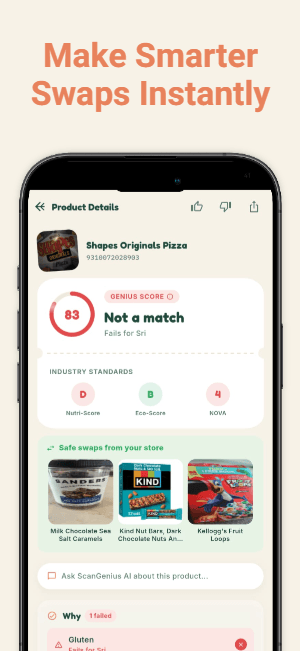
Instant Dairy-Free Audit Trail
7. Frequently Asked Questions (FAQ)
What is the best dairy free milk replacement for baking?
Unsweetened, fortified soy milk is the most reliable all-purpose option because its protein content helps with structure and browning in cakes, muffins, and quick breads. Unsweetened oat milk works well for tender bakes, and canned coconut milk adds richness to custards and sauces. For a buttermilk substitute, stir a tablespoon of lemon juice or vinegar into a cup of soy milk and let it sit for a few minutes. Choose unsweetened and unflavored versions so you control the sugar. Scanning with Food Scan Genius confirms the carton has no hidden milk derivatives and flags added oils or sugars you may want to avoid.
Which dairy free milk replacement works best in coffee?
Barista-style oat and soy milks usually perform best because they contain acidity regulators and a little added fat that help prevent splitting in hot, acidic coffee. Letting the coffee cool for a moment before pouring also helps. Those same stabilizers and oils are what some people prefer to avoid, so check the label. Food Scan Genius lets you add custom sensitivities, such as seed oils or specific gums, and shows precisely which ingredient triggered a flag, with ScanGenius AI Insight explaining the context rather than just assigning a score.
Is ‘non-dairy’ the same as dairy-free or safe for a milk allergy?
No. In the U.S., ‘non-dairy’ is a marketing term, and some products carrying it, especially creamers, contain milk-derived proteins such as sodium caseinate. Under FALCPA, milk must be declared on the label, but you have to read the ingredient list or allergen statement to see it. Voluntary ‘may contain milk’ warnings are also inconsistent. Food Scan Genius parses sub-ingredients through the NutriGraph Database and flags milk derivatives under the Dairy-Free profile. For severe allergies, still confirm with the manufacturer and your allergist.
Is oat milk safe for someone with celiac disease or gluten sensitivity?
Only if it is certified gluten-free. Oats are commonly cross-contaminated with wheat, barley, or rye during growing and processing, so standard oat milk may not be safe. Enable the Gluten-Free profile in Food Scan Genius for the person who needs it, and a family scan will show named results such as ‘Fails for Sri (Gluten)’ while still showing which products work for everyone else. Always follow your physician’s guidance on celiac disease management.
Know What’s In Your Food Before You Buy — Scan Free Today
Never second-guess confusing grocery labels again. Download Food Scan Genius to uncover hidden additives, toxic dyes, and allergens for the whole household before you buy.
Related guides