
1. Why Dairy Free Snacks Are So Hard to Verify in 2026
If you have ever stood in a grocery aisle at 5:45 p.m. with a hungry child, a school lunch deadline, and a bag of crackers whose label says “dairy free” on the front and “may contain milk” on the back, you know this is not a simple shopping problem. It is a daily exercise in risk management, and it is exhausting. Parents of children with milk allergies, adults managing lactose intolerance, and families who simply avoid dairy for ethical or digestive reasons all describe the same feeling: the label is supposed to help, but it often raises more questions than it answers.
The clinical picture explains why the stakes feel so high. Cow’s milk allergy is among the most common food allergies in infants and young children, and it is an immune-mediated reaction to milk proteins such as casein and whey. It is different from lactose intolerance, which is a digestive issue involving the sugar in milk, and different again from non-IgE milk protein intolerance. A snack that is fine for a child with lactose intolerance (say, one containing trace milk protein) may be genuinely unsafe for a child with an IgE-mediated allergy. Because one phrase, “dairy free,” gets applied to all of these needs, shoppers have to translate it themselves every time.
Regulation helps, but only to a point. Under the FDA Food Allergen Labeling & Consumer Protection Act (FALCPA), milk must be clearly declared when it is an ingredient in a packaged food regulated by the FDA. That is a real protection. But FALCPA does not govern voluntary advisory statements like “may contain milk,” and it does not make the word “dairy free” a standardized claim in the way many parents assume. The responsibility to interpret still lands on you, often in a noisy aisle, one tiny font at a time.
Travel and school lunches add pressure. At an airport, you may be reading unfamiliar brands, or labels in another language. At school, snacks must often be shelf-stable, nut-aware, and acceptable to a teacher who is managing twenty-five lunchboxes. And being dairy free should not mean being nutritionally empty: the World Health Organization Guidelines on Healthy Diets & Saturated Fats remind us that overall diet quality, including limiting free sugars and certain fats, matters for children as much as avoiding a single allergen. You are not being overly cautious. You are doing a hard job well, and you deserve better tools.
Scan Any Label for Hidden Additives and Allergens — Free
Never second-guess confusing grocery labels again. Download Food Scan Genius to uncover hidden additives, toxic dyes, and allergens for the whole household before you buy.


2. Where Dairy Hides: Sneaky Ingredients and Labeling Loopholes
The most common mistake in choosing dairy free snacks is trusting the front of the package. Dairy-derived ingredients can appear under technical names, inside sub-ingredients of seasonings or coatings, or through cross-contact on shared equipment. Here are the six places we see shoppers caught off guard most often:
- “Non-dairy” does not mean milk-free. In the U.S., products labeled “non-dairy,” such as some creamers and whipped toppings, can legally contain sodium caseinate, a milk protein. Always read the ingredient and allergen statement, not the marketing claim.
- Casein, caseinate, and whey under technical names. Look for hydrolyzed casein, calcium caseinate, whey protein concentrate, lactalbumin, and lactoglobulin. These show up in chips, crackers, flavored popcorn, and protein bars, often in the seasoning blend.
- Nested sub-ingredients. A “seasoning” or “coating” may itself contain buttermilk powder, cheese powder, or lactose. Manual label reading rarely catches how deep these lists go, which is why recursive ingredient parsing matters.
- Butter flavor and “natural flavors.” Natural flavors can be derived from milk, and in the U.S. the milk source must be declared under allergen rules, but only if you check the “Contains” line. Diacetyl-style “butter flavor” claims should prompt a closer look.
- Voluntary “may contain” statements. Precautionary labeling is not standardized. A product with no warning can still be made on shared lines, and one with a warning may carry very low actual risk. Neither situation is obvious without context.
- Confusing look-alike terms. Lactic acid, cocoa butter, and sodium stearoyl lactylate are generally not milk-derived despite their names, while ghee, curds, and “lactose-free milk” products are still dairy. Misreading in either direction leads to unnecessary restriction or real risk.
Additive questions matter too. The European Food Safety Authority (EFSA) Additive Safety Regulations evaluate emulsifiers, colors, and preservatives that are common in packaged snacks, and families often want to avoid specific ones alongside dairy. There is also growing interest in how heavily processed snacks fit into a child’s diet; see this PubMed Research on Ultra-Processed Foods & Gut Microbiome Disruption for background on why many parents look beyond the allergen line. Dairy free is a safety filter, not a complete picture of quality.
15 Dairy Free Snack Ideas to Start With
Formulations change, so treat these as categories to verify by barcode rather than guarantees. Whole foods are the simplest place to begin, and packaged versions should always be scanned.
- Fresh whole fruit such as apples, grapes, clementines, and bananas
- Apple slices with sunflower seed butter (a school-friendly, nut-free option)
- Roasted chickpeas, plain or lightly seasoned
- Plain air-popped popcorn
- Hummus with cucumber, carrot, or pepper sticks
- Rice cakes with mashed avocado
- Roasted seaweed snacks
- Fruit leather made from 100% fruit
- Edamame in pods or dry-roasted
- Guacamole cups with corn tortilla chips
- Olives in single-serve pouches
- Trail mix made from seeds and dried fruit, without milk chocolate
- Coconut- or oat-based yogurt cups with fruit
- Plain pretzels, after checking for butter or milk in the coating
- Oat or seed-based snack bars verified free of milk ingredients
Whole foods travel well in a cooler bag, while shelf-stable packaged items like seaweed, roasted chickpeas, and fruit leather suit flights, road trips, and lunchboxes. Always confirm that the specific package in your hand matches what you expect, because the same brand can use different recipes by flavor or region.
3. Food Scan Genius vs. Manual Label Reading, Fig, and Spoonful
| Dimension | Food Scan Genius | Manual Label Reading | Fig | Spoonful |
|---|---|---|---|---|
| Cost | 100% free core features, zero paywalls | Free, but costs time and attention | $59/year for full access | Limited scans on free use |
| Database & ingredient depth | NutriGraph: 5,000,000+ verified UPC/EAN barcodes with recursive sub-ingredient parsing | Only what you notice on the printed panel | Barcode-based ingredient checks | Barcode-based ingredient checks |
| Dietary profiles | 39 profiles plus custom sensitivities (seed oils, dyes, additives) | Whatever you remember to look for | Preset restriction lists | Preset restriction lists |
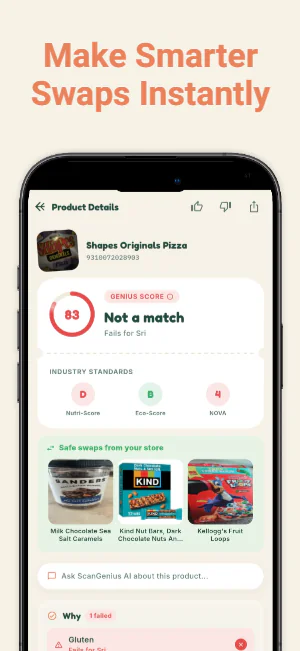
| Family screening | Multi-household profiles, one scan, named results such as “Fails for Sri (Gluten)” | Re-check mentally for each person | Check current plan details | Check current plan details |
| Context & languages | ScanGenius AI Insight, NOVA 1-4, Nutri-Score, and 11 languages with real-time translation | No context; foreign labels need separate translation | Focused on pass/fail results | Focused on pass/fail results |
The technological advantage comes down to depth and context. Food Scan Genius is powered by the NutriGraph Database, which maps more than 5,000,000 verified UPC/EAN barcodes and uses recursive abstract-syntax-tree parsing to unpack nested ingredients. When a seasoning blend contains a buttermilk powder buried two levels down, the scan finds it instead of stopping at the first line. For families managing several needs at once, Multi-Household Family Profiles screen everyone in a single scan and name exactly who is affected, so you see “Fails for Sri (Gluten)” rather than a vague warning. With 39 dietary profiles, custom sensitivities, and 11 languages translated in real time, it also works when you are shopping abroad or sharing the app with a grandparent.
Just as importantly, it does not reduce a snack to a moralizing grade. ScanGenius AI Insight explains why a product matched or failed your profile, notes where a “may contain” statement changes the picture, and pairs that with a NOVA 1-4 processing classification and Nutri-Score, so you can decide for yourself how a snack fits your child’s needs. A dairy free snack can be perfectly safe and still be highly processed, and you should see both facts side by side. Food Scan Genius is a decision-support tool, not a medical authority, so always follow your allergist’s guidance and read the physical label when your child’s health depends on it.
4. Related Food Safety & Dietary Guides
- Best Food Allergy Scanner App – Scan Food Labels Instantly — Food Allergy & Sensitivity Scanner Hub
- The 7 Best Free Food Scanner Apps of 2026 — best free food scanner apps
- Choosing the Best Barcode Scan App for Your Health — guide to choosing a barcode scanner app
- Food Scan Genius: World’s #1 Food Ingredient Scanner App — Food Scan Genius scanner app
5. Scientific & Health Authority References
- FDA Food Allergen Labeling & Consumer Protection Act (FALCPA)
- European Food Safety Authority (EFSA) Additive Safety Regulations
- PubMed Research on Ultra-Processed Foods & Gut Microbiome Disruption
- World Health Organization Guidelines on Healthy Diets & Saturated Fats
6. How to Scan in 3 Simple Steps
- Download Food Scan Genius free on iOS or Android. There are no paywalls on core features, so you can scan every snack in your cart without worrying about a scan limit.
- Set up your family profiles: select the Dairy-Free (or Milk Allergy) profile for each person, add any other needs from the 39 supported dietary profiles, and use Add Your Own Custom Sensitivity for items such as seed oils, specific dyes, or additives you want to avoid.
- Scan the barcode on any snack. In about 2 seconds you get an instant audit trail showing which ingredient triggered a flag, who in the household it affects, and ScanGenius AI Insight with NOVA and Nutri-Score context.
Instant Dairy-Free Audit Trail
7. Frequently Asked Questions (FAQ)
Does a “dairy free” label guarantee a snack is safe for a child with a milk allergy?
No. “Dairy free” is not a uniformly defined claim, and “non-dairy” products can still contain milk proteins like caseinate. While FALCPA requires milk to be declared as an ingredient in FDA-regulated packaged foods, cross-contact warnings are voluntary. Food Scan Genius scans the barcode against 5,000,000+ products in the NutriGraph Database, parses nested sub-ingredients, and flags milk-derived components so you can verify the actual ingredient list. For severe allergies, always confirm with your allergist and the physical package.
What are the best dairy free snacks for school lunches?
Good options include fruit, sunflower seed butter with apple slices, roasted chickpeas, plain popcorn, hummus with vegetables, seaweed snacks, and 100% fruit leather. Always check your school’s nut and allergen policies. Scan any packaged item with Food Scan Genius before it goes in the lunchbox, since recipes can differ between flavors and sizes, and use Family Profiles to screen for siblings’ needs at the same time.
How can I find dairy free snacks when traveling abroad?
Labels in other countries use different ingredient names and allergen formats. Food Scan Genius supports 11 global languages with real-time in-app translation, so you can scan a local barcode and see the result in your own language. Remember that regulations differ by country, so use the scan as a first screen and ask staff or manufacturers for clarification when your child has a serious allergy.
Is Food Scan Genius really free for checking dairy free snacks, and how is it different from other apps?
Yes. Core features are 100% free with zero paywalls, unlike Fig at $59 per year or Spoonful’s limited scans. You get access to 39 dietary profiles, custom sensitivities, multi-household family screening with named fail attribution, ScanGenius AI Insight, NOVA 1-4 classification, and Nutri-Score. It offers context rather than a simplistic good-or-bad score, which helps you choose dairy free snacks that fit both safety and your family’s broader preferences.
Know What’s In Your Food Before You Buy — Scan Free Today
Never second-guess confusing grocery labels again. Download Food Scan Genius to uncover hidden additives, toxic dyes, and allergens for the whole household before you buy.