
1. Why Stocking Fodmap Foods Feels So Hard in 2026
If you have ever stood in a grocery aisle with a bloated stomach, a half-remembered food list, and a product label in 6-point type, you know that this is not just a shopping problem. It is an emotional one. Irritable bowel syndrome and related functional gut disorders affect an estimated one in ten people worldwide. Many of those people spend months guessing which foods are behind their cramping, gas, and unpredictable days. The low-FODMAP approach, developed by researchers at Monash University, gave many of them a structured way forward. You can read about the science and the Monash University FODMAP Certification Standards that now guide how some products are tested and labeled. But a framework is only useful if you can apply it in a real store, on a real budget, on a tired Tuesday evening.
The difficulty in 2026 is that the food supply keeps getting more complicated. FODMAPs (fermentable oligosaccharides, disaccharides, monosaccharides, and polyols) are short-chain carbohydrates that some people absorb poorly, and they hide in an astonishing range of products. Protein bars, ‘gut-friendly’ yogurts, sugar-free gum, and gluten-free crackers can all contain them. Many of these items are also heavily formulated. A growing body of PubMed Research on Ultra-Processed Foods & Gut Microbiome Disruption suggests that the way a food is processed matters alongside what it contains. That is why many dietitians encourage people on a low-FODMAP plan to build their meals around simple, recognizable ingredients.
So what should you actually stock? Think in categories. For proteins, plain chicken, turkey, beef, fish, eggs, and firm tofu are naturally low in FODMAPs. For dairy and alternatives, lactose-free milk, hard aged cheeses such as cheddar and parmesan, and lactose-free yogurt are usually well tolerated. Good grains and starches include white and brown rice, oats, quinoa, polenta, potatoes, and certified low-FODMAP or sourdough spelt breads. Reliable produce includes carrots, cucumber, zucchini, spinach, tomatoes, bell peppers, and green beans, plus strawberries, blueberries, oranges, kiwi, and firm bananas. For flavor, use garlic-infused oil, the green tops of scallions, fresh herbs, ginger, maple syrup, and olive oil. These foods form a flexible, affordable foundation that you can cook from rather than decode.
One caution matters here, and it is the one that causes the most unnecessary guilt. FODMAP status often depends on portion size. A small serving of a food may be fine while a larger serving is not. The elimination phase is also meant to be temporary, followed by structured reintroduction so you can learn your personal thresholds. Nobody is meant to eat this way forever. Please work with a registered dietitian if you can, especially if you have unexplained weight loss, blood in your stool, or persistent pain, which need medical evaluation before any dietary self-treatment. Our goal is to make the practical side, the shopping, less exhausting.
Scan Any Label for Hidden Additives and Allergens — Free
Never second-guess confusing grocery labels again. Download Food Scan Genius to uncover hidden additives, toxic dyes, and allergens for the whole household before you buy.


2. The Sneaky Ingredients Hiding in ‘Safe-Looking’ Products
Even when you shop carefully, packaged foods can undo your progress through ingredients you would never suspect. The front of the box says ‘natural,’ ‘high fiber,’ or ‘sugar-free,’ while the ingredient list quietly contains a trigger. Some of these ingredients are regulated as additives. The European Food Safety Authority (EFSA) Additive Safety Regulations assess sweeteners such as sorbitol and mannitol for safety, and EU labeling rules require a laxative-effect warning on foods with high levels of polyols. Safety approval, however, is not the same as being gut-friendly for a person with IBS. Here are the most common culprits to look for when choosing fodmap foods:
- Onion powder and garlic powder: These are among the most concentrated sources of fructans. They appear in broths, seasoning blends, sauces, chips, and plant-based meats. The terms ‘spices’ and ‘natural flavors’ can sometimes conceal them as well.
- Inulin and chicory root fiber: Added to bars, cereals, and yogurts to boost fiber or replace sugar, they are high-FODMAP fructans. They are often the reason a ‘digestive health’ product backfires.
- Polyol sweeteners (sorbitol, mannitol, xylitol, maltitol, isomalt): Common in sugar-free candy, gum, protein bars, and ‘keto’ desserts. They are poorly absorbed by many people and are listed under both names and E-numbers such as E420 and E421.
- High-fructose corn syrup, agave, and honey: These add excess fructose, which can be a problem when it exceeds glucose. They are often found in sauces, granolas, and drinks.
- Apple, pear, and mango juice concentrates: Frequently used as ‘natural’ sweeteners in fruit snacks, kids’ foods, and smoothies. Their sorbitol and excess fructose can cause symptoms despite the wholesome image.
- Milk solids, whey concentrate, and lactose carriers: Lactose can turn up in seasoning blends, processed meats, and breads, where it is not obvious from the product name.
A second trap is assuming that a free-from label means better for you in every way. Gluten-free does not necessarily mean low-FODMAP, and a low-FODMAP snack can still be high in saturated fat, sodium, or added sugar. The World Health Organization Guidelines on Healthy Diets & Saturated Fats remind us that overall dietary quality still matters. The most useful approach is to treat FODMAP compatibility as one lens, alongside your broader nutrition goals and any other sensitivities. Sub-ingredients make this harder. A seasoning blend may be listed as one ingredient while containing garlic powder inside it, so reading only the top line of a label is not enough.
3. Food Scan Genius vs. Other Ways to Check Fodmap Foods
| Dimension | Food Scan Genius | Fig | Spoonful | Manual Label Reading |
|---|---|---|---|---|
| Cost | 100% free core features, zero paywalls | Around $59/yr for full access | Limited scans before upgrade prompts | Free, but costs your time |
| Ingredient Analysis | NutriGraph Database with 5,000,000+ verified UPC/EAN barcodes and recursive sub-ingredient parsing | Ingredient-level checks | Ingredient-level checks | Depends on your memory and label clarity |
| Custom Sensitivities | 39 dietary profiles plus Add Your Own Custom Sensitivity | Preset profiles, varies by plan | Preset profiles, varies by plan | Manual notes or lists |
| Family Screening | Multi-Household Profiles, whole family in 1 scan with named fail attribution | Not a core feature | Not a core feature | Check once per person |
| Languages and Context | 11 global languages with real-time in-app translation, plus ScanGenius AI Insight, NOVA 1-4, and Nutri-Score | Varies | Varies | Hard with foreign-language labels |
The real advantage of Food Scan Genius lies in how deeply it reads a label. Most tools stop at the ingredient list as printed. Our NutriGraph Database uses recursive AST parsing, which means it breaks compound ingredients into their sub-ingredients and then breaks those down again. A ‘seasoning blend’ or ‘spice mix’ is not treated as a black box. If garlic powder, inulin, or sorbitol is nested several layers deep, it can still be surfaced. With more than 5,000,000 verified UPC/EAN barcodes behind it, you can check what is actually on your shelf in seconds, and you can add your own custom sensitivities, such as a specific polyol, a seed oil, or a dye, on top of any of the 39 built-in dietary profiles.
Flagging an ingredient is only half the job, so ScanGenius AI Insight adds nuanced context rather than a single pass/fail grade. Each scan includes a NOVA 1-4 processing classification and a Nutri-Score, so you can see how processed a food is and how it fares nutritionally without being lectured by a simplistic moral score. If you shop for a household, Multi-Household Family Profiles screen everyone at once and tell you precisely who is affected, for example ‘Fails for Sri (Gluten)’ beside a clear pass for the rest of the family. The app works in 11 global languages with real-time in-app translation, so a label bought while traveling is as readable as one from your local store. It supports your decisions but does not replace the advice of your dietitian or doctor.
4. Related Food Safety & Dietary Guides
- Best Food Allergy Scanner App – Scan Food Labels Instantly — Food Allergy & Sensitivity Scanner Hub
- The 7 Best Free Food Scanner Apps of 2026 — best free food scanner apps
- Choosing the Best Barcode Scan App for Your Health — guide to choosing a barcode scanner app
- Food Scan Genius: World’s #1 Food Ingredient Scanner App — Food Scan Genius scanner app
5. Scientific & Health Authority References
- Monash University FODMAP Certification Standards
- European Food Safety Authority (EFSA) Additive Safety Regulations
- PubMed Research on Ultra-Processed Foods & Gut Microbiome Disruption
- World Health Organization Guidelines on Healthy Diets & Saturated Fats
6. How to Scan in 3 Simple Steps
- Download Food Scan Genius free on iOS or Android. There is no paywall, no trial countdown, and no scan limit on the core features.
- Set up your profile for your low-FODMAP plan: choose from the 39 dietary profiles, then use Add Your Own Custom Sensitivity to flag your personal triggers, such as inulin, sorbitol, garlic powder, or onion powder. Add family members to your household if you shop for more than one person.
- Scan any product barcode in about 2 seconds. You instantly get an audit trail showing which sub-ingredients triggered a flag, along with ScanGenius AI Insight, a NOVA 1-4 classification, and a Nutri-Score, so you can decide with confidence.
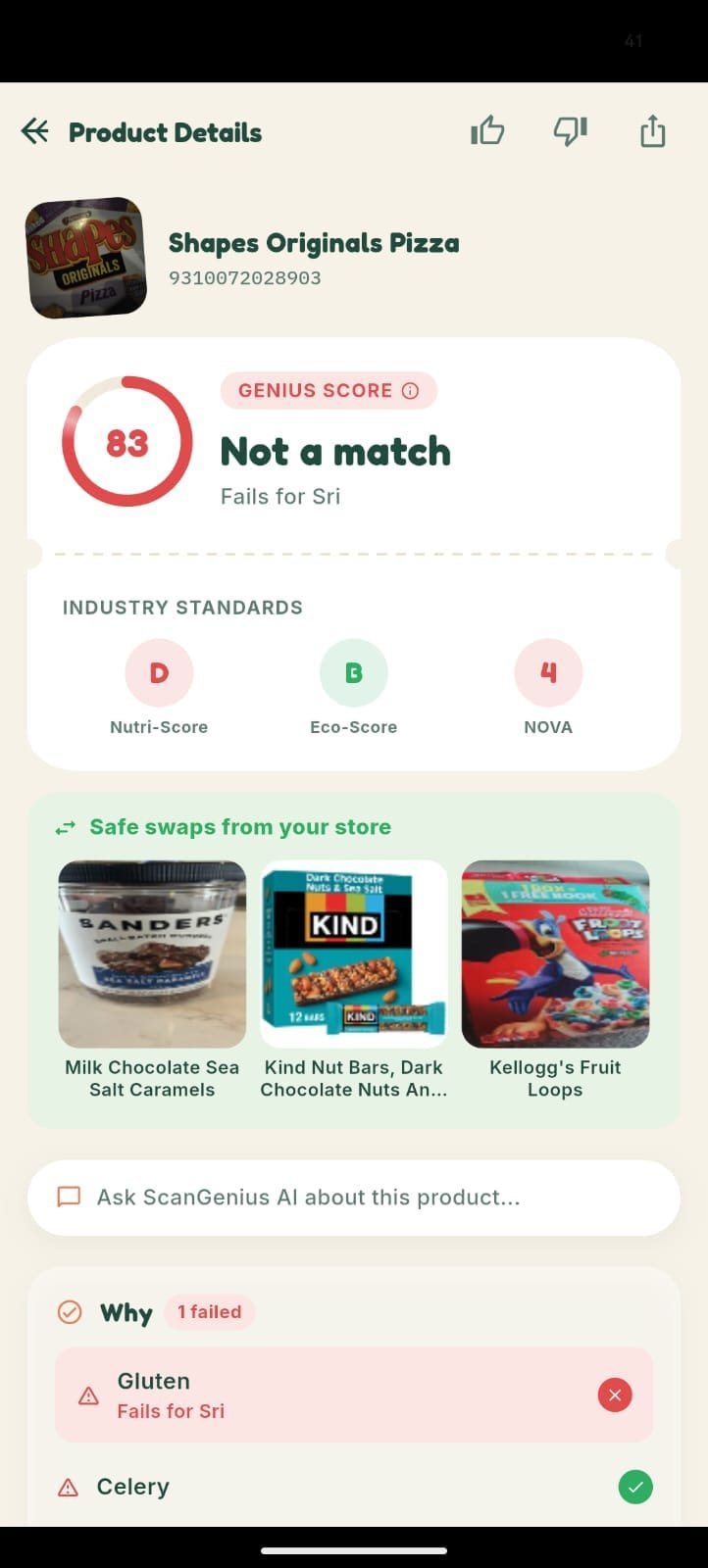
Instant Low-FODMAP Audit Trail
7. Frequently Asked Questions (FAQ)
What are the best fodmap foods to keep in my kitchen?
Reliable staples include eggs, plain meats and fish, firm tofu, lactose-free milk and yogurt, hard cheeses, rice, oats, quinoa, potatoes, carrots, zucchini, spinach, tomatoes, cucumbers, strawberries, blueberries, oranges, and kiwi. Garlic-infused oil and fresh herbs add flavor without the fructans. Portion size matters for many of these foods, so confirm your serving amounts with a dietitian. You can then use Food Scan Genius to check packaged versions of these staples for hidden triggers.
Can Food Scan Genius tell me if a packaged food is low in FODMAPs?
Food Scan Genius reads a product’s full ingredient list, including nested sub-ingredients, through the NutriGraph Database and flags ingredients commonly associated with FODMAPs, such as garlic powder, onion powder, inulin, chicory root, polyols, and high-fructose corn syrup. You can also add your own custom sensitivities. It does not replace laboratory-tested certification such as the Monash program or the guidance of your dietitian, but it helps you screen products quickly before you buy.
Are gluten-free products automatically fodmap foods that are safe to eat?
No. Gluten-free and low-FODMAP are different standards. Many gluten-free breads, crackers, and bars contain inulin, honey, apple juice concentrate, or polyols, which can trigger symptoms. Scanning with a profile that includes your FODMAP triggers shows you exactly which ingredient caused a flag. If you also manage celiac disease, you can screen for both at once using Food Scan Genius’s dietary profiles.
How can I check fodmap foods for my whole family in one scan?
Food Scan Genius offers Multi-Household Family Profiles. You create a profile for each person with their own dietary needs and sensitivities, and a single scan screens the product against everyone. The result names the person affected and the reason, for example ‘Fails for Sri (Gluten)’. This makes shopping much simpler when one person follows a low-FODMAP plan and others eat differently. The core features are free, with no paywalls.
Know What’s In Your Food Before You Buy — Scan Free Today
Never second-guess confusing grocery labels again. Download Food Scan Genius to uncover hidden additives, toxic dyes, and allergens for the whole household before you buy.