
1. Why Finding a Safe Gluten Free Tortilla Is Harder Than It Looks in 2026
If you have ever stood in the tortilla aisle with a package in each hand, squinting at a label while your dinner plans quietly fall apart, you are not alone. A gluten free tortilla should be simple. Yet many shoppers with celiac disease, non-celiac gluten sensitivity, or a wheat allergy tell the same story: the wrap cracks the moment you fold it, tastes like cardboard, or turns out to carry a cross-contact risk nobody warned them about. Tortillas are a daily staple for tacos, breakfast burritos, quesadillas and school lunches, so getting this one product right matters more than most people realize.
The clinical stakes are real. For people with celiac disease, even small amounts of gluten can trigger an autoimmune response that damages the lining of the small intestine, whether or not symptoms appear that day. The Celiac Disease Foundation Threshold Requirements and related guidance explain why a ‘gluten-free’ claim is tied to a measurable limit (under 20 parts per million in the United States) rather than a marketing impression. That limit is meaningful, but it also means the claim is only as trustworthy as the manufacturer’s ingredient sourcing and testing.
Then there is the taste problem. Gluten gives wheat tortillas their stretch and chew. Without it, brands lean on blends of corn, rice, tapioca, cassava, potato starch, almond flour and a long list of gums and binders to imitate that texture. Some of these blends are excellent. Others pile on refined starches, gums, preservatives and oils to hold the shape of a wrap that might otherwise crumble. You deserve a tortilla that is safe and enjoyable, and you should not need a chemistry degree to find one.
That is why we built this guide: to help you understand what separates a trustworthy gluten free tortilla from a risky one, and how to verify any product in seconds instead of relying on a front-of-pack claim. Formulations change often, so rather than a static list that may be outdated by next month, we show you how to evaluate the types of tortillas worth buying right now.
Scan Any Label for Hidden Additives and Allergens — Free
Never second-guess confusing grocery labels again. Download Food Scan Genius to uncover hidden additives, toxic dyes, and allergens for the whole household before you buy.


2. Sneaky Ingredients and Labeling Loopholes in Gluten Free Tortillas
Most corn-based tortillas begin with a short, safe-looking ingredient list: corn, water, lime. The trouble starts with the shared facilities that make them, the additives that extend their shelf life, and the way labels summarize rather than disclose. Here are the most common issues we flag when auditing a gluten free tortilla:
- Shared-line cross-contact: Many corn tortillas are produced on the same equipment as wheat flour tortillas. Unless the package carries a third-party gluten-free certification or a clear ‘made in a dedicated facility’ statement, a plain corn tortilla may not meet the threshold celiac patients need.
- Wheat starch and ‘hidden’ wheat derivatives: In some regions, wheat starch that has been processed to remove gluten can legally appear in gluten-free products if the final food stays under the limit. Many people with celiac disease prefer to avoid it entirely, so it deserves a flag rather than a quiet pass.
- Oat ingredients: Oat flour or oat fiber in a wrap can be contaminated by wheat, barley or rye during harvest and milling unless the oats are specifically certified gluten-free.
- Vague ‘natural flavors’ and processing aids: A short label can hide sub-ingredients. Flavorings, enzymes, dough conditioners and malt-derived components can come from gluten-containing grains, and the parent ingredient name does not always show it.
- Gums, emulsifiers and preservatives: Xanthan gum, guar gum, cellulose gum, calcium propionate and sorbic acid are common in gluten-free wraps. They are widely permitted, and the European Food Safety Authority (EFSA) Additive Safety Regulations show how rigorously additives are reviewed. Still, some people react to specific gums or simply prefer to avoid them, which is why personal sensitivity matters.
- Refined starches and heavy oils: To replace gluten’s structure, some brands rely on starch-heavy blends with palm oil, shortening or seed oils. That affects both nutrition and ultra-processing level. See the World Health Organization Guidelines on Healthy Diets & Saturated Fats for context on fat quality.
Ultra-processing deserves a calm, evidence-based look rather than panic. Many gluten-free tortillas land in NOVA group 4 because of their additive profiles, and researchers continue to study how such foods affect health. The PubMed Research on Ultra-Processed Foods & Gut Microbiome Disruption is a useful starting point for understanding why processing level is part of the conversation, especially for people whose digestive systems are already under strain. A simple corn and lime tortilla and a 25-ingredient cassava wrap are both ‘gluten-free,’ yet they are very different foods.
3. Food Scan Genius vs. Other Ways to Vet a Gluten Free Tortilla
| Dimension | Food Scan Genius | Fig | Spoonful | Manual Label Reading |
|---|---|---|---|---|
| Cost | 100% free core features, zero paywalls | $59/year | Limited scans | Free, but time-consuming |
| Ingredient depth | Recursive AST parsing of sub-ingredients across 5,000,000+ verified barcodes | Ingredient-level screening | Ingredient-level screening | Limited to what you recognize |
| Personalization | 39 dietary profiles plus custom sensitivities (gums, seed oils, dyes, additives) | Profile-based | Profile-based | Entirely from memory |
| Family screening | Multi-household profiles in one scan, with named results such as ‘Fails for Sri (Gluten)’ | Varies by plan | Varies by plan | One person at a time |
| Context and language | ScanGenius AI Insight, NOVA 1-4, Nutri-Score, 11 languages with real-time translation | Limited context | Limited context | None; foreign labels are a barrier |
Most label-reading tools stop at the surface of an ingredient list. Food Scan Genius is powered by the NutriGraph Database, an enterprise dataset of more than 5,000,000 verified UPC/EAN barcodes. Its recursive AST parsing breaks compound ingredients into their sub-ingredients, so a vague line such as ‘seasoning’ or ‘dough conditioner’ is unpacked rather than taken at face value. For a gluten free tortilla, that means a possible wheat-derived component buried two levels deep can be surfaced before it ends up in your cart. Because the core experience is completely free, no one has to choose between safety and a subscription.
Data alone is not enough, so ScanGenius AI Insight adds the nuance. It explains why a product was flagged, pairs the result with a NOVA 1-4 classification and a Nutri-Score, and avoids the simplistic, moralizing ‘good or bad’ numbers that leave people feeling judged. A tortilla might be perfectly safe for a celiac family member yet still be highly processed, and you get both facts side by side. You can also add a custom sensitivity for xanthan gum, seed oils or a specific dye, and screen your whole household at once. If the label is in another language, real-time translation across 11 languages keeps the audit clear.
4. Related Food Safety & Dietary Guides
- Best Food Allergy Scanner App – Scan Food Labels Instantly — Food Allergy & Sensitivity Scanner Hub
- The 7 Best Free Food Scanner Apps of 2026 — best free food scanner apps
- Choosing the Best Barcode Scan App for Your Health — guide to choosing a barcode scanner app
- Food Scan Genius: World’s #1 Food Ingredient Scanner App — Food Scan Genius scanner app
5. Scientific & Health Authority References
- Celiac Disease Foundation Threshold Requirements
- European Food Safety Authority (EFSA) Additive Safety Regulations
- PubMed Research on Ultra-Processed Foods & Gut Microbiome Disruption
- World Health Organization Guidelines on Healthy Diets & Saturated Fats
6. How to Scan in 3 Simple Steps
- Download Food Scan Genius free on iOS or Android. There are no paywalls on core features, so you can start scanning tortillas right away.
- Set up your profile for gluten-free eating: choose the Gluten-Free or Celiac profile from 39 dietary options, add family members to your household, and create custom sensitivities for gums, seed oils or additives you want to avoid.
- Scan the tortilla barcode in about 2 seconds. You will get an instant audit trail showing pass or fail per person (for example, ‘Fails for Sri (Gluten)’), sub-ingredient findings, NOVA group, Nutri-Score and a ScanGenius AI Insight explanation.
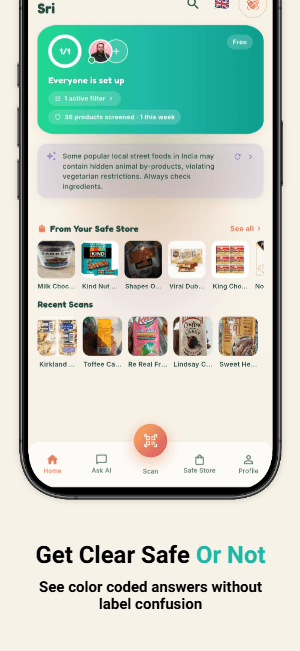
Instant Gluten-Free Audit Trail
7. Frequently Asked Questions (FAQ)
Are all corn tortillas automatically a safe gluten free tortilla?
No. Corn is naturally gluten-free, but many corn tortillas are made on shared equipment with wheat flour tortillas, or contain additives with unclear sources. Look for a third-party gluten-free certification or a dedicated-facility statement, then scan the barcode with Food Scan Genius. Its NutriGraph Database and sub-ingredient parsing flag wheat-derived components and cross-contact risks that a short ingredient list may not reveal.
What should I look for in a gluten free tortilla that actually tastes good and holds together?
Texture usually comes from the base flour and binders. Corn masa tortillas are traditionally sturdy and flavorful with minimal ingredients, while cassava, almond flour and rice-tapioca blends tend to be softer and more pliable for wraps. Warming them briefly helps prevent cracking. For the best balance, compare ingredient length and processing level: Food Scan Genius shows the NOVA 1-4 classification and Nutri-Score alongside gluten safety, so you can choose a wrap that is both enjoyable and reasonably simple.
Can I screen a gluten free tortilla for my whole family in one scan?
Yes. Food Scan Genius supports multi-household family profiles, so you can assign each person their own dietary needs, such as gluten for one family member, a nut allergy for another, and a seed oil sensitivity for a third. A single scan screens everyone and names the result clearly, for example ‘Fails for Sri (Gluten)’, so you know exactly who a tortilla works for before you buy it.
Is Food Scan Genius really free for checking gluten free tortilla labels?
Yes. Core features are 100% free with zero paywalls, unlike Fig’s $59 per year plan or Spoonful’s limited scans. You get access to 39 dietary profiles, custom sensitivities, ScanGenius AI Insight, NOVA and Nutri-Score data, and support for 11 languages with real-time translation. Always confirm critical medical decisions, including celiac management, with your healthcare provider and the manufacturer when in doubt.
Know What’s In Your Food Before You Buy — Scan Free Today
Never second-guess confusing grocery labels again. Download Food Scan Genius to uncover hidden additives, toxic dyes, and allergens for the whole household before you buy.