
1. Why the Greek Yogurt Lactose Question Is So Confusing in 2026
If you have ever stood in the dairy aisle wondering whether greek yogurt is lactose free, you are in good company. Wellness blogs say yes, a friend swears it never bothers her, and your own stomach may have told you something different last Tuesday. The frustration is real, and it is not a failure of willpower or research. Lactose intolerance is common, dose-dependent, and very individual, and yogurt sits in an unusual middle zone that invites oversimplified claims.
Here is the direct answer: regular Greek yogurt is not lactose-free. It is usually lower in lactose than milk, and often lower than conventional yogurt, but it still contains some. Fermentation converts part of the milk’s lactose into lactic acid, and straining removes liquid whey, which carries much of the remaining lactose away. Depending on brand and process, a serving of plain Greek yogurt often lands in the range of roughly 4 to 8 grams of lactose, compared with about 12 grams in a cup of milk. That can be well tolerated by many people with lactose intolerance and still be too much for others.
It also helps to separate two conditions that get tangled together. Lactose intolerance is a digestive issue involving the enzyme lactase. A milk allergy is an immune reaction to milk proteins. Under the FDA Food Allergen Labeling & Consumer Protection Act (FALCPA), milk must be declared as a major allergen. That is vital for allergic shoppers, but a "Contains: Milk" line says nothing about how much lactose is inside. Even truly lactose-free yogurts carry that statement, because they are still made from milk. If you have a milk allergy, Greek yogurt, lactose-free or not, is not a safe swap.
The other layer is everything else in the cup. Flavored and dessert-style yogurts often include added sweeteners, thickeners, and flavor systems, and discomfort after eating them is easily blamed on lactose when something else may be involved. Broader research, such as this PubMed Research on Ultra-Processed Foods & Gut Microbiome Disruption, is a reminder that how heavily a food is processed deserves attention alongside any single nutrient. Sorting out which ingredient is the real trigger takes careful label reading, and that is exactly where most of us run out of time and patience in the store.
Scan Any Label for Hidden Additives and Allergens — Free
Never second-guess confusing grocery labels again. Download Food Scan Genius to uncover hidden additives, toxic dyes, and allergens for the whole household before you buy.


2. What Fermentation and Straining Really Do (and Where Labels Mislead)
Two processes explain why Greek yogurt is a gentler choice for many people. First, live bacterial cultures ferment lactose, turning part of it into lactic acid. Those cultures also produce some lactase-like activity, which may help digestion in the gut. Second, traditional straining separates thick curd from watery whey. Since lactose is water-soluble, much of it leaves with the whey. The result is a higher-protein, lower-lactose product, but never a zero-lactose one unless lactase is added afterward.
The trouble starts when marketing and manufacturing shortcuts blur this picture. Here are the most common loopholes and surprises to watch for when you are asking whether greek yogurt is lactose free:
- "Strained" or "high-protein" does not mean lactose-free. These words describe texture and macros. Only a lactose-free claim, usually achieved by adding lactase enzyme, signals that lactose has been broken down.
- Added milk solids and protein concentrates. Ingredients such as nonfat dry milk, milk protein concentrate, or whey protein concentrate can raise protein while reintroducing lactose that straining removed.
- "Greek-style" products. Some are thickened with starches, pectin, gelatin, or gums rather than strained. They may look similar to the real thing but retain more lactose, much like conventional yogurt.
- Sweeteners and sugar alcohols in flavored cups. Sorbitol, erythritol, and similar additives can cause bloating and loose stools that mimic lactose symptoms. Ingredient safety frameworks such as the European Food Safety Authority (EFSA) Additive Safety Regulations show how many additives are evaluated individually, which is why checking each one matters.
- No single, universally enforced "lactose-free" threshold in the US. Lactose-free products are generally lactase-treated, but definitions and testing practices vary by country and brand. Look for the claim plus "lactase enzyme" in the ingredients.
- Allergen statements are about protein, not sugar. A milk declaration tells allergic shoppers to avoid the product, but it cannot tell lactose-intolerant shoppers how much lactose is present.
It is also worth keeping overall nutrition in perspective. The World Health Organization Guidelines on Healthy Diets & Saturated Fats encourage attention to saturated fat and free sugars, both of which vary widely between plain nonfat Greek yogurt and a full-fat, sweetened dessert cup. The best choice for your gut may not be the best choice for your overall dietary pattern, and a good tool should show you both.
3. Food Scan Genius vs. the Usual Ways of Checking Yogurt
| Dimension | Food Scan Genius | Manual Label Reading | Front-of-Pack Claims | Generic Calorie-Tracking Apps |
|---|---|---|---|---|
| Ingredient depth | Recursive sub-ingredient parsing across 5,000,000+ verified barcodes in the NutriGraph Database | Depends on your memory and time in the aisle | None; a marketing summary only | Usually macros only, with ingredient lists often missing |
| Personalization | 39 dietary profiles plus custom sensitivities (sugar alcohols, specific additives, seed oils) | Fully manual | One-size-fits-all | Limited to calorie and macro goals |
| Household screening | Whole family in one scan, with named results such as "Fails for Sri (Lactose)" | Repeat the process for each person | Not available | Typically single-user |
| Context and classification | ScanGenius AI Insight, NOVA 1-4, and Nutri-Score without moralizing scores | No built-in framework | Selective and promotional | Rarely offers classification |
| Cost and language | 100% free core features, no paywalls, 11 languages with real-time translation | Free, but slow | Free, but unreliable | Frequently subscription-gated |
The core challenge with yogurt is that the answer lives in the details: whether lactase is listed, whether milk protein concentrate was added to a "strained" product, whether the thickener is a starch or real straining, and whether a sweetener might be the true culprit. Food Scan Genius is powered by the NutriGraph Database, which parses ingredients recursively, so compound ingredients and sub-ingredients are broken down instead of glossed over. Scan a tub and the app can flag milk-derived ingredients, lactase treatment, and the additives you have told it to watch. A custom sensitivity, such as sorbitol or a particular sweetener, lets you track the real trigger instead of guessing.
ScanGenius AI Insight then adds the nuance that a pass/fail badge cannot. It explains why a product was flagged, places it on the NOVA 1-4 scale, and shows its Nutri-Score so you can weigh processing and nutrition together, without a guilt-inducing number. One honest caveat: most labels do not list exact lactose grams, so the app cannot invent a figure. Instead, it surfaces the signals that are on the label and clearly separates lactose concerns from milk-allergy concerns. With Multi-Household Family Profiles, one scan can show that a yogurt works for one person but not another, and everything is free to use.
4. Related Food Safety & Dietary Guides
- Best Food Allergy Scanner App – Scan Food Labels Instantly — Food Allergy & Sensitivity Scanner Hub
- The 7 Best Free Food Scanner Apps of 2026 — best free food scanner apps
- Choosing the Best Barcode Scan App for Your Health — guide to choosing a barcode scanner app
- Food Scan Genius: World’s #1 Food Ingredient Scanner App — Food Scan Genius scanner app
5. Scientific & Health Authority References
- FDA Food Allergen Labeling & Consumer Protection Act (FALCPA)
- European Food Safety Authority (EFSA) Additive Safety Regulations
- PubMed Research on Ultra-Processed Foods & Gut Microbiome Disruption
- World Health Organization Guidelines on Healthy Diets & Saturated Fats
6. How to Scan in 3 Simple Steps
- Download Food Scan Genius free on iOS or Android. There are no paywalls on core scanning, and you can choose any of 11 languages with real-time in-app translation.
- Set up your profile for lactose sensitivity. Choose the dairy-related dietary profile that fits you, add a milk-allergy profile if relevant, and create custom sensitivities for triggers like sugar alcohols or specific sweeteners. Add family members so each person is screened by name.
- Scan the yogurt barcode and get results in about 2 seconds. Review the instant audit trail showing milk-derived ingredients, lactase enzyme, added milk solids, thickeners, NOVA class, Nutri-Score, and any named failures such as ‘Fails for Sri (Lactose)’.
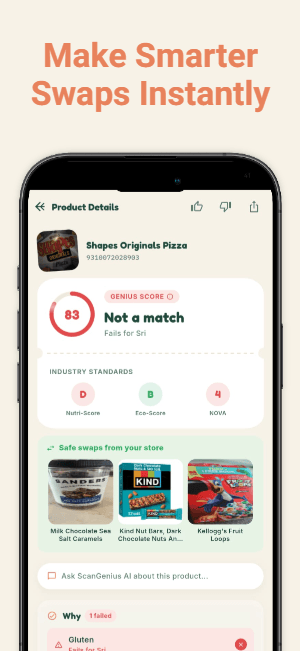
Instant Lactose-Free Audit Trail
7. Frequently Asked Questions (FAQ)
Is Greek yogurt lactose-free?
Not by default. Greek yogurt is typically lower in lactose than milk because fermentation converts some lactose to lactic acid and straining removes lactose-bearing whey, but it still contains some. Only products labeled lactose-free, usually made with added lactase enzyme, are designed to avoid it. Food Scan Genius can scan the barcode and flag lactase treatment, added milk solids, and other milk-derived ingredients so you can see what you are really getting.
Why do some people with lactose intolerance tolerate Greek yogurt?
Three factors help: reduced lactose from fermentation, further reduction from straining, and live cultures that may assist lactose digestion in the gut. Tolerance depends on your own lactase levels, portion size, and what else you eat with it. Many people manage a small serving of plain Greek yogurt, while others still react. Using a custom sensitivity in Food Scan Genius helps you track which products work for you.
Is lactose-free Greek yogurt safe for a milk allergy?
No. Lactose intolerance and milk allergy are different conditions. Lactose-free yogurt is still made from milk and still contains milk proteins, so it must be labeled as containing milk under allergen rules like FALCPA. If you or a family member has a milk allergy, Food Scan Genius lets you assign an allergy profile and shows a named fail, so a lactose-free claim is not mistaken for allergen safety.
How can I tell if a ‘Greek-style’ yogurt is actually strained?
Check the ingredient list. Products thickened with starches, pectin, gelatin, or added milk protein concentrate may be ‘Greek-style’ without the lactose reduction of true straining. Terms like ‘strained’ on the label are a better sign, and ‘lactose-free’ with lactase listed is the clearest indicator. Scanning with Food Scan Genius parses these ingredients, classifies the product with NOVA 1-4, and gives ScanGenius AI Insight context so you can decide with confidence.
Know What’s In Your Food Before You Buy — Scan Free Today
Never second-guess confusing grocery labels again. Download Food Scan Genius to uncover hidden additives, toxic dyes, and allergens for the whole household before you buy.