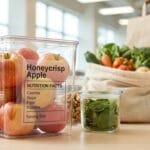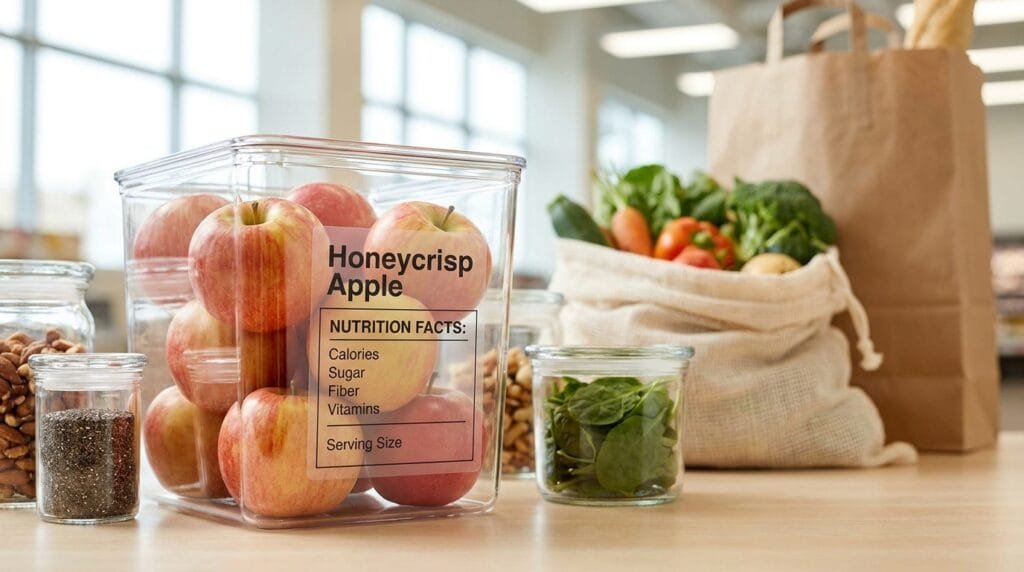
A medium Honeycrisp apple (about 200 grams) contains approximately 104 calories, 25 grams of carbohydrates, 19 grams of natural sugar, 4.4 grams of dietary fiber, and 8.4 milligrams of vitamin C, with zero grams of fat.
Honeycrisp Apple Nutrition Breakdown: Calories, Sugar, and Nutrients
The Honeycrisp apple is one of the most popular fruits in the grocery store produce aisle, and for good reason. Bred at the University of Minnesota in the 1960s and officially released to growers in 1991, this variety was developed specifically for crispness. Plant scientists discovered that Honeycrisp cells are roughly twice as large as the cells in older apple varieties like Red Delicious. When you take a bite, those larger cells rupture cleanly rather than crushing, releasing a burst of sweet juice. Even with that explosion of sweetness, a standard medium Honeycrisp apple (about 200 grams or 7 ounces) has only about 104 calories, making it a satisfying, naturally portioned snack for children and adults alike.
A common question from shoppers is whether the sweetness of a Honeycrisp means it is packed with unhealthy sugar. A medium fruit holds roughly 19 grams of natural fruit sugars, mainly fructose, with smaller amounts of glucose and sucrose. Unlike the refined sweeteners found in sodas or baked goods, these sugars are held inside an intact cellular structure alongside 4.4 grams of dietary fiber. This combination changes how your body digests the fruit. The soluble fiber, known as pectin, dissolves in water to form a gentle gel in your digestive tract. This slows the absorption of carbohydrates into your bloodstream and keeps you feeling satisfied for hours. This balance aligns directly with the World Health Organization Guidelines on Healthy Diets & Saturated Fats, which highlight the importance of eating whole, fiber-rich fruits rather than relying on products with free or added sugars.
Beyond sweetness and crunch, Honeycrisp apples offer steady everyday micronutrients. Each medium fruit provides roughly 8.4 milligrams of vitamin C, which is about 9% to 10% of what an adult needs in a day. You also get roughly 214 milligrams of potassium, a mineral that helps support healthy blood pressure and fluid balance. Apples are also about 86% water by weight, meaning each crisp bite helps hydrate your body. Eating the whole fruit also provides your digestive system with prebiotic plant fibers that nourish healthy gut bacteria, contrasting sharply with the effects seen in PubMed Research on Ultra-Processed Foods & Gut Microbiome Disruption, which shows how heavily manufactured snacks can throw your digestive balance off course.
Much of an apple’s nutritional value lives right on the surface. The bright red and speckled yellow peel contains concentrated plant pigments called anthocyanins, along with a protective antioxidant called quercetin. Quercetin has been studied for its ability to help calm seasonal inflammation and protect cardiovascular cells. When you peel an apple, you strip away almost half of the total dietary fiber and a significant portion of these protective antioxidants. Washing your apple under clean running water while rubbing the skin gently with your hands is all you need to do to enjoy the full nutritional package safely.
Why Shopping for Fresh Fruit and Packaged Snacks Shouldn’t Be This Hard
Standing in the produce aisle with a shopping cart and a family to feed can feel surprisingly confusing. Unlike cereal boxes or frozen dinners, loose produce does not come with a standard black-and-white Nutrition Facts label. Most grocery stores sell Honeycrisp apples loose by the pound, meaning a shopper has to guess whether the apple they just picked up counts as a small, medium, or large serving. In recent years, orchards have grown much larger fruit, and it is common to find jumbo Honeycrisp apples that weigh over 300 grams (nearly 11 ounces). If you eat a jumbo apple thinking it has the standard 95 calories listed in a basic calorie-tracking book, you are actually taking in closer to 155 calories and nearly 30 grams of sugar. The fruit is still completely wholesome, but the difference in real-world portion size is substantial.
The confusion multiplies when you move over to the grab-and-go snack sections or school lunchbox aisles. Pre-sliced apples, like those sold by Crunch Pak, or dried fruit bags, like Bare Baked Apple Chips, carry official Nutrition Facts panels, but their numbers look completely different from raw fruit. A 2-ounce (57g) pouch of Crunch Pak Sweet Apple Slices lists just 30 calories and 6 grams of sugar because it represents only a fraction of a whole apple. On the other hand, a standard 1-ounce (28g) bag of dried Honeycrisp apple chips packs 110 calories and 21 grams of sugar. When water is removed during baking or drying, the carbohydrates and natural sugars become tightly concentrated. If you compare labels in the United States against those in Europe, the format changes again: US panels base their facts on variable “household servings” (like one medium apple or a 2-ounce bag), while European labels are required by law to list all nutrient values per 100 grams, making direct comparisons much simpler for consumers.
Packaged apple products also include ingredients to keep the cut flesh from turning brown. If you pick up a bag of sliced apples at your local grocer, you will likely see ingredients such as calcium ascorbate or citric acid listed. These are safe forms of vitamin C and citrus salts that stop oxygen from darkening the fruit when it is exposed to air. In European markets, these preservation techniques must adhere to strict guidelines outlined by the European Food Safety Authority (EFSA) Additive Safety Regulations, which confirm that these simple mineral salts preserve freshness without altering safety or nutritional value. When parents see these multi-syllable ingredients on a package of fruit slices, they often worry whether artificial chemicals have been added to their children’s lunchboxes.
This is where Food Scan Genius fits naturally into your routine. When you are walking down Aisle 4 trying to finish your weekly grocery trip in twenty minutes, you do not need complicated charts or food guilt; you just need a fast, 2-second sanity check. Scanning a barcode on a bag of apple slices, applesauce, or dried fruit chips instantly translates the label into plain English. It is important to know that Food Scan Genius pulls its data directly and exclusively from the physical packaging printed by the manufacturer. The food company is entirely responsible for declaring every ingredient, preservative, and nutrition figure on that label. The app does not run lab chemical tests or guess what happens behind factory doors; instead, it reads the manufacturer’s own verified label text so you can make informed choices for your family without slowing down your shopping trip.
| Product / Serving Size | Calories | Total Carbs | Dietary Fiber | Total Sugars | Vitamin C | Potassium |
|---|---|---|---|---|---|---|
| Raw Honeycrisp (per 100g) | 52 kcal | 13.8 g | 2.4 g | 10.4 g | 4.6 mg (5% DV) | 107 mg |
| Small Raw Apple (150g / 5.3 oz) | 78 kcal | 20.7 g | 3.6 g | 15.6 g | 6.9 mg (8% DV) | 161 mg |
| Medium Raw Apple (200g / 7 oz) | 104 kcal | 27.6 g | 4.8 g | 20.8 g | 9.2 mg (10% DV) | 214 mg |
| Large Raw Apple (250g / 8.8 oz) | 130 kcal | 34.5 g | 6.0 g | 26.0 g | 11.5 mg (13% DV) | 268 mg |
| Crunch Pak Sliced Apples (57g pouch) | 30 kcal | 8.0 g | 1.0 g | 6.0 g | 30.0 mg (35% DV)* | 60 mg |
| Dried Apple Chips (28g / 1 oz bag) | 110 kcal | 25.0 g | 4.0 g | 21.0 g | 0.0 mg | 180 mg |
*Note: Higher Vitamin C levels in pre-cut packaged slices reflect added calcium ascorbate used to prevent browning. Values reflect average raw Honeycrisp testing and manufacturer packaging declarations.
Common Honeycrisp Nutrition Mistakes and Confusions
The biggest misunderstanding shoppers have about Honeycrisp apples is believing they are loaded with significantly more sugar than other apple varieties. Because a Honeycrisp tastes remarkably sweet and refreshing, many people assume it has double the sugar of a tart Granny Smith. In reality, laboratory testing shows that a Honeycrisp has roughly 10.4 grams of sugar per 100 grams of fruit, while a Granny Smith contains about 9.6 grams per 100 grams. That is a difference of less than one single gram of sugar per serving! Honeycrisps taste much sweeter because they contain lower levels of malic acid and have larger cell chambers that release juice quickly across your tongue, not because they are overflowing with extra carbohydrates.
Another common mistake is peeling the apple to avoid agricultural coatings or waxes. Shoppers often see a glossy sheen on grocery store apples and worry that synthetic wax is harmful. In standard commercial packing, apples are washed to remove orchard dust, which strips away the fruit’s natural wax. Packing houses replace this with tiny amounts of food-grade carnauba wax (made from palm leaves) or shellac (a natural resin) to keep the fruit from drying out and wrinkling on store shelves. These coatings are non-digestible, completely non-toxic, and approved globally for food use. When you peel the skin away to avoid this wax, you throw away roughly half of the total dietary fiber and nearly all the quercetin. For individuals who experience tingling in their mouth after eating fresh raw apples, the cause is usually not wax or chemicals; it is often Oral Allergy Syndrome, a cross-reaction between apple skin proteins and birch pollen, as documented by Food Allergy Research & Education (FARE) Clinical Standards.
Finally, many people fall into the trap of using generic “one apple” entries when tracking their food intake in health apps. A generation ago, the average supermarket apple weighed around 140 to 150 grams. Today, modern farming methods produce Honeycrisp apples that routinely weigh 240 to 320 grams. If you log a large 280-gram Honeycrisp as a generic “small apple,” you may be undercounting your carbohydrate intake by 15 grams and your calorie intake by more than 60 calories. When accurate tracking matters for health reasons, weighing your fruit on a simple kitchen scale gives you the real number every time.
Frequently asked questions
How many calories are in a large Honeycrisp apple?
A large Honeycrisp apple weighing around 250 grams (about 8.8 ounces) contains approximately 130 calories. If you purchase an extra-large or jumbo fruit weighing 300 grams or more, the calorie count will be closer to 155 calories.
Are Honeycrisp apples a good choice for people with diabetes?
Yes. While Honeycrisp apples taste very sweet, they have a low glycemic index ranging between 36 and 40. The 4 to 5 grams of dietary fiber in a medium apple slows down sugar digestion, preventing sudden blood sugar spikes when eaten as part of a balanced diet.
Does keeping Honeycrisp apples in the refrigerator destroy their vitamins?
No, chilling your apples actually preserves their nutrients. Cold temperatures slow down natural fruit respiration and enzymatic breakdown, which helps maintain crispness and keeps delicate vitamins, like vitamin C, stable for weeks longer than storing them at room temperature.
Is the wax coating on grocery store Honeycrisp apples safe to eat?
Yes, the wax is completely safe and food-grade. Commercial packers apply microscopic coatings of natural waxes like carnauba wax or shellac to replace the apple’s natural moisture barrier, and these food-grade coatings pass harmlessly through your digestive system without being absorbed.
Does cooking or baking a Honeycrisp apple lower its fiber content?
Cooking does not destroy dietary fiber, although it softens the tough plant walls. Baking or stewing a Honeycrisp retains all the total fiber, but some heat-sensitive vitamin C will be lost during prolonged high-heat cooking.
References
- Food Allergy Research & Education (FARE) Clinical Standards
- European Food Safety Authority (EFSA) Additive Safety Regulations
- PubMed Research on Ultra-Processed Foods & Gut Microbiome Disruption
- World Health Organization Guidelines on Healthy Diets & Saturated Fats
Related guides
- Best Food Allergy Scanner App – Scan Food Labels Instantly — Food Allergy & Sensitivity Scanner Hub
- The 7 Best Free Food Scanner Apps of 2026 — best free food scanner apps
- Choosing the Best Barcode Scan App for Your Health — guide to choosing a barcode scanner app
- Food Scan Genius: World’s #1 Food Ingredient Scanner App — Food Scan Genius scanner app
Check Any Label Against 5 Million Products — Free
Never second-guess confusing grocery labels again. Download Food Scan Genius to uncover hidden additives, toxic dyes, and allergens for the whole household before you buy.