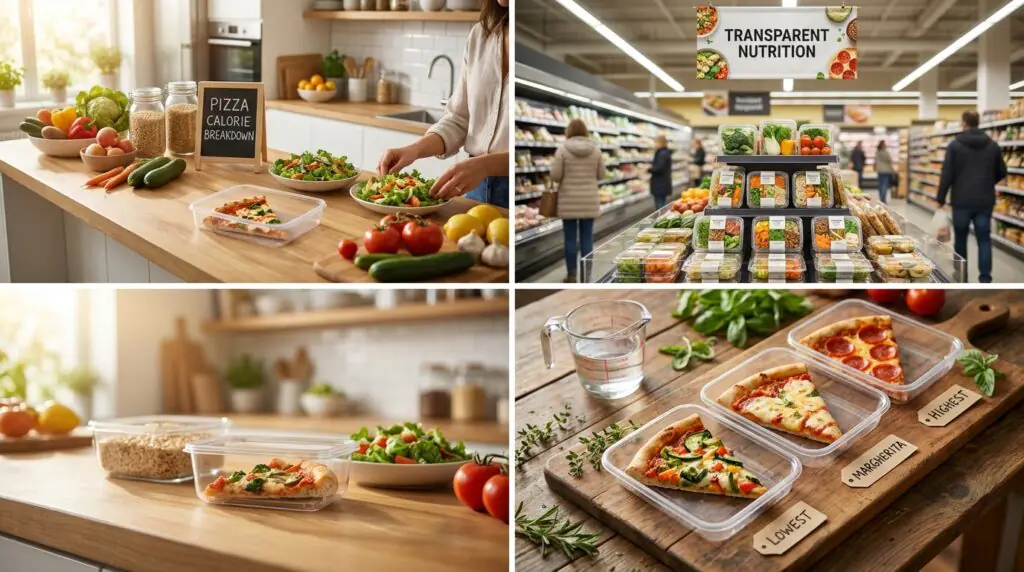
A standard slice of medium cheese pizza contains between 200 and 290 calories. Whole 12-inch commercial pizzas range from 1,600 to 2,400 calories, while thin-crust veggie slices average 150 to 200 calories and deep-dish meat varieties reach 350 to 500 calories per slice.
Caloric Architecture: How Crust, Cheese, and Cured Meats Determine Energy Density
The caloric value of a pizza is governed primarily by its base and fat content rather than sauce or raw vegetable toppings. Dough formulation accounts for 40% to 60% of a standard pizza’s total energy value. A classic yeast dough composed of refined wheat flour, water, yeast, salt, and olive oil yields roughly 250 to 280 calories per 100 grams of baked crust. When commercial producers integrate shortening, chemical dough conditioners, or sugar to accelerate fermentation and enhance browning, caloric density increases significantly. Stuffed-crust formulations and deep-dish recipes compound this by embedding string cheese or pan-frying the dough in shortening, escalating dough calories alone to over 350 calories per 100 grams.
Cheese forms the second major caloric driver. Low-moisture part-skim (LMPS) mozzarella—the standard commercial cheese choice across North America and fast-food chains—delivers roughly 80 to 85 calories, 6 grams of fat, and 6 grams of protein per 28-gram (1-ounce) serving. Full-fat whole-milk mozzarella delivers closer to 90 to 100 calories per ounce with higher saturated fat concentrations. Because an average 12-inch commercial pizza uses between 170 and 250 grams of cheese (6 to 9 ounces), cheese accounts for 500 to 850 total calories across the whole pie. According to the World Health Organization Guidelines on Healthy Diets & Saturated Fats, limiting saturated fats to less than 10% of daily caloric intake is essential for metabolic health, a threshold frequently exceeded by a two-slice portion of standard cheese pizza.
Toppings dictate the final variance between a low-calorie and high-calorie slice. Raw or roasted vegetables like mushrooms, green bell peppers, red onions, and spinach contribute negligible calories—typically under 15 calories per slice—while adding moisture and dietary fiber. Conversely, cured animal proteins such as pepperoni, pork sausage, bacon, and ground beef increase energy density dramatically. Sliced pepperoni contains approximately 130 to 140 calories per ounce (28 grams), of which roughly 85% comes directly from fat. Furthermore, commercial cured pizza meats are classified as ultra-processed foods containing sodium nitrites and artificial phosphates; clinical reviews such as PubMed Research on Ultra-Processed Foods & Gut Microbiome Disruption show that repeated exposure to these formulations can adversely alter microbial diversity and systemic inflammatory markers.
Deciphering Labels: US Nutrition Facts vs. EU Formats on Supermarket Pizzas
Supermarket frozen pizzas reveal stark differences in consumer reporting between jurisdictions, making accurate portion tracking difficult without close inspection. In the United States, the Food and Drug Administration (FDA) establishes Reference Amounts Customarily Consumed (RACC) to dictate serving sizes on Nutrition Facts panels. Under 21 CFR 101.12, the standard RACC for pizza is set at 140 grams. However, manufacturers frequently divide packaging into fractions such as 1/5th, 1/4th, or 1/3rd of a pie to make the per-serving caloric load appear lower. For instance, a standard DiGiorno Four Cheese Original Rising Crust Pizza (774g total weight) declares a serving size of 1/6th of a pizza (129g) at 290 calories. If a consumer eats half the pizza—a common real-world portion—the actual intake is 870 calories.
In contrast, European Union and UK food laws (Regulation EU No 1169/2011) mandate that all packaged foods display nutritional values standardized per 100 grams alongside any optional per-portion metrics. This standardized reporting eliminates manufacturer manipulation of slice divisions. For example, a Dr. Oetker Ristorante Mozzarella Pizza sold in European markets lists 246 kcal (1,030 kJ) per 100 grams. Because the entire pizza weighs 335 grams, the total unit contains precisely 824 calories. A consumer evaluating Goodfella’s Stonebaked Thin Pepperoni Pizza sees 278 kcal per 100g, allowing direct, immediate comparison against Dr. Oetker without performing fractional arithmetic.
Label discrepancies also extend to allergen declarations and chemical additives across borders. In the US, wheat flour, dairy mozzarella, and soy lecithin emulsifiers fall under mandatory disclosure per the FDA Food Allergen Labeling & Consumer Protection Act (FALCPA). In Europe, additives such as modified starches, cellulose powder in shredded cheese, and dough improvers like L-cysteine must comply with strict European Food Safety Authority (EFSA) Additive Safety Regulations, requiring specific E-number labeling (e.g., E460 for cellulose). When scanning retail boxes with Food Scan Genius, consumers can instantly verify whether the stated calorie count reflects an unrealistic fractional cut or the actual portion they intend to consume.
| Pizza Style / Variety | Typical Serving Size | Calories per 100g | Calories per Slice | Total Fat (g) | Net Carbs (g) | Protein (g) |
|---|---|---|---|---|---|---|
| Cauliflower Crust Roasted Vegetable | 1 slice (1/6 of 10-inch, 95g) | 168 kcal | 160 kcal | 6.0g | 19.0g | 7.0g |
| Neapolitan Margherita (Wood-Fired) | 1 slice (1/4 of 11-inch, 105g) | 190 kcal | 200 kcal | 6.5g | 26.0g | 9.0g |
| New York Style Thin Crust Cheese | 1 slice (1/8 of 14-inch, 110g) | 227 kcal | 250 kcal | 9.0g | 30.0g | 12.0g |
| Gluten-Free Thin Crust Four Cheese | 1 slice (1/5 of 10.5-inch, 100g) | 245 kcal | 245 kcal | 10.5g | 28.0g | 9.5g |
| Commercial Hand-Tossed Pepperoni | 1 slice (1/8 of 14-inch, 125g) | 256 kcal | 320 kcal | 13.0g | 36.0g | 13.0g |
| Pan Pizza Supreme / Deluxe | 1 slice (1/8 of 14-inch, 145g) | 262 kcal | 380 kcal | 18.0g | 38.0g | 15.0g |
| Stuffed Crust Three-Meat Trio | 1 slice (1/8 of 14-inch, 160g) | 275 kcal | 440 kcal | 21.0g | 42.0g | 19.0g |
| Chicago Deep Dish Sausage | 1 slice (1/6 of 10-inch, 215g) | 242 kcal | 520 kcal | 28.0g | 44.0g | 23.0g |
Common Pitfalls: Why Calorie Counts Are Consistently Underestimated
The most frequent error in calculating pizza calories is the assumption that slice counts are standardized. Fast-food restaurants and supermarket producers cut pizzas into varying portions: a standard 14-inch large pizza is traditionally sliced into eight pieces, but smaller 10-inch or 12-inch medium pizzas are often cut into six pieces, and party-cut or “tavern-style” pies are diced into dozens of small squares. Comparing a slice of 14-inch New York-style pizza (roughly 120 grams) to a slice of 12-inch personal hand-tossed pizza (roughly 85 grams) produces false assumptions if evaluated purely on a per-slice metric rather than weight.
A second major pitfall is the “health halo” surrounding vegetarian and alternative-crust pizzas. A vegetarian pizza covered in full-fat cheese, garlic herb butter crust drippings, and marinated vegetables packed in soybean oil can easily match or exceed the caloric density of a standard pepperoni slice. Similarly, commercial cauliflower crusts commonly substitute refined flour with high-fat binders such as parmesan cheese, whole eggs, and isolated tapioca starch to achieve structural cohesion, resulting in a product that often contains identical or higher calories per 100 grams than traditional yeast-leavened dough.
Finally, dipping sauces and crust seasoning oils are rarely accounted for on front-of-pack or menu-board calculations. A single commercial dipping cup of creamy garlic sauce adds 250 calories and 28 grams of fat, while standard ranch dipping cups deliver 180 to 220 calories. Applying garlic butter spread directly to the crust rim during baking adds an unlisted 40 to 60 calories per slice. Without calculating these additions, total meal intake is consistently underestimated by 25% to 50%.
Frequently asked questions
How many calories are in a whole medium pepperoni pizza?
A standard 12-inch medium commercial pepperoni pizza contains between 1,900 and 2,400 calories in total, depending on whether it has a thin, hand-tossed, or pan-fried crust.
Does thin-crust pizza significantly lower total calories?
Yes. Choosing a thin crust reduces carbohydrate mass by roughly 30% to 50% compared to a hand-tossed or pan crust, saving between 60 and 110 calories per slice.
Why do frozen pizza serving sizes say 1/4 or 1/6 of a pizza?
US FDA regulations allow manufacturers to base serving sizes on a 140-gram reference amount (RACC). Dividing a 600- to 900-gram frozen pizza into fourths or sixths aligns with this metric, despite most consumers eating larger portions.
How many calories are in a slice of cheese pizza from a typical pizzeria?
An average slice cut from a large 14-inch to 16-inch New York-style cheese pizza contains between 250 and 320 calories and weighs approximately 105 to 130 grams.
Are cauliflower crust pizzas lower in calories than wheat crust pizzas?
Not necessarily. Many commercial cauliflower crusts utilize high-fat cheeses, egg whites, and concentrated starches as binding agents, resulting in 220 to 260 calories per 100g—virtually identical to traditional thin wheat crusts.
References
- FDA Food Allergen Labeling & Consumer Protection Act (FALCPA)
- European Food Safety Authority (EFSA) Additive Safety Regulations
- PubMed Research on Ultra-Processed Foods & Gut Microbiome Disruption
- World Health Organization Guidelines on Healthy Diets & Saturated Fats
Related guides
- Best Food Allergy Scanner App – Scan Food Labels Instantly — Food Allergy & Sensitivity Scanner Hub
- The 7 Best Free Food Scanner Apps of 2026 — best free food scanner apps
- Choosing the Best Barcode Scan App for Your Health — guide to choosing a barcode scanner app
- Food Scan Genius: World’s #1 Food Ingredient Scanner App — Food Scan Genius scanner app
Check Any Label Against 5 Million Products — Free
Never second-guess confusing grocery labels again. Download Food Scan Genius to uncover hidden additives, toxic dyes, and allergens for the whole household before you buy.