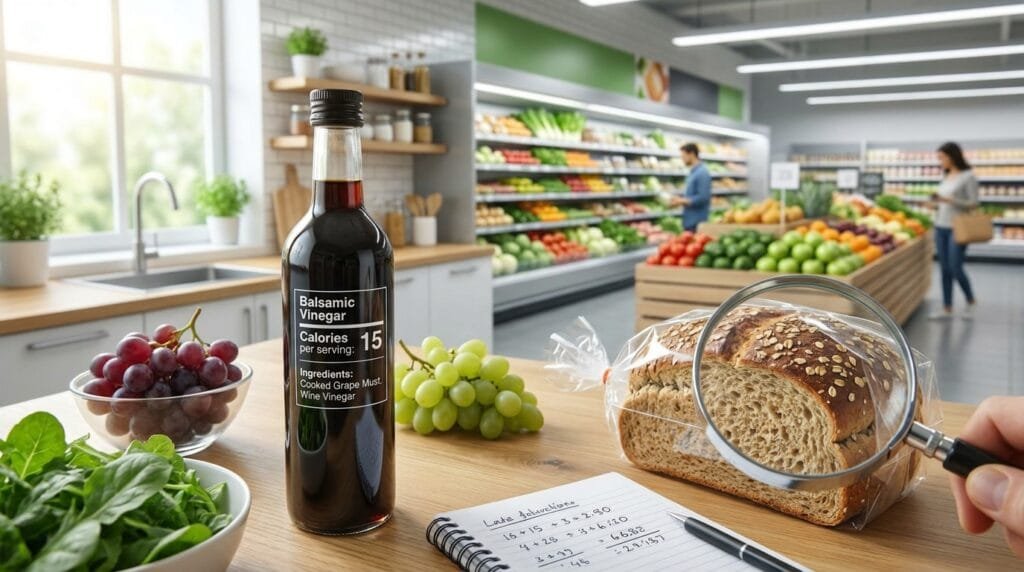
Commercial balsamic vinegar contains 14 to 20 calories per tablespoon (15 ml), derived almost entirely from 2.5 to 4 grams of carbohydrates. Traditional aged DOP varieties yield 30 to 40 calories, while sweetened balsamic glazes reach 40 to 50 calories per tablespoon.
Why Balsamic Vinegar Calories Vary: Chemistry, Must Concentration, and Legal Classifications
Unlike distilled white vinegar or red wine vinegar—which hover near zero calories per serving—balsamic vinegar possesses a distinct caloric density directly tied to its biochemical composition. Traditional vinegars undergo a simple two-stage fermentation: yeasts convert alcoholic liquids into ethanol, and Acetobacter bacteria subsequently convert that ethanol into acetic acid, consuming nearly all residual sugars in the process. Authentic balsamic production begins not with fermented wine, but with unfermented grape juice, known as “grape must” (mosto d’uva), harvested from Trebbiano, Lambrusco, or other specified grape cultivars. This must is simmered over open fires in copper cauldrons to reduce its volume and concentrate natural fructose and glucose before any acetification occurs. The starting dissolved sugar content can reach 30 to 40 degrees Brix, laying the foundation for a calorie-dense final liquid.
The legal classification of the bottle fundamentally dictates its caloric content. The gold standard, Aceto Balsamico Tradizionale di Modena DOP (and its sister denomination from Reggio Emilia), contains zero wine vinegar. It is composed exclusively of boiled grape must aged through dynamic battery barrels of varying woods (oak, chestnut, cherry, ash, and juniper) for a minimum of 12 years (Affinato) or 25 years (Extravecchio). Over decades of water evaporation through wood pores, the liquid reaches extreme density (up to 1.35 g/ml), concentrating the carbohydrates to 50–70 grams per 100 grams. Consequently, a single tablespoon of traditional DOP balsamic yields 30 to 40 calories entirely from bio-concentrated, natural grape monosaccharides. In balancing these macronutrients alongside dietary targets, public health authorities such as the World Health Organization Guidelines on Healthy Diets & Saturated Fats emphasize monitoring simple sugars even when derived from unrefined, traditional botanical sources.
Conversely, mass-market supermarket varieties belong to the Protected Geographical Indication: Aceto Balsamico di Modena IGP. Established by European Commission regulations, IGP standards require a minimum of only 20% concentrated or cooked grape must, combined with at least 10% standard wine vinegar, a minimum 6% total acidity, and an addition of aged vinegar. To mimic the dark, syrupy depth of aged traditional balsamic without years of expensive evaporation, producers frequently use caramel coloring (Class IV caramel, E150d) up to a maximum of 2% by volume, governed by European Food Safety Authority (EFSA) Additive Safety Regulations. Because commercial IGP versions incorporate higher ratios of thin, non-caloric wine vinegar and shorter wood-aging intervals (as little as 60 days), their carbohydrate concentration is substantially diluted, producing products that register between 14 and 20 calories per 15 ml tablespoon (approximately 88 to 135 kcal per 100 ml).
Reading Balsamic Labels: US Nutrition Facts vs. EU Formats and Real Market Products
Navigating balsamic vinegar calories requires an understanding of how regulatory bodies govern food labeling across jurisdictions. In the United States, the Food and Drug Administration (FDA) mandates a standard reference amount customarily consumed (RACC) for vinegars of 15 milliliters (1 tablespoon). Under Title 21 of the Code of Federal Regulations (21 CFR 101.9), caloric amounts below 5 calories per serving may be labeled as 0 calories, while values between 5 and 50 calories are rounded to the nearest 5-calorie increment. This mathematical rounding routinely obscures reality: a brand containing 17.4 calories per tablespoon will display “15 calories” on a US Nutrition Facts panel, while a formulation with 18 calories may display “20 calories.” In contrast, the European Union (under Regulation EU No 1169/2011) and the United Kingdom mandate disclosures per 100 grams or 100 milliliters without arbitrary rounding brackets, exposing the exact thermodynamic energy value of the liquid.
Examining well-known supermarket products demonstrates this contrast. Consider Colavita Balsamic Vinegar of Modena IGP: its US label reports 15 calories, 3 grams of carbohydrate, and 3 grams of total sugars per 15 ml serving. On its European export label, the identical batch is declared as 418 kJ / 98 kcal per 100 ml, indicating precisely 14.7 calories per 15 ml. Moving up the quality spectrum, Lucini Aged Balsamic Vinegar of Modena features a substantially higher proportion of cooked must relative to wine vinegar, which produces a denser liquid. Its US panel lists 25 calories and 6 grams of carbohydrates per tablespoon, corresponding to roughly 166 kcal per 100 ml. High-density, multi-leaf graded IGP vinegars—such as Giuseppe Giusti 3 Medaglie d’Oro—contain nearly 60% cooked must, logging approximately 35 calories per tablespoon (235 kcal per 100 ml) despite carrying no added sugar, artificial sweeteners, or thickeners.
The greatest consumer misinterpretation occurs with commercial “balsamic glazes” or reductions, such as Bertolli Balsamic Glaze or Modenaceti Crema di Balsamico. These products are not authentic vinegars; they are industrial culinary sauces formulated from concentrated grape must, balsamic vinegar, glucose syrup, modified food starches, and xanthan gum. A standard serving size is frequently manipulated down to 1 teaspoon (5 ml) or 10 grams on packaging to suppress the visible caloric load. On a normalized 1-tablespoon basis (15 ml), these glazes yield between 40 and 55 calories and 9 to 12 grams of refined carbohydrate. Using Food Scan Genius to scan a bottle’s barcode can instantly parse whether an elevated calorie count stems from authentic cooked must or industrial glucose syrups. Furthermore, understanding the nutritional risks of regular consumption of engineered emulsifiers and thickeners is supported by published PubMed Research on Ultra-Processed Foods & Gut Microbiome Disruption, which analyzes how industrial food texturizers alter gastrointestinal environments compared to whole-food derived reductions.
| Vinegar Category / Product Type | Typical Density (g/ml) | Calories per 15 ml (1 Tbsp) | Carbohydrates per 15 ml (g) | Calories per 100 ml | Primary Ingredients & Regulations |
|---|---|---|---|---|---|
| Standard Commercial Balsamic (IGP) e.g., Colavita, Bertolli Standard |
1.06 – 1.15 | 14 – 20 kcal | 2.5 – 4.5 g | 90 – 135 kcal | Wine vinegar, cooked grape must (min. 20%), caramel color (E150d max 2%). |
| Premium Dense Balsamic (IGP) e.g., Giuseppe Giusti, Lucini Aged |
1.18 – 1.28 | 25 – 35 kcal | 6.0 – 8.5 g | 165 – 235 kcal | High cooked grape must ratio (>50%), wine vinegar; naturally barrel-concentrated. |
| Traditional Balsamic (DOP) Aceto Balsamico Tradizionale |
1.30 – 1.36 | 35 – 45 kcal | 8.0 – 11.0 g | 240 – 300 kcal | 100% cooked grape must aged 12–25+ years in battery woods. Zero additives. |
| Commercial Balsamic Glaze / Crema Thickened decorative glaze |
1.25 – 1.32 | 40 – 55 kcal | 9.0 – 13.0 g | 270 – 360 kcal | Balsamic IGP, glucose syrup, modified corn/tapioca starch, xanthan gum. |
| White Balsamic (Condimento Bianco) Pale, uncaramelized dressing |
1.10 – 1.18 | 15 – 25 kcal | 3.5 – 6.0 g | 100 – 165 kcal | White grape must (cooked under vacuum to avoid Maillard browning), white wine vinegar. |
| Standard Red or White Wine Vinegar Reference comparison |
1.00 – 1.01 | 2 – 4 kcal | 0.1 – 0.4 g | 15 – 25 kcal | Fermented wine, completely acetified. Negligible residual sugar. |
Common Label Misinterpretations and Caloric Calculation Errors
A widespread nutritional error is assuming all table vinegars possess a flat zero-calorie footprint. Consumers routinely aggregate balsamic vinegar with distilled white, apple cider, and champagne vinegars when using logging algorithms. Because standard culinary recipes often call for generous pours—such as a 60 ml (1/4 cup) base for a homemade vinaigrette—substituting balsamic for standard red wine vinegar adds 60 to 100 unexpected calories entirely composed of fast-acting grape sugars. When constructing marinades, calculating the ratio of carbohydrate grams to acid concentration is essential for accurate macronutrient tracking.
A second common point of confusion stems from deceptive serving sizes on processed glaze bottles. In an effort to keep carbohydrate and caloric counts visually minimal on US labels, manufacturers often present data based on a 5-milliliter (1 teaspoon) serving rather than the FDA’s standard 15-milliliter condiment reference amount. A casual diner using three tablespoons of glaze over grilled meat or salad can unknowingly consume 150 calories and over 30 grams of sugar, the biological equivalent of drinking nearly an entire standard can of sweetened soda.
Finally, consumers often confuse the caloric and biological effects of sulfites versus added sugars. Nearly all commercial balsamic vinegars carry the warning “Contains Sulfites” on the back panel. These compounds (naturally occurring sulfur dioxide produced during yeast fermentation, sometimes augmented synthetically to prevent spoilage) contribute zero calories to the vinegar. However, their mandatory inclusion on product packaging is strictly managed by medical and regulatory bodies such as the Food Allergy Research & Education (FARE) Clinical Standards when levels exceed 10 parts per million (mg/L), due to asthma and severe sensitivity reactions. Do not assume a bottle labeled “Sulfite-Free” contains fewer calories; its caloric output remains purely a function of its residual grape must concentration.
Frequently asked questions
Can balsamic vinegar kick you out of ketosis?
Commercial balsamic vinegars contain 2.5 to 4.5 grams of net carbohydrates per tablespoon, while dense aged varieties contain up to 8.5 grams. If consumed within strict daily limits (typically under 20 to 50 grams of net carbohydrates total), a single tablespoon will not disrupt ketosis, but generous unmeasured pours can rapidly exhaust your daily carbohydrate allowance.
Why does balsamic vinegar have more calories than apple cider vinegar?
Apple cider vinegar is made from fermented apple juice wherein yeasts and bacteria consume virtually all sugars, yielding less than 3 calories and under 0.2 grams of carbohydrate per tablespoon. Balsamic vinegar is made from concentrated unfermented grape must, which retains high concentrations of natural fructose and glucose.
How many calories are in a standard oil and balsamic salad dressing?
A classic vinaigrette mixed at a 3:1 ratio (three parts extra virgin olive oil to one part commercial balsamic vinegar) contains approximately 125 calories per tablespoon. Roughly 120 calories originate from olive oil lipids (13.5 grams of fat), and 5 calories originate from the balsamic vinegar carbohydrates.
Does white balsamic vinegar contain fewer calories than dark balsamic?
Not necessarily. White balsamic vinegar (Condimento Bianco) is made from white grape must concentrated under vacuum at low temperatures to prevent heat-induced caramelization. Its sugar and caloric densities (15 to 25 kcal per tablespoon) are comparable to standard dark Balsamic Vinegar of Modena IGP.
How do you calculate balsamic calories in bulk cooking?
To calculate precisely, weigh the volume of balsamic used. For commercial IGP varieties, calculate 0.9 to 1.3 calories per milliliter (or 0.8 to 1.1 calories per gram, accounting for a specific gravity around 1.10). For thick glazes, use 2.5 to 3.2 calories per milliliter.
References
- Food Allergy Research & Education (FARE) Clinical Standards
- European Food Safety Authority (EFSA) Additive Safety Regulations
- PubMed Research on Ultra-Processed Foods & Gut Microbiome Disruption
- World Health Organization Guidelines on Healthy Diets & Saturated Fats
Related guides
- Best Food Allergy Scanner App – Scan Food Labels Instantly — Food Allergy & Sensitivity Scanner Hub
- The 7 Best Free Food Scanner Apps of 2026 — best free food scanner apps
- Choosing the Best Barcode Scan App for Your Health — guide to choosing a barcode scanner app
- Food Scan Genius: World’s #1 Food Ingredient Scanner App — Food Scan Genius scanner app
Check Any Label Against 5 Million Products — Free
Never second-guess confusing grocery labels again. Download Food Scan Genius to uncover hidden additives, toxic dyes, and allergens for the whole household before you buy.