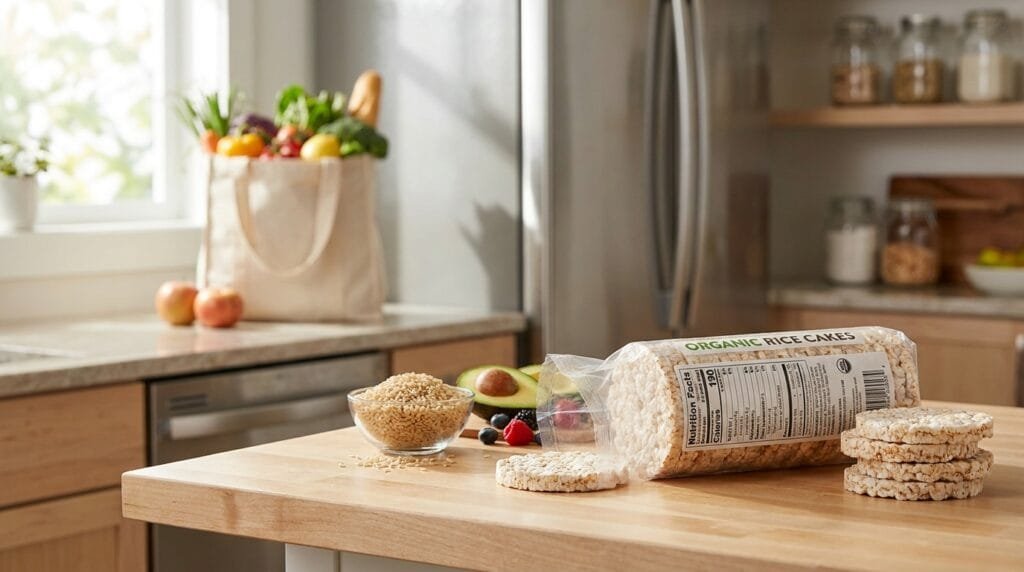
One plain, lightly salted puffed brown rice cake (9 grams) contains 35 calories, 7.3 grams of carbohydrates, 0.7 grams of protein, 0.3 grams of fat, and 0.4 grams of dietary fiber, with a high glycemic index averaging 82.
Nutritional Mechanics: Carbohydrate Density and Glycemic Response
A standard commercially manufactured rice cake consists almost entirely of milled white or brown rice subjected to high heat and moisture-vaporization pressure. During extrusion, trapped moisture flash-boils, expanding the grain’s starch matrix into an airy, porous structure. While this process results in a product that feels light and provides a modest 35 calories per single 9-gram cake, it alters the physical architecture of the starch. The gelatinization and puffing disrupt the amylose and amylopectin granules, making them exceptionally accessible to salivary and pancreatic alpha-amylase enzymes. Consequently, the starch digests into glucose almost as rapidly as pure dextrose.
Because of this rapid enzymatic breakdown, plain puffed rice cakes carry an average Glycemic Index (GI) of 82 to 87, placing them firmly in the high-GI category. For perspective, pure glucose has a baseline GI of 100, while boiled brown rice averages around 55. Although the Glycemic Load (GL) of a single cake remains low at approximately 6 due to its minimal total weight (9 grams), consuming three or four cakes delivers a rapid carbohydrate bolus of 22 to 30 grams. Clinical evaluations indexed in PubMed Research on Ultra-Processed Foods & Gut Microbiome Disruption demonstrate that physically disrupted, low-fiber cereal matrices alter postprandial glucose curves and pass through the upper digestive tract with minimal sustained satiety signaling.
From a macronutrient perspective, rice cakes offer negligible dietary fats (0.3g per cake) and low protein content (0.7g per cake), consisting primarily of the rice endosperm’s storage protein, oryzenin. Mineral retention depends entirely on whether whole brown rice or polished white rice serves as the primary substrate. Whole brown rice cakes retain modest quantities of manganese, phosphorus, and magnesium, whereas white rice variants lose these micronutrients during milling unless artificially enriched. Dietary guidance detailed in the World Health Organization Guidelines on Healthy Diets & Saturated Fats emphasizes prioritizing intact, unrefined carbohydrates over structurally depleted puffed grains to maintain metabolic equilibrium.
Deconstructing Real Commercial Labels: US Nutrition Facts vs. International Standards
When analyzing packaged rice cakes across global markets, regulatory frameworks create stark differences in how nutritional density appears to consumers. In the United States, the Food and Drug Administration (FDA) establishes Reference Amounts Customarily Consumed (RACC) under 21 CFR 101.12. For crackers and puffed grain cakes, the RACC is set at 15 to 30 grams. On a package of Quaker Lightly Salted Rice Cakes, the declared serving size is 1 cake (9g), listing 35 calories, 0g fat, 15mg sodium, 7g total carbohydrates, and 0g dietary fiber. Because FDA rounding rules (21 CFR 101.9) allow values under 0.5 grams to round down to zero, the 0.4 grams of actual fiber and 0.3 grams of polyunsaturated fats present in the brown rice substrate vanish entirely from the label, obscuring minor nutritional contributions.
Conversely, European Union regulations (EU FIC Annex IX) and UK standards mandate labeling per 100 grams alongside any optional per-portion metric. When examining a benchmark brand like Kallo Organic Unsalted Rice Cakes on a European shelf, the 100-gram baseline reveals a dense nutritional profile: 382 kcal, 81.5g carbohydrates (of which sugars comprise 0.5g), 8.1g protein, 2.8g fat, and 3.1g dietary fiber. Seeing 382 calories per 100 grams frequently surprises consumers who view rice cakes strictly as a low-calorie food; gram for gram, puffed rice possesses an energy density nearly identical to that of plain wheat flour or unbuttered pretzels. When verifying product claims across imported or domestic packaging, utilizing Food Scan Genius allows users to normalize these differing declaration standards instantly against raw ingredient databases.
Formulated and flavored varieties present further regulatory divergences. Sweetened profiles such as Apple Cinnamon or Caramel Quaker Rice Cakes incorporate high-fructose corn syrup, sugar, and artificial coloring agents. These additives increase the carbohydrate load to 11 grams per cake, with free sugars accounting for 3 to 4 grams per serving (amounting to 35-40% of the cake’s total weight). In the EU, flavored options frequently employ natural extracts or polyols, governed under strict additive guidelines defined by the European Food Safety Authority (EFSA) Additive Safety Regulations. Furthermore, facilities that process flavored variants often utilize shared production lines handling milk powders, soy, or sesame, requiring cross-contamination notices consistent with Food Allergy Research & Education (FARE) Clinical Standards.
| Nutrient / Metric | Plain Brown Rice Cake (1 Cake, 9g) | Flavored/Caramel Rice Cake (1 Cake, 13g) | Puffed Brown Rice (Per 100g Reference) |
|---|---|---|---|
| Energy (Calories) | 35 kcal | 50 kcal | 387 kcal |
| Total Carbohydrates | 7.3 g | 11.0 g | 81.5 g |
| Free / Added Sugars | 0.0 g | 3.5 g | 0.5 g |
| Dietary Fiber | 0.4 g | 0.2 g | 4.1 g |
| Crude Protein | 0.7 g | 0.8 g | 7.9 g |
| Total Fat | 0.3 g | 0.4 g | 2.8 g |
| Saturated Fat | 0.05 g | 0.1 g | 0.6 g |
| Sodium (Lightly Salted) | 15 mg | 25 mg | 170 mg |
| Glycemic Index (GI) | 82 (High) | 85 (High) | 82 (High) |
| Glycemic Load (GL) | 6 (Low) | 9 (Low) | 67 (Very High) |
Common Analytical Errors: Weight Biases and Satiety Misconceptions
The primary error consumers make regarding rice cakes is conflating low absolute energy per piece with low nutritional density. Because an individual cake weighs only 9 grams, it delivers few calories purely by virtue of lacking mass, not because puffed rice is calorically dilute. On an equal-weight basis (100 grams), plain rice cakes contain roughly 385 calories, which exceeds the caloric density of boiled white potato (87 kcal/100g), cooked whole-wheat pasta (131 kcal/100g), or skinless chicken breast (165 kcal/100g). Treating rice cakes as an unlimited volume snack ignores the cumulative carbohydrate concentration introduced as portion count rises.
A second common analytical error involves misinterpreting the physical density of the product for biological satiety. Due to the high-temperature puffing process, the cellular walls of the rice grain are fractured, eliminating the natural chew resistance and textural delay that stimulates mechanical and hormonal satiety cues. Ingesting three dry rice cakes (27g total) provides approximately 105 calories and 22 grams of high-glycemic carbohydrates with virtually no liquid volume, fat, or cohesive fiber matrix. Without co-ingesting exogenous lipids or proteins—such as nut butter, eggs, or avocado—gastric emptying proceeds rapidly, precipitating early postprandial hunger.
Frequently asked questions
Are plain rice cakes considered keto-friendly?
No. A single 9-gram plain rice cake contains approximately 7 grams of net carbohydrates and almost no dietary fat. Consuming two cakes can consume up to 70% of an individual’s strict 20-gram daily net carb threshold on a standard ketogenic diet.
What is the difference in nutrition between white and brown rice cakes?
Brown rice cakes retain the germ and bran layer, providing roughly 0.4g of fiber, trace minerals (manganese, magnesium), and slightly higher polyunsaturated fat per cake. White rice cakes consist purely of endosperm starch, offering less than 0.1g of fiber and marginally faster carbohydrate digestion.
Do plain rice cakes contain gluten?
Rice is inherently gluten-free, so pure white or brown rice cakes do not naturally contain gluten. However, individuals with celiac disease must check for shared-facility processing statements, as cross-contamination can occur if wheat crackers are produced on identical manufacturing lines.
Why do rice cakes cause rapid blood sugar spikes?
The intense heat and pressure used during extrusion gelatinize the rice starches and destroy their intact granule structure. This structural breakdown allows digestive enzymes like amylase to rapidly hydrolyze the starch into glucose, resulting in a high Glycemic Index of roughly 82.
How much sodium is in commercial rice cakes?
Unsalted rice cakes contain virtually zero sodium (1 to 2 milligrams naturally occurring). Lightly salted commercial versions generally contain 15 to 35 milligrams of sodium per cake, while savory flavored varieties (such as white cheddar or barbecue) can contain 75 to 150 milligrams per serving.
References
- Food Allergy Research & Education (FARE) Clinical Standards
- European Food Safety Authority (EFSA) Additive Safety Regulations
- PubMed Research on Ultra-Processed Foods & Gut Microbiome Disruption
- World Health Organization Guidelines on Healthy Diets & Saturated Fats
Related guides
- Best Food Allergy Scanner App – Scan Food Labels Instantly — Food Allergy & Sensitivity Scanner Hub
- The 7 Best Free Food Scanner Apps of 2026 — best free food scanner apps
- Choosing the Best Barcode Scan App for Your Health — guide to choosing a barcode scanner app
- Food Scan Genius: World’s #1 Food Ingredient Scanner App — Food Scan Genius scanner app
Check Any Label Against 5 Million Products — Free
Never second-guess confusing grocery labels again. Download Food Scan Genius to uncover hidden additives, toxic dyes, and allergens for the whole household before you buy.