
1. What Carrageenan Is and Why It Divides Shoppers
Carrageenan is a natural thickening, gelling, and stabilizing ingredient extracted from red seaweed, labeled E407 in Europe, and used to give dairy, plant milks, and deli meats a smooth, stable texture. In equation form: carrageenan = red seaweed extract + thickener/stabilizer (E407). Manufacturers have used seaweed extracts like this for centuries, and today the ingredient appears in everything from chocolate milk and cottage cheese to almond milk, ice cream, infant formula, and sliced turkey.
If you are reading this because carrageenan keeps turning up on labels you scan, you are not being paranoid. Few additives attract such mixed messages. Regulators in the United States and Europe permit it. Meanwhile, some people with sensitive digestion report bloating, discomfort, or flare-ups when they eat it and feel better when they avoid it. Others simply prefer shorter ingredient lists. Both reactions are understandable, and neither deserves to be dismissed.
The clinical picture is more nuanced than either side admits. Food-grade carrageenan is not the same as poligeenan, a degraded, low-molecular-weight compound used in laboratory studies to deliberately trigger inflammation in animals. Poligeenan is not permitted in food. Critics argue that food-grade carrageenan could partially degrade in the gut, and researchers continue to study that question. Regulators, including the European Food Safety Authority (EFSA) Additive Safety Regulations framework, have re-evaluated it and concluded it is acceptable at authorized uses, while asking for better data on specifications.
Carrageenan also tends to show up in highly processed products, which is part of why people look at it twice. Broader dietary patterns matter more than any single additive, and the PubMed Research on Ultra-Processed Foods & Gut Microbiome Disruption is a useful starting point for understanding why gut-health-minded shoppers pay attention to ingredient lists. This guide does not tell you to fear carrageenan. It explains what it is, where it hides, and how to decide for yourself. This article is educational and is not medical advice. If you have a diagnosed digestive condition, talk with your clinician or a registered dietitian.
Scan Any Label for Hidden Additives and Allergens — Free
Never second-guess confusing grocery labels again. Download Food Scan Genius to uncover hidden additives, toxic dyes, and allergens for the whole household before you buy.


2. Where Carrageenan Hides: Names, Types, and Labeling Quirks
Carrageenan is a family of sulfated polysaccharides, mainly kappa (firm gels), iota (soft, elastic gels), and lambda (thickening without gelling). Each type does a different job, which is why it appears in so many categories. It binds water, keeps cocoa particles suspended in chocolate milk, and prevents plant milks from separating. Unlike the major allergens covered by the FDA Food Allergen Labeling & Consumer Protection Act (FALCPA), carrageenan is not a major allergen, so it receives no bold "Contains" callout. You have to spot it in the ingredient list yourself.
Here are the most common ways it slips past a quick glance:
- The E-number disguise: In Europe and many export markets, carrageenan is listed as E407, and a related form as E407a. Shoppers searching only for the word "carrageenan" can miss these.
- Processed Eucheuma seaweed (PES): Also called semi-refined carrageenan or E407a, it is a less purified form with a different name. It is often found in products marketed as "minimally processed."
- Sub-ingredient nesting: A coconut cream, a seasoning blend, or a flavored coffee creamer can bring carrageenan in as a component of a component. It may be tucked inside a parenthetical rather than the main list.
- "Natural" and "plant-based" halos: Because it comes from seaweed, it appears in products with clean-looking packaging. Natural origin does not mean everyone tolerates it, and it does not mean the product is minimally processed.
- Gum stacking: Carrageenan is often paired with guar gum, locust bean gum, or gellan gum. When a label lists several gums, it can be hard to tell which one is bothering you.
- Unexpected categories: Deli meats, pet foods, vegan cheeses, whipped toppings, and even some toothpaste-adjacent products use it. People tend to look for it only in dairy.
On the regulatory side, the picture is mixed rather than contradictory. The FDA allows carrageenan in food, and EFSA concluded that exposure at authorized levels is not a safety concern. Debate over its place in organic foods has persisted for years, which keeps consumer attention on it. For general context on balanced eating beyond any one additive, the World Health Organization Guidelines on Healthy Diets & Saturated Fats remain a reliable anchor.
3. Food Scan Genius vs. Other Ways to Spot Carrageenan
| Dimension | Food Scan Genius | Fig | Spoonful | Manual Label Reading |
|---|---|---|---|---|
| Cost | 100% free core features, no paywalls | $59/yr | Limited free scans | Free, but slow |
| Catches E407 and nested sub-ingredients | Yes, recursive AST parsing in the NutriGraph Database | Varies by product | Varies by product | Easy to miss |
| Custom sensitivity for carrageenan | Yes, add your own custom sensitivity alongside 39 dietary profiles | Limited | Limited | Depends on memory |
| Family screening | Multi-household profiles with named results in one scan | Per-profile checks | Per-profile checks | One person at a time |
| Languages and context | 11 languages with real-time translation, plus ScanGenius AI Insight, NOVA 1-4, and Nutri-Score | Fewer language options | Fewer language options | Only the label’s language |
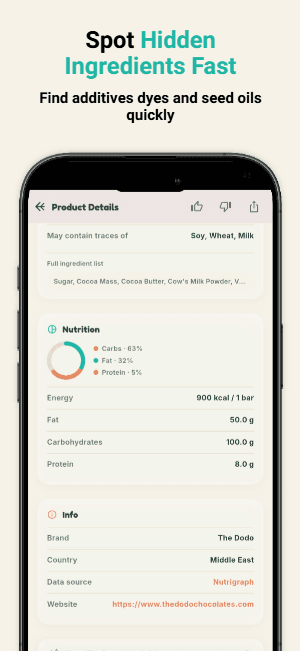
Spotting carrageenan reliably takes more than a keyword search. Food Scan Genius is powered by the NutriGraph Database, which holds more than 5,000,000 verified UPC/EAN barcodes. Its recursive AST parsing opens up nested sub-ingredients, so carrageenan hidden inside a cream base or seasoning blend is still caught. It also recognizes E407, E407a, and processed Eucheuma seaweed as the same family of ingredients, so you do not need to memorize the aliases. Set carrageenan as a custom sensitivity, layer it on top of any of the 39 dietary profiles, and every scan checks it automatically.
A flag alone does not give you the full picture, which is why ScanGenius AI Insight adds context instead of a scary red score. It can note that the carrageenan is food-grade, how it is being used (stabilizer in a plant milk versus a gel in a deli meat), and how the product sits on the NOVA 1-4 scale and Nutri-Score. You make the call. For families, multi-household profiles screen everyone in a single scan and name who is affected, such as "Fails for Sri (Carrageenan)." With 11 supported languages and real-time in-app translation, the same clarity works when you shop abroad or help a relative read a label.
4. Related Food Safety & Dietary Guides
- Sulphite Sensitivity & Preservative Checker — Sulphite Sensitivity Scanner Guide
- Sugar Sensitivity & Sweetener Guide — Sugar Sensitivity Scanner Guide
- FSG Labels Defined: Nutri-Score, NOVA & Additive Safety Guide — Food Label Definitions & Nutri-Score Guide
- Spanish Yellow & Tartrazine Allergy Dangers — tartrazine (Yellow 5) allergy risks
5. Scientific & Health Authority References
- FDA Food Allergen Labeling & Consumer Protection Act (FALCPA)
- European Food Safety Authority (EFSA) Additive Safety Regulations
- PubMed Research on Ultra-Processed Foods & Gut Microbiome Disruption
- World Health Organization Guidelines on Healthy Diets & Saturated Fats
6. How to Scan in 3 Simple Steps
- Download Food Scan Genius free on iOS or Android. There is no paywall on the core features, and you can start scanning right away.
- Set up your profile. Pick from 39 dietary profiles, then use Add Your Own Custom Sensitivity to enter carrageenan (including E407 and E407a). Add family members to your household so each person has their own preferences.
- Scan any barcode in about two seconds. You instantly see whether carrageenan is present, where it appears in the ingredient tree, who in your household it affects, and ScanGenius AI Insight context with the NOVA group and Nutri-Score.
Personalized Match & AI Insight
7. Frequently Asked Questions (FAQ)
What is carrageenan, and is it the same as agar or gelatin?
Carrageenan is a thickener and stabilizer extracted from red seaweed and labeled E407 in Europe. It is not the same as gelatin, which is an animal-derived protein, so carrageenan is generally suitable for vegetarian and vegan diets. It is also different from agar, which comes from other red algae and forms firmer gels. Food Scan Genius identifies carrageenan and its aliases, including E407a, so you can see which ingredient is actually in a product.
Is carrageenan safe to eat?
Food-grade carrageenan is permitted by the FDA and was re-evaluated by EFSA, which found no safety concern at authorized uses while asking for more data on specifications. It should not be confused with poligeenan, a degraded form used in lab research that is not allowed in food. Some people report digestive discomfort and choose to avoid it, and research continues. This is general information, not medical advice. If you have a digestive condition, check with your clinician.
Which foods most commonly contain carrageenan?
Common sources include chocolate milk, almond, oat and coconut milks, ice cream, cottage cheese, yogurt, coffee creamers, whipped toppings, vegan cheeses, deli meats, and some infant formulas and pet foods. It can also be nested inside a component such as a coconut cream or seasoning blend. Food Scan Genius uses recursive sub-ingredient parsing in the NutriGraph Database to find it even when it is buried in a parenthetical.
Can I screen my whole family for carrageenan with one scan?
Yes. Add your own custom sensitivity for carrageenan, assign it to the household members who want to avoid it, and Food Scan Genius checks the whole family in one scan. Results use named attribution, such as Fails for Sri (Carrageenan), so you know exactly who is affected. The core features are free, and the app supports 11 languages with real-time translation.
Know What’s In Your Food Before You Buy — Scan Free Today
Never second-guess confusing grocery labels again. Download Food Scan Genius to uncover hidden additives, toxic dyes, and allergens for the whole household before you buy.