
1. The Keto Label Equation (and Why It Is Harder Than It Looks in 2026)
To read food labels for keto diet, use this equation: Net Carbs = Total Carbohydrates − Dietary Fiber − Sugar Alcohols (adjusted), then compare the result to your daily limit, typically 20–50 g.
That formula is simple. Applying it in a real store is not. In the US, “net carbs” is not a regulated term, so the number on the front of a package can be calculated however the manufacturer likes. Many people on a ketogenic diet do everything right for weeks, then stall or feel off and cannot work out why. Often the culprit is a handful of “keto-friendly” products whose real carbohydrate load was far higher than the packaging suggested. If that has happened to you, you were working with incomplete information, and the fault does not lie with your discipline.
The stakes are higher for some people than for others. Many follow keto under medical supervision for epilepsy, type 2 diabetes, or insulin resistance. For them, an inaccurate carb count can affect glucose readings, medication planning, and ketosis. Keto shoppers also tend to buy specialty products, such as almond-flour breads, protein bars, and sweetened sauces. These are often ultra-processed, and the PubMed Research on Ultra-Processed Foods & Gut Microbiome Disruption is a reminder that a low-carb food is not automatically a nutritious one. The best keto label strategy checks both carbohydrate math and ingredient quality.
Fat quality matters too, because keto pushes fat intake up. The World Health Organization Guidelines on Healthy Diets & Saturated Fats recommend keeping saturated fat below 10% of total energy intake. A label that is carb-friendly can still be a poor fit for your cardiovascular goals. Reading the Nutrition Facts panel, the ingredient list, and the serving size together gives you the full picture.
Scan Any Label for Hidden Additives and Allergens — Free
Never second-guess confusing grocery labels again. Download Food Scan Genius to uncover hidden additives, toxic dyes, and allergens for the whole household before you buy.


2. Six Sneaky Ways Carbs Hide on Keto Labels
Manufacturers are mostly following the rules, but the rules leave room for numbers that mislead a carb-counter. These are the loopholes and ingredients that cause the most trouble, and what to do about each one.
- Unrealistic serving sizes: A bag of keto granola may list 3 g net carbs per “serving” of two tablespoons. Check the servings-per-container line and multiply. If you eat the whole bag, the carbs may be five or six times what you assumed.
- Rounding to zero: Labeling rules allow amounts under 0.5 g per serving to be declared as 0 g. Sauces, spice blends, creamers, and sprays can look carb-free, yet several servings across a day quietly add up. Always scan the ingredient list for sugar, dextrose, or starch.
- Sugar alcohols that are not equal: Erythritol is largely unabsorbed and is generally subtracted in full. Maltitol, sorbitol, and xylitol raise blood glucose to a meaningful degree, so many keto practitioners subtract only about half or none of them. Sweeteners are also reviewed under the European Food Safety Authority (EFSA) Additive Safety Regulations, which is a useful reference when you want to understand a polyol’s safety and laxative thresholds.
- Isolated fibers that may not be fully “free”: Soluble corn fiber, isomaltooligosaccharides (IMO), and some other added fibers are subtracted by brands as if they were zero-impact. Digestibility varies by fiber type, and some can raise glucose in sensitive people. If you test your glucose or ketones, treat these with caution and watch your own response.
- Bulking agents in “zero-calorie” sweeteners and savory products: Maltodextrin and dextrose are common carriers in powdered sweeteners, seasoning mixes, deli meats, and flavored packets. Both are rapidly absorbed, and maltodextrin has a very high glycemic index. They may appear in tiny amounts yet still matter, especially when stacked.
- “Keto” and “low carb” front-of-pack claims: These are marketing terms with no uniform legal definition. Ignore the banner and read the panel. Rare sugars such as allulose also complicate things, since regulators treat them differently from other sugars in the carbohydrate declaration, so check how the brand handled it.
Keto products frequently use nut flours, soy protein, and dairy proteins to replace wheat. If you or a family member also manage food allergies, cross-reference the standards from Food Allergy Research & Education (FARE) Clinical Standards and always check the “Contains” statement. A low-carb swap that introduces tree nuts or soy can be a serious problem for the wrong household member.
Finally, a practical rule: calculate net carbs yourself from the Nutrition Facts panel, then look at the ingredient list for the first five items. If a sweetener, starch, or syrup shows up near the top, the product deserves extra scrutiny whatever the front says.
3. Head-to-Head: Doing Keto Label Math by Hand vs. Scanning with Food Scan Genius
| Dimension | Food Scan Genius | Manual Label Math | Front-of-Pack “Keto” Claims | Crowdsourced Carb-Tracker Databases |
|---|---|---|---|---|
| Hidden carb detection | Flags maltodextrin, dextrose, maltitol, and similar sub-ingredients automatically | Depends on your knowledge and time | Not reliable; marketing only | Varies by user-entered data |
| Ingredient depth | NutriGraph: 5M+ verified UPC/EAN barcodes with recursive sub-ingredient parsing | Only what you can read and recognize | None | Often macros only; entries may be outdated |
| Cost | 100% free core features, no paywalls | Free, but costs time | Free | Core logging often free; barcode and premium features may be paid |
| Personalization | 39 dietary profiles plus custom sensitivities; multi-household family profiles | Entirely manual | One-size-fits-all | Usually one user, carbs only |
| Languages and context | 11 languages with real-time translation; NOVA 1-4 and Nutri-Score | Only the language on the package | None | Limited |
The core advantage of Food Scan Genius is depth. Our NutriGraph Database holds more than 5,000,000 verified UPC/EAN barcodes, and each ingredient list is parsed recursively. When a “natural flavor blend” or “seasoning” is itself made of sub-ingredients, those sub-ingredients are broken out instead of hidden behind a single line. That is where maltodextrin, dextrose, and starches tend to sit. Choose the Keto profile from our 39 supported dietary profiles, or add your own custom sensitivity for something like specific sweeteners, seed oils, or additives, and every scan is checked against your rules in about two seconds.
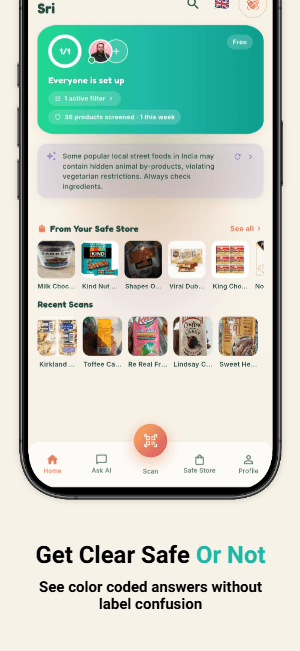
ScanGenius AI Insight then adds context rather than a verdict. Instead of a simplistic good-or-bad score, you get a plain-language explanation of why an item was flagged, plus its NOVA 1-4 classification and Nutri-Score, so you can weigh carb count, processing level, and nutritional quality for yourself. If you shop for a household where one person eats keto and another avoids gluten, Multi-Household Family Profiles screen everyone in one scan and name the person affected, for example “Fails for Sri (Gluten).” The app is available in 11 languages with real-time translation, which helps when you are reading imported products.
4. Related Food Safety & Dietary Guides
- Best Food Allergy Scanner App – Scan Food Labels Instantly — Food Allergy & Sensitivity Scanner Hub
- The 7 Best Free Food Scanner Apps of 2026 — best free food scanner apps
- Choosing the Best Barcode Scan App for Your Health — guide to choosing a barcode scanner app
- Food Scan Genius: World’s #1 Food Ingredient Scanner App — Food Scan Genius scanner app
5. Scientific & Health Authority References
- Food Allergy Research & Education (FARE) Clinical Standards
- European Food Safety Authority (EFSA) Additive Safety Regulations
- PubMed Research on Ultra-Processed Foods & Gut Microbiome Disruption
- World Health Organization Guidelines on Healthy Diets & Saturated Fats
6. How to Scan in 3 Simple Steps
- Download Food Scan Genius free on iOS or Android. There are no paywalls on core features and no account fees.
- Choose the Keto profile from our 39 dietary profiles, then add your own custom sensitivities, such as maltitol, maltodextrin, or seed oils. Add family members if you shop for a household.
- Scan any barcode in about 2 seconds. You get an instant audit trail showing which ingredients triggered a flag, along with ScanGenius AI Insight, NOVA 1-4 classification, and Nutri-Score.
Instant Nut Allergen Audit Trail
7. Frequently Asked Questions (FAQ)
What is the formula for calculating net carbs on a nutrition label?
The standard formula for how to read food labels for keto diet is Net Carbs = Total Carbohydrates − Dietary Fiber − Sugar Alcohols (adjusted). Subtract erythritol fully, but subtract only about half of maltitol, sorbitol, or xylitol, or none, because they affect blood glucose. Food Scan Genius flags these ingredients when you scan so you can see what is inside the carb number.
How many net carbs per day do I need to stay in ketosis?
Most people aim for roughly 20–50 g of net carbs per day, though individual tolerance varies with activity level, metabolism, and medical factors. If you have diabetes or take glucose-lowering medication, work with your healthcare provider on your target. Food Scan Genius helps you apply your chosen limit by showing carb-driving ingredients at the moment you shop.
Can I trust ‘keto-friendly’ or ‘net carbs’ claims on the front of the package?
Not on their own. In the US, “net carbs” and “keto-friendly” have no uniform regulatory definition, so each brand may calculate them differently, for instance by subtracting isolated fibers or all sugar alcohols. Always verify with the Nutrition Facts panel and the ingredient list. Scanning with Food Scan Genius adds a sub-ingredient check from the NutriGraph Database.
Do I need to pay to use Food Scan Genius for keto label scanning?
No. Food Scan Genius core features are 100% free with zero paywalls, including barcode scanning, the Keto dietary profile, custom sensitivities, and ScanGenius AI Insight. You can also set up Multi-Household Family Profiles and use the app in 11 languages with real-time translation, without a subscription.
Know What’s In Your Food Before You Buy — Scan Free Today
Never second-guess confusing grocery labels again. Download Food Scan Genius to uncover hidden additives, toxic dyes, and allergens for the whole household before you buy.