1. Why the Cheerios Question Is Harder Than It Looks for Celiac Households
Yes, original U.S. Cheerios are labeled gluten free: mechanically sorted oats + under 20 ppm gluten = gluten free label, but not every Cheerios variety qualifies. That is the short answer to is cheerios gluten free. The longer answer matters a great deal if you or your child has celiac disease, because the details behind that label are what people in the community still argue about.
Oats contain no wheat, barley or rye, so they are gluten free by nature. In practice, though, oats are often grown in rotation with wheat and barley, harvested with shared equipment, and trucked in shared containers. That is why conventional oats so often arrive with stray grains mixed in. General Mills addressed this by using optical and mechanical sorting to pull out the gluten-containing grains, then testing to confirm the finished cereal stays below the legal limit. The Celiac Disease Foundation Threshold Requirements and related guidance explain the 20 parts per million standard behind the label. It is the level generally regarded as safe for most people with celiac disease.
We understand why this is stressful. A box of cereal is a daily staple, often the first food a child eats in the morning. When one “gluten free” cereal sits next to a similar-looking box that is not, and the front-of-pack claims are easy to misread, the fear of getting it wrong is reasonable. Some people with celiac disease also report symptoms after eating even sorted oats. This may be due to cross-contact, or in a small number of people, a reaction to avenin, a protein naturally found in oats. Your gastroenterologist or dietitian is the right person to decide whether mechanically sorted oats suit you.
Cheerios also has a public track record. In 2015, General Mills recalled roughly 1.8 million boxes of Cheerios and Honey Nut Cheerios after wheat flour got into gluten-free production at one facility. The recall was a reminder that a label is only as reliable as the system behind it. It does not mean the cereal is unsafe today. It does mean checking each box, rather than assuming, is a sound habit.
Scan Any Label for Hidden Additives and Allergens — Free
Never second-guess confusing grocery labels again. Download Food Scan Genius to uncover hidden additives, toxic dyes, and allergens for the whole household before you buy.


2. Where the “Gluten Free” Label on Cheerios Gets Complicated
Most confusion about Cheerios comes from a handful of loopholes and look-alike products, not from the original cereal itself. Here are the issues that matter most when you are working out whether is cheerios gluten free applies to the exact box in your hand:
- Mechanical sorting versus purity-protocol oats. Some brands grow and handle oats in dedicated, gluten-free supply chains from the start. Cheerios instead starts with conventional oats and sorts out foreign grains. Both approaches can meet the legal limit, but some celiac patients and dietitians prefer purity-protocol oats, so this is a point to raise with your care team.
- Variety confusion. The Cheerios name covers many products. Original and Honey Nut have carried gluten free labels in the U.S. for years. Several other flavors have too, but others, particularly multigrain or specialty lines, have not. Never assume one box’s status carries over to another with a similar name.
- “Under 20 ppm” does not mean zero. The FDA standard allows trace amounts below 20 ppm. For most people with celiac disease that is safe, but a few highly sensitive people prefer to avoid products that rely on testing thresholds.
- Regional label differences. A gluten free claim in the United States may not exist on the same cereal sold in Canada, the UK or the EU, where rules on oats and labeling differ. If you travel or buy imports, check the local box.
- Batch-level risk and formulation changes. Recipes, suppliers and facilities change. The 2015 recall shows that a past label does not guarantee a future batch, so look for the gluten free statement on the package you are about to eat.
- Oat avenin sensitivity. A small subset of people with celiac disease react to avenin even in oats that meet every gluten standard. A “gluten free” label cannot account for this, so it can be misleading for that group.
Plain Cheerios is also a processed food. Its short ingredient list (whole grain oats, modified corn starch, sugar, salt, tripotassium phosphate and added vitamins and minerals) is simple compared with many cereals, but flavored versions add more. If you care about additive safety, the European Food Safety Authority (EFSA) Additive Safety Regulations are a useful reference for how additives like phosphates are evaluated. Many breakfast cereals also fall into the ultra-processed category. For background on how that may relate to digestive health, see this PubMed Research on Ultra-Processed Foods & Gut Microbiome Disruption. Gluten status and processing level are separate questions, and you deserve clear information on both.
3. Food Scan Genius vs. Other Ways to Check a Cheerios Box
| Feature | Food Scan Genius | Reading the Label by Hand | Fig (paid app) | Spoonful (limited scans) |
|---|---|---|---|---|
| Cost | 100% free core features, no paywalls | Free, but time-consuming | About $59/year | Capped scans on free tier |
| Database depth | NutriGraph: 5,000,000+ verified UPC/EAN barcodes, recursive sub-ingredient parsing | Only what you can read and interpret | Varies by product | Varies by product |
| Dietary profiles | 39 profiles plus custom sensitivities | Your own memory | Limited preset list | Limited preset list |
| Family screening | Multi-household profiles, one scan, named results | Manual, one person at a time | Typically individual profile | Typically individual profile |
| Languages | 11 languages with real-time translation | Only the label’s language | Limited | Limited |
The reason a scanner helps with a question like is cheerios gluten free is that the answer changes with the exact product. Food Scan Genius runs on the NutriGraph Database, which links more than 5,000,000 verified UPC and EAN barcodes to full ingredient data. Its recursive parsing breaks compound ingredients down into their own sub-ingredients, so a vague entry like “natural flavor” or a multigrain blend is not skipped over. Scanning the barcode matches the specific box you are holding, whether that is Original, Honey Nut or a flavor you have never tried. This avoids the “same name, different product” trap. You can also create a custom sensitivity for something your doctor has flagged, such as oats, specific additives, seed oils or dyes, alongside the 39 built-in dietary profiles.
The ScanGenius AI Insight adds context rather than a verdict. It explains why a product passes or fails for your profile, and it shows a NOVA 1-4 classification and a Nutri-Score so you can weigh processing and nutrition without a single scary number. This matches the balanced approach in the World Health Organization Guidelines on Healthy Diets & Saturated Fats, which focus on overall dietary patterns rather than labeling single foods good or bad. For families, Multi-Household Family Profiles screen everyone at once. If one person at the table has celiac disease and another does not, a single scan can return a clear result such as “Fails for Sri (Gluten)”. With 11 supported languages and real-time in-app translation, it also helps when you are shopping abroad or a relative reads a different language. Food Scan Genius is a screening aid and does not replace your clinician’s advice or the manufacturer’s current labeling.
4. Related Food Safety & Dietary Guides
- Best Food Allergy Scanner App – Scan Food Labels Instantly — Food Allergy & Sensitivity Scanner Hub
- The 7 Best Free Food Scanner Apps of 2026 — best free food scanner apps
- Choosing the Best Barcode Scan App for Your Health — guide to choosing a barcode scanner app
- Food Scan Genius: World’s #1 Food Ingredient Scanner App — Food Scan Genius scanner app
5. Scientific & Health Authority References
- Celiac Disease Foundation Threshold Requirements
- European Food Safety Authority (EFSA) Additive Safety Regulations
- PubMed Research on Ultra-Processed Foods & Gut Microbiome Disruption
- World Health Organization Guidelines on Healthy Diets & Saturated Fats
6. How to Scan in 3 Simple Steps
- Download Food Scan Genius free on iOS or Android. There is no subscription or paywall on core features.
- Set up your profile: choose the Gluten-Free/Celiac dietary profile, add family members under Multi-Household Profiles, and add a custom sensitivity (for example, oats if your doctor advises avoiding them) if needed.
- Scan the Cheerios barcode in about 2 seconds. You get an instant audit trail showing which ingredients and flags triggered a pass or fail, who in your household it affects, and AI Insight context with NOVA and Nutri-Score. Then confirm the gluten free statement on the physical box.
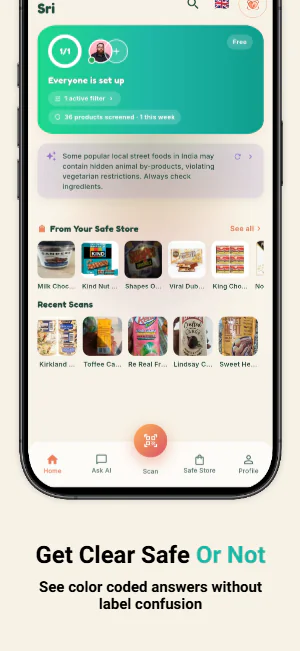
Instant Gluten-Free Audit Trail
7. Frequently Asked Questions (FAQ)
Is Cheerios gluten free for people with celiac disease?
Original Cheerios and several other U.S. varieties are labeled gluten free. They are made with oats that are mechanically sorted to remove wheat, barley and rye, and are tested to contain under 20 ppm gluten, which is the FDA standard. Most people with celiac disease tolerate them, but not every Cheerios variety carries the label. Scan the exact box in Food Scan Genius, confirm the printed gluten free statement, and ask your doctor whether sorted oats are right for you.
Are all Cheerios flavors gluten free?
No. Cheerios is a family of products, and gluten free labeling varies by variety. Original and Honey Nut have been labeled gluten free in the U.S., but multigrain and some specialty lines have not been part of the gluten free lineup. Formulations can change, so check the package each time. Food Scan Genius reads the specific barcode from its NutriGraph Database, so you get a result for that flavor rather than a guess based on the brand name.
Why do some people with celiac disease react to Cheerios even when they are labeled gluten free?
There are a few possible explanations. Mechanical sorting reduces but may not eliminate every stray grain, and the legal limit allows trace amounts below 20 ppm. A small number of people with celiac disease also react to avenin, a protein in oats, regardless of gluten content. Cross-contact at home and batch-level problems, like the 2015 recall, are other possibilities. If you have symptoms, speak with your gastroenterologist. Food Scan Genius lets you add a custom sensitivity, such as oats, to flag them in future scans.
Can Food Scan Genius check Cheerios for my whole family at once?
Yes. With Multi-Household Family Profiles, you can add each family member’s dietary needs and scan once. The result names who is affected, for example “Fails for Sri (Gluten)”, so you can tell at a glance whether a box suits the person with celiac disease and everyone else. Core features are free with no paywall, and the app supports 11 languages with real-time translation. It is a screening tool, so always confirm the gluten free claim on the package.
Know What’s In Your Food Before You Buy — Scan Free Today
Never second-guess confusing grocery labels again. Download Food Scan Genius to uncover hidden additives, toxic dyes, and allergens for the whole household before you buy.