
1. Why the Rice Krispies Treats Gluten Question Trips Up So Many Families
No: Rice Krispies Treats are not gluten free. Rice cereal + barley malt flavoring = gluten-containing, and the bars carry no gluten-free label, so people with celiac disease should avoid them.
That answer surprises a lot of people, and it is easy to see why. The ingredients sound harmless: puffed rice, marshmallow, a little butter. Rice is naturally gluten free, and so are most marshmallows. The trouble is the malt flavoring in the crisped rice cereal. Malt flavoring is normally made from barley, and barley is one of the three grains (with wheat and rye) that trigger celiac disease. If you have been wondering whether is rice krispies treats gluten free, the short version is that one small line on the ingredient list changes everything.
This matters because of how little gluten it takes to cause harm. According to the Celiac Disease Foundation Threshold Requirements, a food needs to contain fewer than 20 parts per million of gluten to be labeled gluten free in the United States. Barley malt is a deliberate ingredient, not a trace contaminant, so a product containing it is almost always well over that line. Many people with celiac disease feel fine after a single exposure and assume they got away with it. Intestinal damage can still build up quietly, and that is the reason strict avoidance is the standard recommendation.
We know how draining this is. You are packing a lunchbox or planning a birthday party, and you do not want to be the person who turns a childhood favorite into a research project. A second trap is that in the U.S., barley is not one of the major allergens that must be called out in a bolded ‘Contains’ statement. A label can say ‘malt flavor’ with no ‘Contains: Wheat’ warning anywhere near it, and you could scan the allergen box and walk away reassured. This guide explains what is actually in the product, where the loopholes hide, and how to check any similar snack in seconds.
Scan Any Label for Hidden Additives and Allergens — Free
Never second-guess confusing grocery labels again. Download Food Scan Genius to uncover hidden additives, toxic dyes, and allergens for the whole household before you buy.


2. Where Gluten Hides in Rice Krispies Treats and Similar Snacks
Gluten in a marshmallow-and-cereal snack rarely looks like gluten. It tends to show up through ingredient names and manufacturing practices that read as innocent. Here are the specific places to look when you are asking whether is rice krispies treats gluten free, or when you check any copycat bar, cereal, or homemade recipe:
- Malt flavor or malt extract in the cereal: This is the main issue. Barley malt gives the crisped rice its toasty taste, and it is a gluten source. The word ‘barley’ may never appear on the front of the box.
- No bolded allergen warning for barley: U.S. allergen labeling covers wheat but not barley or rye. A product can contain barley malt and still show a clean-looking allergen statement.
- ‘Natural flavors’ and ‘artificial flavors’: These can occasionally include gluten-derived components. Without a gluten-free claim or certification, you cannot tell from the label alone.
- Flavor and seasonal variations: Cookies-and-cream, chocolate-chunk, or limited-edition versions can add wheat flour, cookie pieces, or other inclusions. A formula that is one thing in the original flavor may be different in another, and manufacturers change recipes without announcement.
- Shared lines and cross-contact: Even when an ingredient list looks clean, products made on equipment shared with wheat-based items carry a cross-contact risk. Only a tested, labeled gluten-free claim addresses that.
- Homemade versions using regular cereal: A recipe ‘from scratch’ is only gluten free if the cereal is labeled gluten free. Many standard crisped rice cereals contain malt, and a marshmallow brand also needs checking.
A fair caveat: some manufacturers have sold separate crisped rice cereals marketed as gluten free in certain markets. If you want a homemade version, pick a cereal that carries an explicit gluten-free label on the package, and confirm the marshmallows too. Do not assume a gluten-free cereal means the packaged bars are safe. They are separate products with separate formulas.
It is also worth stepping back to look at the snack as a whole. Packaged treat bars are usually classified as ultra-processed (NOVA 4). Researchers are still studying how heavily processed diets affect digestion, and the PubMed Research on Ultra-Processed Foods & Gut Microbiome Disruption is a useful starting point if you want the science. This is not a reason to panic over an occasional treat, but for someone with celiac disease or a sensitive gut, it is context worth having. The World Health Organization Guidelines on Healthy Diets & Saturated Fats and the European Food Safety Authority (EFSA) Additive Safety Regulations offer helpful frameworks for evaluating sugar, fat, and additive content more broadly. Gluten safety, though, is a separate question from general nutrition, and it should be answered first.
3. Food Scan Genius vs. Traditional Ways of Checking a Label
| Dimension | Food Scan Genius | Reading the Label Yourself | Searching the Web | Calling the Manufacturer |
|---|---|---|---|---|
| Speed | About 2 seconds per barcode | 1-3 minutes per product | 5-10 minutes, mixed sources | Hours to days |
| Catches hidden sub-ingredients (e.g., malt flavor) | Yes, via recursive sub-ingredient parsing | Only if you recognize the terms | Inconsistent | Depends on the representative |
| Whole-family screening | One scan, named results like ‘Fails for Sri (Gluten)’ | Manual, per person | Manual, per person | Manual, per person |
| Dietary profiles and custom sensitivities | 39 profiles plus custom sensitivities | Your own memory | None | None |
| Cost and languages | Free core features, no paywall; 11 languages with in-app translation | Free, but only in the label’s language | Free, variable quality | Free, but slow |
The reason a barcode scan beats a quick read of the label is depth. Food Scan Genius runs on the NutriGraph Database, which holds more than 5,000,000 verified UPC/EAN barcodes. Each product’s ingredient list is parsed recursively, so a compound ingredient such as ‘crisped rice cereal’ is broken down into its own sub-ingredients, including malt flavoring. That is exactly the kind of detail that gets skipped when you scan a label by eye in a busy store. If you have set a gluten profile, the app flags the product instead of leaving you to decode it.
Flagging is only half of it. ScanGenius AI Insight explains why a product was flagged, in plain language, alongside its NOVA 1-4 processing classification and Nutri-Score. It does this without a single moralizing ‘good or bad’ number, because a snack can fail your gluten profile and still be a reasonable choice for someone else in the household. Family Profiles let you screen everyone at once. With 39 supported dietary profiles and the option to add your own custom sensitivity (seed oils, specific dyes, particular additives), the result reflects your household’s rules. The 11 supported languages with real-time translation also help when you are reading a label from another country. The core features are completely free, with no paywall.
4. Related Food Safety & Dietary Guides
- Best Food Allergy Scanner App – Scan Food Labels Instantly — Food Allergy & Sensitivity Scanner Hub
- The 7 Best Free Food Scanner Apps of 2026 — best free food scanner apps
- Choosing the Best Barcode Scan App for Your Health — guide to choosing a barcode scanner app
- Food Scan Genius: World’s #1 Food Ingredient Scanner App — Food Scan Genius scanner app
5. Scientific & Health Authority References
- Celiac Disease Foundation Threshold Requirements
- European Food Safety Authority (EFSA) Additive Safety Regulations
- PubMed Research on Ultra-Processed Foods & Gut Microbiome Disruption
- World Health Organization Guidelines on Healthy Diets & Saturated Fats
6. How to Scan in 3 Simple Steps
- Download Food Scan Genius free on iOS or Android. There is no paywall on the core scanning features, and you can start without a subscription.
- Set up your profile: choose the Gluten-Free or Celiac profile from the 39 dietary profiles, add any custom sensitivities (for example, a specific dye or additive), and create a named profile for each family member so results show who a product fails for.
- Scan the barcode on any Rice Krispies Treats package or similar snack. In about 2 seconds you get a pass/fail result, the flagged sub-ingredient (such as malt flavoring), and an audit trail you can review, along with ScanGenius AI Insight, NOVA class, and Nutri-Score.
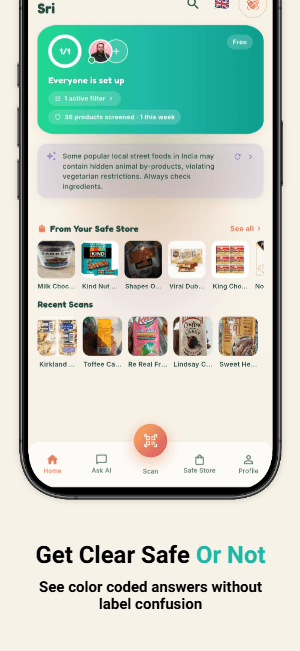
Instant Gluten-Free Audit Trail
7. Frequently Asked Questions (FAQ)
Is Rice Krispies Treats gluten free?
No. The packaged bars are made with crisped rice cereal that contains barley malt flavoring, which is a gluten source, and they are not labeled gluten free. People with celiac disease or non-celiac gluten sensitivity should avoid them. Scan the package with Food Scan Genius and the gluten profile will flag the malt sub-ingredient for you.
Why isn’t rice gluten free here if rice is naturally gluten free?
Plain rice is gluten free, but the cereal is a processed product with added ingredients. The malt flavoring is typically derived from barley, which contains gluten. Because the ingredient list may only say ‘malt flavor,’ the gluten source is easy to miss, and U.S. allergen statements do not require barley to be called out. Food Scan Genius parses these sub-ingredients so the hidden source shows up.
Can I make gluten-free Rice Krispies Treats at home?
Yes, as long as every ingredient is safe. Use a crisped rice cereal that is explicitly labeled gluten free, confirm that your marshmallows and butter or margarine are gluten free, and use clean utensils and pans to avoid cross-contact. You can scan each ingredient’s barcode in Food Scan Genius before you start. A recipe is only as safe as its least-checked component.
How can I check my whole family at once if only one person avoids gluten?
Use Multi-Household Family Profiles in Food Scan Genius. You add each person with their own dietary rules, and one scan screens the product against all of them. The result names who it fails for, such as ‘Fails for Sri (Gluten),’ so the rest of the household can still enjoy foods that are fine for them. Results also appear in any of the app’s 11 supported languages.
Know What’s In Your Food Before You Buy — Scan Free Today
Never second-guess confusing grocery labels again. Download Food Scan Genius to uncover hidden additives, toxic dyes, and allergens for the whole household before you buy.