1. Why Choosing a Keto-Friendly Mayo Is Trickier Than It Looks in 2026
On paper, the question is mayo keto friendly has an easy answer. Traditional mayonnaise is an emulsion of oil, egg yolk, an acid such as vinegar or lemon juice, and a little salt. A tablespoon typically has about 90 to 100 calories, 10 to 11 grams of fat, and close to zero carbohydrates. That profile fits a ketogenic diet well, which is why mayo is a staple for people eating roughly 20 to 50 grams of net carbs a day. Then you stand in the condiment aisle and see forty jars. Some say ‘light,’ some say ‘avocado oil,’ some say ‘dressing,’ and some say ‘plant-based.’ The simple answer stops being simple.
If you have felt that frustration, you are not alone. Many people who start keto are careful about bread, pasta, and fruit, then find out weeks later that a ‘harmless’ sandwich spread added starch and sugar to every meal. Others did everything right on carbs and still felt unwell, because the oil in their jar was not what they expected. Wanting a clean, predictable condiment is a reasonable thing to ask of a grocery store. It should not take a chemistry degree.
The context matters clinically too. Keto is used for many reasons, including weight management, blood sugar control under medical supervision, and neurological therapy. In every case, small hidden carbohydrates add up across the day. The World Health Organization Guidelines on Healthy Diets & Saturated Fats recommend limiting free sugars and keeping saturated fat below 10% of total energy. Mayo is mostly unsaturated fat, but it is easy to use too much of it, and the ingredient quality still matters. Anyone with a medical condition should plan a ketogenic diet with their clinician.
There is also a growing conversation about processing. Mayo ranges from a four-ingredient kitchen staple to a long list of stabilizers, preservatives, and flavorings. Published work such as PubMed Research on Ultra-Processed Foods & Gut Microbiome Disruption is part of why many shoppers now look at how much a product has been formulated, not just its macros. You deserve to see the whole picture without being scolded for it, and that is what this guide aims to give you.
Scan Any Label for Hidden Additives and Allergens — Free
Never second-guess confusing grocery labels again. Download Food Scan Genius to uncover hidden additives, toxic dyes, and allergens for the whole household before you buy.


2. Sneaky Ingredients and Label Loopholes That Make Mayo Less Keto-Friendly
A jar can look keto-friendly on the front and read differently on the back. These are the most common ways a mayo that should be mayo keto friendly turns out not to be:
- ‘Dressing’ instead of ‘mayonnaise.’ In the United States, a product called mayonnaise must meet a standard of identity that includes a minimum amount of vegetable oil. Products labeled ‘dressing,’ ‘spread,’ or ‘sandwich sauce’ do not have to. They often replace oil with water, sugar, and starch, which raises carbs and lowers fat. Check the exact product name first.
- Added sugars and syrups. Sugar, dextrose, corn syrup, and honey show up in sweeter dressings, flavored aiolis, chipotle and sriracha mayos, and some ‘light’ versions. Even a gram or two per tablespoon becomes meaningful when you use mayo several times a day.
- Modified food starch in light, low-fat, and vegan mayo. When oil is removed, thickeners such as modified corn starch, maltodextrin, or gums fill the gap. These add digestible carbs and can change the texture and the net-carb count. Plant-based mayos often rely on starches or protein isolates for the same reason.
- The ‘zero carb’ rounding rule. Nutrition labels can round amounts below 0.5 grams per serving down to zero, and serving sizes are small, usually one tablespoon. If you use three or four tablespoons in a chicken salad, a ‘0g’ label can hide a couple of grams. The ingredient list tells you more than the rounded panel does.
- Seed oils hiding behind ‘avocado’ or ‘olive’ branding. Many jars with an avocado or olive oil banner are blends, and soybean or canola oil can still be the first ingredient. If avoiding seed oils is your preference, the ingredient order is the only reliable evidence. Seed oils are not a keto rule, but many keto shoppers want to know exactly what they are buying.
- Preservatives, ‘natural flavors,’ and the ‘contains less than 2%’ tail. Calcium disodium EDTA, flavor blends, and sweetening agents often appear at the end of the list. Regulators such as the EU review these through the European Food Safety Authority (EFSA) Additive Safety Regulations, and the rules differ by region. The same jar formulation can legally vary between countries.
One more consideration is the egg itself. Under the FDA Food Allergen Labeling & Consumer Protection Act (FALCPA), egg must be declared in plain language. That helps with allergies. It does nothing to tell you about sugar, starch, or oil quality, which are the issues that decide whether a jar fits your keto plan. FALCPA protects against major allergens, but it was never designed to be a keto filter.
3. Head-to-Head: Scanning a Jar vs. Squinting at the Label
| Dimension | Food Scan Genius | Manual Label Reading | Fig | Spoonful |
|---|---|---|---|---|
| Cost | 100% free core features, no paywalls | Free, but costs time | $59/yr | Limited scans |
| Ingredient depth | NutriGraph: 5M+ verified barcodes with recursive sub-ingredient parsing | Only what you notice and recognize | Subscription-based screening | Scan-capped screening |
| Custom sensitivities (e.g., seed oils) | 39 dietary profiles plus ‘Add Your Own Custom Sensitivity’ | Manual memory and notes | Varies by plan | Varies by plan |
| Family screening | Multi-household profiles, one scan, named results like ‘Fails for Sri (Gluten)’ | Read the label once per person | Check current plan details | Check current plan details |
| Languages | 11 global languages with real-time in-app translation | Only the language on the jar | Check current availability | Check current availability |
Most mayo problems are ingredient problems, and ingredients are layered. ‘Mayonnaise’ might be a sub-ingredient inside a dip, a sandwich kit, or a ready-made salad. A flavored aioli can contain a sauce that itself contains sugar and starch. Food Scan Genius is powered by the NutriGraph Database, which covers more than 5,000,000 verified UPC/EAN barcodes. It uses recursive parsing of the ingredient tree, so a sub-ingredient nested three levels deep gets flagged as clearly as the first item on the list. For a keto shopper, that means the sugar hiding in a sauce is not missed. You can also set a custom sensitivity for seed oils, a specific preservative, or a dye, and every scan checks against it.
The ScanGenius AI Insight then explains the result in plain language instead of handing you a moralizing number. A jar might be very low in carbs but built on soybean oil, or an avocado oil mayo might include a starch. The Insight gives you that context alongside a NOVA 1 to 4 classification of processing level and a Nutri-Score, so you can weigh the trade-offs yourself. If you shop for a household where one person is keto and another avoids gluten or egg, family profiles screen everyone in one scan and name who the product fails for. The app also works in 11 languages with real-time translation, which helps when you are reading imported jars.
4. Related Food Safety & Dietary Guides
- Best Food Allergy Scanner App – Scan Food Labels Instantly — Food Allergy & Sensitivity Scanner Hub
- The 7 Best Free Food Scanner Apps of 2026 — best free food scanner apps
- Choosing the Best Barcode Scan App for Your Health — guide to choosing a barcode scanner app
- Food Scan Genius: World’s #1 Food Ingredient Scanner App — Food Scan Genius scanner app
5. Scientific & Health Authority References
- FDA Food Allergen Labeling & Consumer Protection Act (FALCPA)
- European Food Safety Authority (EFSA) Additive Safety Regulations
- PubMed Research on Ultra-Processed Foods & Gut Microbiome Disruption
- World Health Organization Guidelines on Healthy Diets & Saturated Fats
6. How to Scan in 3 Simple Steps
- Download Food Scan Genius free on iOS or Android. There is no paywall on core scanning, so you can audit every jar in your pantry without a subscription or scan limit.
- Set up your keto profile. Choose a low-carb or ketogenic dietary profile from the 39 available, then use ‘Add Your Own Custom Sensitivity’ to flag added sugars, modified starches, seed oils such as soybean or canola, or any additive you want to avoid. Add family members if you shop for a household.
- Scan the barcode on any mayo jar. In about two seconds you get an instant audit trail showing exactly which ingredient triggered a flag, the NOVA 1 to 4 classification, the Nutri-Score, and the ScanGenius AI Insight explaining the result in plain language.
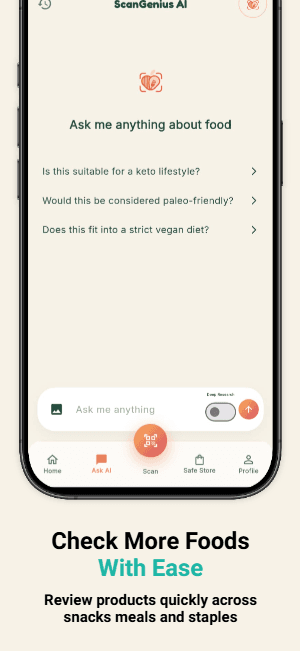
Instant Keto & Sugar Audit Trail
7. Frequently Asked Questions (FAQ)
Is mayo keto friendly in general?
Classic mayonnaise made from oil, egg yolks, vinegar or lemon juice, and salt is generally keto friendly. It usually has about 0 to 1 gram of carbs per tablespoon and is high in fat. What makes a jar unsuitable is usually what has been added: sugar, corn syrup, modified starches, or thickeners in ‘light,’ ‘dressing,’ or flavored versions. Scanning the barcode with Food Scan Genius shows the full ingredient breakdown so you can confirm which jars fit your plan.
Does ‘zero carbs’ on a mayo label really mean zero?
Not always. Labeling rules let manufacturers round amounts below 0.5 grams per serving down to zero, and the serving size is usually one tablespoon. If you use several tablespoons in a salad or sauce, hidden carbs can add up. Reading the ingredient list for sugar, dextrose, starch, or maltodextrin gives a clearer picture, and Food Scan Genius flags those ingredients automatically through its NutriGraph ingredient analysis.
Is avocado oil mayo better for keto than regular mayo?
It can be, but only if the jar is made mostly with avocado oil. Many avocado oil mayos blend it with soybean or canola oil, and ingredients are listed by weight, so the first oil named is the main one. Carb-wise, both types can fit keto. If you prefer to avoid seed oils, you can create a custom sensitivity in Food Scan Genius and every scan will tell you whether a jar contains them. The ScanGenius AI Insight adds context without declaring any food simply ‘good’ or ‘bad.’
Can I check mayo for my whole family, including egg allergies or other diets, in one scan?
Yes. Food Scan Genius supports multi-household family profiles, so you can screen a product against everyone at once. The result names who it fails for, such as ‘Fails for Sri (Gluten),’ so the keto eater, the person with an egg allergy, and anyone with another dietary need are all covered in a single two-second scan. Egg is a major allergen that must be declared in plain language under FALCPA, and the app helps you see that alongside your keto flags. The app is free and available in 11 languages.
Know What’s In Your Food Before You Buy — Scan Free Today
Never second-guess confusing grocery labels again. Download Food Scan Genius to uncover hidden additives, toxic dyes, and allergens for the whole household before you buy.