You Searched for a “Dairy Free M&M.” Here’s the Warning You Didn’t Know You Needed.
Let’s be direct. You’re here because you want the nostalgic, crunchy, chocolatey satisfaction of an M&M, but without the dairy. It’s a simple, valid search. But this simple search is the entry point to one of the biggest and most frustrating traps for anyone committed to a plant-based or vegan lifestyle: the dangerous gap between “dairy-free” and “truly vegan.”
The label “dairy-free” only tells you one thing: the product does not contain milk from a cow. It tells you nothing about the dozens of other animal-derived ingredients that are routinely hidden in processed foods, especially candy. It doesn’t tell you if the sugar was filtered through animal bones, if the shiny coating comes from insects, or if the food coloring was derived from crushed bugs.
You came here for a simple answer, but the food industry is anything but simple. Your search for a dairy free m&m has uncovered a much more critical question: are you unknowingly consuming hidden animal products? Before you buy that bag of colorful chocolate gems, you need to understand what’s really going on behind the label.
The Test Case: Are Unreal Dark Chocolate Crispy Quinoa Gems Vegan?
To make this real, let’s stop talking in hypotheticals. We’ll analyze a popular alternative you’ll find in the aisle right now: Unreal Dark Chocolate Crispy Quinoa Gems. They are explicitly marketed as dairy-free and are a common choice for people looking for an M&M substitute. Let’s look at the ingredient list you’d see on the back of the pack.
Simulated Ingredient List:
- Dark Chocolate (Chocolate Liquor, Cane Sugar, Cocoa Butter, Vanilla)
- Organic Crispy Quinoa
- Gum Acacia
- Colored with (Beetroot Juice, Spirulina Extract)
- Organic Tapioca Syrup
- Carnauba Wax
On the surface, this looks great. No milk, no whey, no casein. You might be tempted to toss it in your cart and call it a win. But this is exactly where the doubt needs to creep in. A committed vegan knows the devil is in the details—the sourcing, the processing, the things the label *doesn’t* say. Let’s break it down like our app does, ingredient by ingredient.
Ingredient Analysis: The Hidden Threats
This is where a simple visual check fails and a deep analysis is required. Seemingly innocent ingredients can be processed using animal products, making the final product unsuitable for a vegan diet. Here’s the breakdown of potential red flags in this “dairy-free” product.
| Ingredient | Potential Vegan Conflict | Why It’s a Problem |
| Cane Sugar | Bone Char Filtration | A significant portion of non-organic refined cane sugar in the United States is processed using “bone char”—charred cattle bones—to decolorize and purify the sugar. While the bone char isn’t in the final product, the sugar has made direct contact with an animal product, rendering it non-vegan for ethical and dietary vegans. Brands rarely disclose their sugar source on the label. |
| Colored with… | Carmine / Cochineal | While this specific product uses beetroot and spirulina (which are vegan), many similar candies use “carmine” or “cochineal extract” for red coloring. This is a dye made from crushed female cochineal insects. It’s a stark reminder that “natural color” is not a guarantee of being plant-based. You must always verify the specific source. |
| Carnauba Wax | Confectioner’s Glaze / Shellac | Carnauba wax itself is a plant-based wax from a palm tree and is vegan. However, it is often used alongside or confused with “confectioner’s glaze,” which is another name for shellac. Shellac is a resin secreted by the female lac bug. It’s an animal product. Without explicit confirmation, there can be ambiguity in the shiny coatings of candies. |
| (Not Listed) Cross-Contamination | Shared Equipment | The product might be made on the same manufacturing lines as milk chocolate products. For those with severe dairy allergies or strict ethical vegans who avoid any trace contact, this is a critical piece of information that is often buried in a “may contain” statement or not listed at all. |
The Mock Scan Verdict: What Food Scan Genius Says
After analyzing the potential pitfalls within these ingredients, especially the ambiguity of the sugar sourcing which is rarely confirmed on the package, here is our definitive verdict.
⚠️ Caution (Possible cross-contamination or ambiguous sourcing)
The Bottom Line: While the listed ingredients appear to be plant-based, the use of non-organic “Cane Sugar” presents a significant risk of bone char filtration. Without direct confirmation from the manufacturer on their sugar sourcing (which is information you will almost never have in the grocery aisle), we cannot give this a full ✅ Vegan Safe rating. A quick scan with Food Scan Genius would cross-reference the UPC with our database of manufacturer statements and sourcing policies to give you a definitive yes or no.
Yuka Gives a Score. Food Scan Genius Gives a Decision.
You might have an app like Yuka. It will scan this product and tell you it’s “Good” because the sugar content isn’t excessive. That’s useless. Yuka’s generic health score completely misses the point. It doesn’t know you’re vegan. Food Scan Genius gives you a personalized yes/no decision on hidden animal products.
The Constant Anxiety of the Vegan Shopper: A War Fought in the Aisles
The analysis above isn’t just about one brand of dairy free m&m animal products. It’s a window into the daily, exhausting reality of being a conscientious vegan consumer. It’s a mental burden that non-vegans simply don’t experience. Every trip to the grocery store becomes a high-stakes research project. You’re not just a shopper; you’re a food detective, an ingredient analyst, and a supply chain investigator.
The Psychological Toll of Label Reading
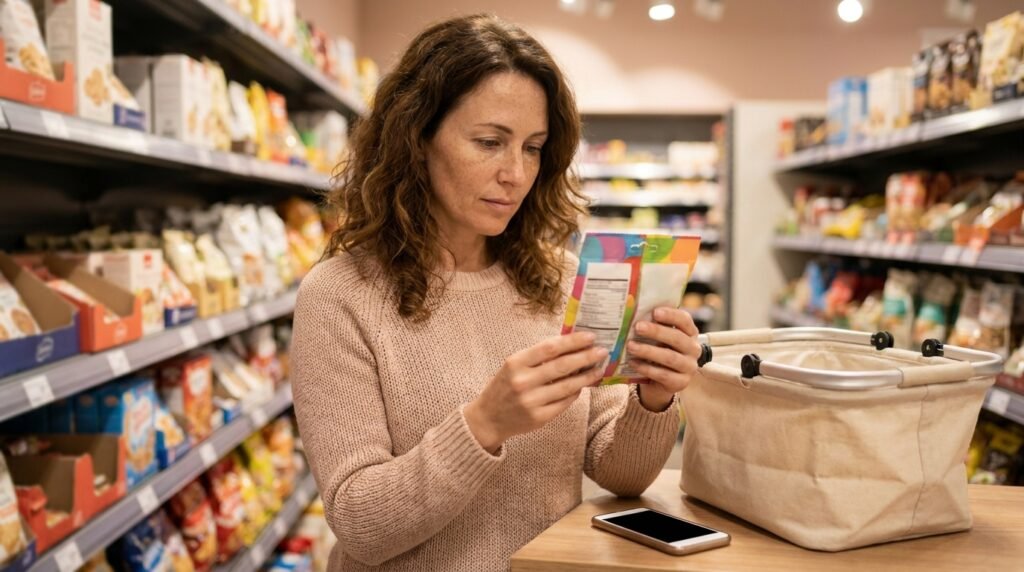
Think about the process. You pick up a package. Your eyes immediately scan for the “Certified Vegan” logo. If it’s not there, the interrogation begins. You flip it over. Your eyes dart past the marketing copy to the tiny, dense block of text that is the ingredient list. You’re not just reading; you’re deciphering.
You’re looking for the obvious culprits first: milk, eggs, whey, casein. Then you move to the second tier of suspects: gelatin, honey, collagen. But the real stress comes from the third tier—the insidious, hidden, and vaguely named ingredients that require a PhD in food science to understand. This is where the anxiety truly lives.
The “Natural Flavors” Black Box
What is a “natural flavor?” According to the FDA, it can be anything derived from a spice, fruit, vegetable, yeast, herb, bark, bud, root, leaf, or… meat, seafood, poultry, eggs, or dairy products. That’s right. The “natural flavor” in your seemingly vegan potato chips could be derived from beef or chicken broth. The vanilla or raspberry flavor could come from castoreum, a secretion from the anal glands of beavers. It’s a black box designed to obscure, and it’s on thousands of products. You can’t know what’s inside without a tool that has already done the research for you.
The Sugar Deception: How Bone Char Infects Your Pantry
We touched on this with the candy, but the problem is far more pervasive. The majority of refined white and brown sugar in North America is not vegan. The bone char filtration process is standard practice for major sugar suppliers. This means any product containing conventional refined sugar is suspect. This isn’t just about candy. We’re talking about:
- Breads and Baked Goods: That loaf of sandwich bread? Likely made with non-vegan sugar.
- Cereals: Most mainstream breakfast cereals, even the “healthy” ones, use bone char-filtered sugar.
- Condiments: Ketchup, BBQ sauce, salad dressings. All are typically loaded with it.
- Plant-Based Milks: Many sweetened almond, soy, or oat milks use conventional sugar.
Trying to track this on your own is a nightmare. It requires contacting every single company for every single product to ask about their sugar supplier’s filtration methods. It’s an impossible task for one person.
The Shiny Candy Lie: Shellac and Carmine
The candy aisle is a minefield. That beautiful, glossy sheen on jelly beans, candy corn, or our dairy free m&m substitute? It’s often “confectioner’s glaze,” the industry-friendly term for shellac. It is an insect secretion, scraped from trees. It is, unequivocally, an animal product. Likewise, that vibrant red in a fruit snack or yogurt? It could very well be carmine, made from thousands of crushed female insects for every pound of dye. These are not fringe ingredients; they are commonplace. Understanding these hidden ingredients is a core part of maintaining a truly vegan lifestyle, as we detail in our complete Vegan Diet Guide. Without this knowledge, you are navigating blind.
Beyond the Label: Isinglass in Your Beer and Gelatin in Your Juice
The problem extends beyond solid foods. Many alcoholic beverages and juices use animal products in a way that never has to be listed on the label. This is called the “fining” process, where agents are used to clarify the liquid and remove impurities.
- Isinglass: A type of collagen derived from the dried swim bladders of fish. It is widely used to clarify cask ales and some white wines.
- Gelatin: Derived from the skin, bones, and connective tissues of cows and pigs. It’s used to clarify many red wines and some fruit juices, including apple juice.
- Casein: A milk protein used as a fining agent in some wines.
- Egg Whites (Albumen): Another common fining agent, especially in winemaking.
These substances are filtered out, but trace amounts can remain, and more importantly, the product was produced using direct contact with animal parts. For a vegan, this makes the product unacceptable. And yet, you will almost never see “fish bladder” listed on a bottle of beer.
Food Scan Genius: Your Equalizer
This is the reality. This is the constant, low-grade stress of trying to do the right thing in a food system that is not built for you. It’s the doubt, the second-guessing, the time spent Googling ingredients in the middle of a crowded supermarket.
This is why Food Scan Genius exists. We have done the work for you. We have built the database. We contact the manufacturers. We track the sugar sources, the natural flavor components, the fining agents, and the hidden derivatives. We turn hours of stressful research into a one-second scan.
We give you back your time. We give you back your peace of mind. We eliminate the doubt. We take the entire psychological burden of being a food detective off your shoulders and place it onto our technology. Your only job is to scan.
Stop Guessing. Start Scanning.
You came here looking for a simple candy. You found a complex problem. The truth is, you can’t trust the front of the package. You can’t even fully trust the ingredient list on the back. The only way to know for sure if that dairy free m&m—or anything else in your cart—is truly vegan is to have a personalized food decision engine in your pocket.
Don’t stand in the aisle wondering if your sugar was filtered through bones. Don’t guess if that shiny coating came from a plant or an insect. Know.
Download Food Scan Genius from the App Store or Google Play. Scan the barcode on that bag of candy. Get a definitive, personalized, yes/no answer in less than a second.
Scan any product in two seconds
Check allergens, additives and 39 diets before you buy. Free on both stores.


Every scan is answered by NutriGraphAPI, our own catalogue of over 5 million barcode-indexed packaged products with allergen, additive and dietary data. Building a food or grocery app yourself? The same data is available as an API.
Related guides