
1. Why Finding Keto Friendly Chocolate Is Harder Than It Should Be in 2026
You have been disciplined all week. You kept your carbs low, you are finally feeling steady, and then you want something chocolatey. You pick up a bar with a bold ‘Keto’ banner, and the back panel tells a different story: maltitol syrup, chicory root fiber, milk solids, and a ‘net carbs’ number you cannot trace to anything official. If that frustrates you, you are not being picky. The front of the package and the back of the package often disagree with each other.
The core problem is that ‘keto’ is a marketing term, not a regulated one. There is no legal definition of keto friendly chocolate. A bar can carry the word with 4 g of net carbs per serving based on the brand’s own math, while a standard-size portion in a real snack session pushes you well past your daily budget. Serving sizes are also small. A ‘serving’ is sometimes just a few squares, which makes the per-serving numbers look better than the bar you are actually going to eat.
There is a clinical side too. People follow ketogenic eating patterns for many reasons, including epilepsy management under medical supervision, type 2 diabetes, and weight goals, and for some of them a hidden 10 g of digestible carbohydrate is a real problem, not a minor slip. Sweeteners also behave differently from person to person. Some sugar alcohols cause bloating and laxative effects in many people. Others raise blood glucose more than the label implies. This is general information, not medical advice, so talk with your clinician about your own targets.
Chocolate is also a processed food category, and the ‘keto’ versions tend to add more engineered ingredients: bulking fibers, emulsifiers, flavor systems, and sugar substitutes. Large reviews of ultra-processed eating, such as this PubMed Research on Ultra-Processed Foods & Gut Microbiome Disruption, are a reminder that how heavily a food is processed matters alongside its macros. The World Health Organization Guidelines on Healthy Diets & Saturated Fats are another useful reference, since cocoa butter, palm fractions, and coconut oil can add up quickly if chocolate becomes a daily habit on a high-fat plan.
Scan Any Label for Hidden Additives and Allergens — Free
Never second-guess confusing grocery labels again. Download Food Scan Genius to uncover hidden additives, toxic dyes, and allergens for the whole household before you buy.


2. Sneaky Ingredients and Label Loopholes in Keto Friendly Chocolate
Before the shopping ideas, it helps to know how a bar that looks perfect can fail. Here are the label traps we see most often, and why each one matters.
- Maltitol and ‘sugar-free’ syrups: Maltitol is a sugar alcohol that is partly digested and can raise blood glucose far more than erythritol or allulose. It is also a frequent cause of digestive upset. If a bar lists maltitol or ‘maltitol syrup’ high in the ingredient list, treat the ‘net carbs’ claim with skepticism.
- Self-defined ‘net carbs’: Net carbs are not an FDA-defined term. Brands subtract fiber and sugar alcohols using their own assumptions, and those assumptions are not equally valid for every ingredient. Check total carbohydrate, fiber, and sugar alcohol grams separately.
- Soluble fibers that are not always ‘free’: Inulin, chicory root fiber, polydextrose, and some isomalto-oligosaccharides are used to add bulk and sweetness. They can ferment in the gut and cause gas, and some products in this family contribute more digestible carbohydrate than the subtraction suggests.
- Hidden sugars in ‘dark’ chocolate: A high cacao percentage does not mean low sugar. Cane sugar, coconut sugar, date paste, honey powder, and fruit concentrates all appear in bars marketed as ‘clean’. Look for added sugar in grams and scan the ingredient order.
- Allergen and cross-contact language: Under the FDA Food Allergen Labeling & Consumer Protection Act (FALCPA), major allergens such as milk, soy, tree nuts, and peanuts must be declared. ‘May contain’ statements, however, are voluntary. Soy lecithin and milk fat show up in many chocolates, so anyone avoiding dairy or soy needs to read beyond the front panel.
- Additives that vary by region: Emulsifiers, flavors, and sweeteners are evaluated differently in different markets. The European Food Safety Authority (EFSA) Additive Safety Regulations are one example of a framework that can differ from US practice, which is useful context if you shop imported chocolate.
A few other points deserve a quick mention. Erythritol has drawn research attention in recent years, including observational and small mechanistic studies exploring a possible cardiovascular link, and the science is still developing. If you consume it often, it is a reasonable topic for your clinician. Dark chocolate can also contain trace heavy metals such as cadmium and lead, so variety across brands beats eating one bar every day.
With those traps in mind, here are the types of products that tend to fit a keto approach best. Formulas change, so treat these as starting points to verify rather than guarantees:
- Unsweetened baking chocolate and cacao nibs: The simplest ingredient lists, and the base for homemade keto treats.
- High-cacao dark bars (85% to 90% and up): Examples include Lindt Excellence 90% and similar bars. Sugar is low per square, though not zero, so portion size matters.
- Stevia- or erythritol-sweetened bars: Brands such as Lily’s and ChocZero build their lines around this approach. Check each flavor, because the sweetener blend and any added fibers differ.
- Allulose-sweetened options: A newer category that some people tolerate better than sugar alcohols. Check labeling, since allulose is treated differently in carbohydrate math.
3. Food Scan Genius vs. Other Ways to Vet Keto Friendly Chocolate
| Dimension | Food Scan Genius | Manual Label Reading | Fig | Spoonful |
|---|---|---|---|---|
| Cost | 100% free core features, zero paywalls | Free, but costs time | $59/yr | Limited scans |
| Database and parsing | NutriGraph: 5,000,000+ verified UPC/EAN barcodes with recursive sub-ingredient parsing | Depends on your own knowledge of ingredient names | Proprietary database | Proprietary database |
| Diet customization | 39 dietary profiles plus custom sensitivities (e.g. maltitol, seed oils, specific dyes) | Fully manual | Focused on its own profile set | Focused on its own profile set |
| Family screening | Multi-household profiles with named fail attribution in one scan | One person at a time | Varies by plan | Varies by plan |
| Context and languages | ScanGenius AI Insight, NOVA 1-4, Nutri-Score, 11 languages with real-time translation | Limited to what the label shows, in the label’s language | Check current feature list | Check current feature list |
Keto chocolate is a good test of an ingredient scanner because the important details sit deep in the ingredient list. A ‘chocolate flavored coating’ or ‘sugar-free filling’ may contain several sub-ingredients, each with its own sweetener or fiber. Food Scan Genius reads these through the NutriGraph Database, which holds more than 5 million verified UPC/EAN barcodes and uses recursive sub-ingredient parsing to look inside compound ingredients rather than stopping at the first line. You can also add a custom sensitivity, such as maltitol, inulin, soy lecithin, or a particular dye, and have every scan checked against it automatically.
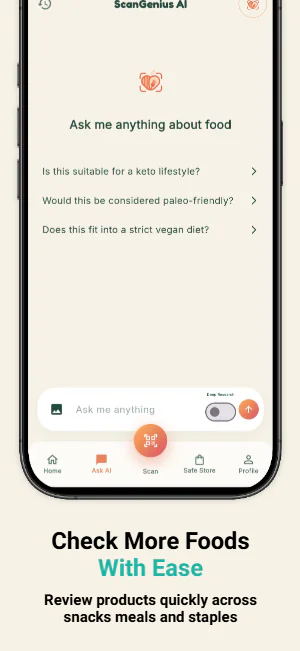
Scores that label food simply ‘good’ or ‘bad’ do not help much when you are deciding whether a 90% bar is a better pick than a stevia-sweetened one. ScanGenius AI Insight gives nuanced context instead: what a sweetener is, why it might matter for your profile, and how it sits next to the NOVA 1-4 processing classification and the Nutri-Score. It does not moralize. If you shop for a household, Multi-Household Family Profiles screen everyone at once and say exactly who is affected, for example ‘Fails for Sri (Gluten)’, and real-time translation across 11 languages helps with imported chocolate whose label is not in your first language.
4. Related Food Safety & Dietary Guides
- Best Food Allergy Scanner App – Scan Food Labels Instantly — Food Allergy & Sensitivity Scanner Hub
- The 7 Best Free Food Scanner Apps of 2026 — best free food scanner apps
- Choosing the Best Barcode Scan App for Your Health — guide to choosing a barcode scanner app
- Food Scan Genius: World’s #1 Food Ingredient Scanner App — Food Scan Genius scanner app
5. Scientific & Health Authority References
- FDA Food Allergen Labeling & Consumer Protection Act (FALCPA)
- European Food Safety Authority (EFSA) Additive Safety Regulations
- PubMed Research on Ultra-Processed Foods & Gut Microbiome Disruption
- World Health Organization Guidelines on Healthy Diets & Saturated Fats
6. How to Scan in 3 Simple Steps
- Download Food Scan Genius free on iOS or Android. The core features have no paywall and no scan cap, so you can check every chocolate bar in the aisle.
- Set up your profile for keto friendly chocolate. Choose from the 39 dietary profiles, then add custom sensitivities such as maltitol, inulin, soy lecithin, seed oils, or any dye or additive you want to avoid. Add family members if you shop for more than one person.
- Scan the barcode, which takes about 2 seconds. You get an instant audit trail showing which ingredients passed or failed, who in your household is affected, plus ScanGenius AI Insight, NOVA 1-4 classification, and Nutri-Score for context.
Instant Keto & Sugar Audit Trail
7. Frequently Asked Questions (FAQ)
What makes a chocolate truly keto friendly?
There is no legal definition, so it comes down to your own carbohydrate target. Look for low total sugar, a short ingredient list, and sweeteners you tolerate well, such as stevia, monk fruit, erythritol, or allulose. Check total carbohydrate, fiber, and sugar alcohol grams rather than relying on a front-of-pack ‘net carbs’ claim. Food Scan Genius breaks down every ingredient and flags the ones on your profile when you scan the barcode.
Is 90% dark chocolate automatically keto friendly?
Not automatically. A high cacao percentage lowers sugar compared with milk chocolate, but a bar still contains some sugar and carbohydrate from cocoa solids, and a few squares can add up. Some ‘dark’ bars also contain coconut sugar, honey, or milk ingredients. Scanning a bar with Food Scan Genius shows the full ingredient breakdown so you can judge the serving against your own daily limit.
Are sugar alcohols like maltitol and erythritol safe on keto?
They behave very differently. Maltitol is partly absorbed, can raise blood glucose more than people expect, and often causes digestive discomfort. Erythritol has a minimal glycemic effect but has been the subject of ongoing research, including studies on a possible cardiovascular association, so it is worth discussing with your clinician if you eat it often. You can add either as a custom sensitivity in Food Scan Genius so every chocolate scan flags it.
Can Food Scan Genius help if my family has different dietary needs?
Yes. Multi-Household Family Profiles let you screen the whole family in one scan, with named results such as ‘Fails for Sri (Gluten)’. That is useful when one person follows keto and another avoids dairy, soy, or nuts, all of which are common in chocolate. The app supports 39 dietary profiles and 11 languages with real-time translation, and the core features are free.
Know What’s In Your Food Before You Buy — Scan Free Today
Never second-guess confusing grocery labels again. Download Food Scan Genius to uncover hidden additives, toxic dyes, and allergens for the whole household before you buy.