1. Why Finding Truly Keto Friendly Tortillas Is So Frustrating in 2026
You open the refrigerated aisle, and the packages all promise the same thing: low carb, keto, zero guilt. You flip one over, and the ingredient list reads like a chemistry exam. If you have ever stood there for ten minutes, phone in hand, trying to work out whether a tortilla will keep you in ketosis, you are not being picky. You are responding sensibly to a category where marketing runs far ahead of regulation.
The core problem is that a tortilla is traditionally a carbohydrate delivery vehicle. Making one that fits a ketogenic pattern, usually somewhere between 20 and 50 grams of total carbohydrate per day, means swapping out most of the flour. Manufacturers do it with wheat gluten, isolated fibers, nut flours, egg whites, cheese, or cauliflower. Each swap changes the texture, the allergen profile, and how much processing the product has gone through. The result can be a tortilla that is excellent for one shopper and a poor choice for another, even when both are “keto.”
There is also a health context worth stating plainly. Many people reach for these products because of type 2 diabetes, prediabetes, PCOS, epilepsy management under medical supervision, or weight goals. For them, a mislabeled carb count is more than an annoyance, because it changes glucose readings and treatment plans. At the same time, a growing body of PubMed Research on Ultra-Processed Foods & Gut Microbiome Disruption suggests that heavily formulated foods may affect the gut ecosystem in ways we are still learning about. Low carb does not automatically mean minimally processed, and many keto tortillas sit firmly in the ultra-processed category.
Official guidance adds another layer. The World Health Organization Guidelines on Healthy Diets & Saturated Fats encourage attention to fat quality and to overall dietary patterns rather than a single macronutrient. A tortilla made with cheese and palm oil is not the same as one built on egg whites or almond flour, even if the carb numbers look alike. Our goal here is to help you shop with confidence, not fear. Keto friendly tortillas do exist, and you can find good ones once you know what to look for.
Scan Any Label for Hidden Additives and Allergens — Free
Never second-guess confusing grocery labels again. Download Food Scan Genius to uncover hidden additives, toxic dyes, and allergens for the whole household before you buy.


2. Sneaky Ingredients and Label Loopholes Hiding in Keto Tortillas
The words “keto,” “low carb,” and “net carbs” are not defined by the U.S. FDA for food labeling. That leaves room for creative math. Here are the most common issues we see when auditing tortilla labels, along with the regulatory context that explains why they slip through.
- Self-defined “net carbs”: Net carbs are typically calculated as total carbohydrate minus fiber (and sometimes minus sugar alcohols). Because the number is not standardized, the front-of-pack claim may subtract fibers that your body partly digests. Always start from total carbohydrate and fiber on the Nutrition Facts panel, then decide how you personally count.
- Questionable fiber sources: Isolated fibers such as isomaltooligosaccharides (IMO), modified wheat starch, and some resistant starches can behave differently from intact fiber in your blood glucose response. Oat fiber, cellulose, and resistant wheat starch tend to be better tolerated for glucose, but they can cause bloating in some people, especially at the amounts these tortillas contain.
- Vital wheat gluten as the structural backbone: Many of the most pliable low-carb tortillas rely on wheat protein to mimic the stretch of flour. That is fine for some keto eaters but a hard stop for anyone with celiac disease or wheat allergy. Under the FDA Food Allergen Labeling & Consumer Protection Act (FALCPA), wheat must be declared, but “keto” or “low carb” in large type can distract from the allergen statement below the ingredient list.
- Seed and refined oils: To keep tortillas soft without sugar, manufacturers often add soybean, canola, or palm oil. If you avoid seed oils for personal or clinical reasons, a tortilla can be low in carbs and still contain exactly what you are trying to skip.
- Preservative and dough conditioner stacks: Shelf-stable tortillas often combine calcium propionate, sorbic acid, fumaric acid, cellulose gum, and enzymes. Many are permitted and well studied, and additive review frameworks like the European Food Safety Authority (EFSA) Additive Safety Regulations reassess them periodically. Still, approval rules differ between regions, and some shoppers prefer shorter ingredient lists.
- Hidden allergens in “clean” alternatives: Grain-free options may use almond flour, egg, dairy, soy, or sesame. A cauliflower tortilla may contain cheese or starches in addition to vegetables. “Grain-free” does not mean “allergen-free.”
None of these ingredients is automatically a villain. The point is that a single checkmark or green score cannot capture what matters to you, which is why a layered ingredient review beats a headline claim every time.
A Quick Look at Popular Types (Verify Each Formulation)
Recipes change often, so treat this as a starting point and confirm on the current package. Wheat-based low-carb tortillas (for example, Mission Carb Balance or La Tortilla Factory Low Carb Originals) are widely available and flexible, but they contain wheat and often added fibers. Flax and bran lavash-style wraps (such as Joseph’s) are another wheat-containing, higher-fiber option. Egg white wraps (such as Egglife) are very low in carbohydrate and grain-free, but they are an egg allergen and have a distinct texture. Almond flour tortillas (such as Siete’s grain-free line) avoid gluten but contain tree nuts and are not always as low in carbs as strict keto eaters expect. Cauliflower tortillas vary widely, so check the starch and cheese content. Compare each one using total carbs, fiber, protein, oil type, and allergens, not just the front label.
3. Head-to-Head: Scanning With Food Scan Genius vs. Traditional Label Checking
| Dimension | Food Scan Genius | Reading Labels Manually | Front-of-Pack “Keto” Claims | Generic Carb-Counting Apps |
|---|---|---|---|---|
| Ingredient depth | NutriGraph Database with 5M+ verified barcodes and recursive sub-ingredient parsing | Only what you can decode in the store aisle | None; a marketing claim | Usually macros only, often user-submitted |
| Personalization | 39 dietary profiles plus custom sensitivities (seed oils, dyes, additives) | Depends on your memory and time | One-size-fits-all | Limited to carb or calorie targets |
| Family screening | Multi-household profiles with named results such as “Fails for Sri (Gluten)” | Manual cross-checking for each person | Not applicable | Typically single-user |
| Context and processing | ScanGenius AI Insight, NOVA 1-4, and Nutri-Score | Requires your own research | No processing information | Rarely includes processing level |
| Cost and language | 100% free core features, no paywalls, 11 languages with real-time translation | Free, but slow and time-consuming | Free, but unreliable | Often subscription-gated features |
What sets Food Scan Genius apart for shoppers hunting keto friendly tortillas is how deeply it reads a product. The NutriGraph Database covers more than five million verified UPC and EAN barcodes, and its recursive parsing breaks compound ingredients into their sub-ingredients. A line like “seasoning blend” or “dough conditioner” stops being a black box. If a tortilla’s wheat protein, soybean oil, or a specific preservative is hiding inside a parent ingredient, it surfaces. You can build a profile from any of 39 dietary patterns and add your own custom sensitivity, such as seed oils, a particular dye, or an additive you prefer to avoid. And because the core features are completely free, with no paywall standing between you and a scan, the same level of detail is available to everyone, unlike subscription tools such as Fig at $59 a year or apps that cap your scans.
The ScanGenius AI Insight adds nuance rather than judgment. Instead of handing you a single moralizing number, it explains why a tortilla was flagged: for example, that it fits your carb target but contains wheat gluten that fails for one family member, or that it is NOVA 4 because of its isolated fibers and emulsifiers, while its Nutri-Score still reflects decent fiber and protein. You decide what matters. Multi-household family profiles let you screen everyone in one scan and see named results, and the app’s 11 languages with real-time in-app translation help multilingual households and travelers read labels they could not otherwise decode. It is a tool that informs your decision and does not replace your clinician’s advice.
4. Related Food Safety & Dietary Guides
- Best Food Allergy Scanner App – Scan Food Labels Instantly — Food Allergy & Sensitivity Scanner Hub
- The 7 Best Free Food Scanner Apps of 2026 — best free food scanner apps
- Choosing the Best Barcode Scan App for Your Health — guide to choosing a barcode scanner app
- Food Scan Genius: World’s #1 Food Ingredient Scanner App — Food Scan Genius scanner app
5. Scientific & Health Authority References
- FDA Food Allergen Labeling & Consumer Protection Act (FALCPA)
- European Food Safety Authority (EFSA) Additive Safety Regulations
- PubMed Research on Ultra-Processed Foods & Gut Microbiome Disruption
- World Health Organization Guidelines on Healthy Diets & Saturated Fats
6. How to Scan in 3 Simple Steps
- Download Food Scan Genius free on iOS or Android. There is no paywall on core features, and no scan limit stands between you and a full ingredient audit.
- Set up your profile for a ketogenic pattern. Choose the dietary profiles that apply to you, add any allergies or family members, and enter custom sensitivities such as seed oils, specific dyes, or additives you want flagged in tortillas.
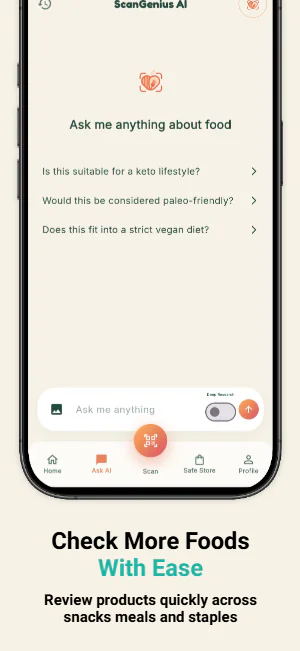
- Scan the tortilla barcode in about two seconds. Review the instant audit trail with sub-ingredient breakdown, named pass or fail results for each household member, NOVA classification, Nutri-Score, and the ScanGenius AI Insight explanation.
Instant Keto & Sugar Audit Trail
7. Frequently Asked Questions (FAQ)
What makes a tortilla truly keto friendly?
There is no official FDA definition of “keto,” so the label alone is not proof. In practice, keto friendly tortillas have low total carbohydrate per serving, meaningful fiber, adequate protein, and an ingredient list you are comfortable with. Most people on a ketogenic diet look for a net carb count in the low single digits per tortilla, but your personal target should come from your clinician or dietitian. Food Scan Genius reads the whole ingredient list, so you can see not just the carb numbers but also what fibers, oils, and additives produce them.
Are keto tortillas gluten-free?
Not necessarily. Many of the most popular low-carb tortillas use vital wheat gluten for structure, which makes them unsuitable for celiac disease or wheat allergy. Grain-free options made from almond flour, egg whites, or cauliflower may be gluten-free, but you should check for a gluten-free statement and cross-contact warnings. By adding a gluten-free or celiac profile in Food Scan Genius, any tortilla containing wheat is flagged immediately, and with family profiles you will see a named result such as “Fails for Sri (Gluten).”
Do net carbs on the package match what I should count?
Not always. Net carbs are generally total carbohydrate minus fiber and sometimes sugar alcohols, but the calculation is not regulated for front-of-pack claims, and some isolated fibers may affect blood glucose more than others. If you have diabetes or are managing glucose closely, ask your healthcare provider how to count them. Food Scan Genius shows the underlying ingredients, so you can spot fibers or starches that might make a manufacturer’s net carb figure optimistic.
Are keto friendly tortillas healthy or ultra-processed?
It depends on the product. Many low-carb tortillas are classified as NOVA 4 (ultra-processed) because they contain isolated fibers, emulsifiers, and preservatives, while a simple egg-based or nut-based wrap may be less processed. Ultra-processed does not automatically mean unsafe, but some research links high intake of ultra-processed foods with gut and metabolic concerns. ScanGenius AI Insight in Food Scan Genius shows the NOVA 1-4 group and Nutri-Score alongside plain-language context, so you can weigh convenience against ingredient quality without being lectured.
Know What’s In Your Food Before You Buy — Scan Free Today
Never second-guess confusing grocery labels again. Download Food Scan Genius to uncover hidden additives, toxic dyes, and allergens for the whole household before you buy.