
1. Why Choosing Keto Friendly Pasta Is So Frustrating in 2026
If you have ever stood in the pasta aisle holding a bright package that says ‘low carb,’ ‘keto,’ or ‘only 4g net carbs,’ you know how quickly hope turns into suspicion. Pasta is one of the foods people miss most when they cut carbohydrates, whether for weight management, type 2 diabetes, or a physician-guided ketogenic plan. Food companies know that, and the shelf is now crowded with products that borrow the language of keto without always meeting the standard behind it. Feeling tired of decoding all this is completely understandable.
The core problem is that ‘keto’ and ‘low carb’ are marketing phrases, not regulated nutrition claims. The FDA does not define ‘net carbs,’ so each brand can choose its own math. Subtract all fiber, subtract all sugar alcohols, subtract allulose, and a pasta that contains 30g of total carbohydrate can print a very small number on the front. Meanwhile your blood glucose, or your ketone readings, may tell a different story.
There is also a layer of clinical complexity. Many keto shoppers are also managing celiac disease, wheat allergy, soy sensitivity, IBS, or kidney concerns. A pasta built from wheat protein is low in carbohydrate but is not gluten-free. A soy-based noodle may be a good fit for keto and a poor one for a soy allergy. Under the FDA Food Allergen Labeling & Consumer Protection Act (FALCPA), major allergens such as wheat, soy, egg, and tree nuts must be declared. Other ingredients that bother your gut or your metabolism are not covered.
Many keto pastas also rely on heavy processing: isolated fibers, gums, protein concentrates, and stabilizers that mimic the chew of semolina. That does not make them ‘bad,’ and we will not moralize about it. Still, it is worth understanding the broader conversation, including PubMed Research on Ultra-Processed Foods & Gut Microbiome Disruption, so you can decide how often these products fit your own plan. Informed choice, not guilt, is the goal of this guide.
Scan Any Label for Hidden Additives and Allergens — Free
Never second-guess confusing grocery labels again. Download Food Scan Genius to uncover hidden additives, toxic dyes, and allergens for the whole household before you buy.


2. Six Label Tricks Hiding Inside Keto Friendly Pasta
Most keto pasta falls into a few categories: konjac (shirataki) noodles, hearts of palm noodles, soy or edamame-based pasta, lupin or protein-blend pasta, and wheat-protein pasta. Brands such as Palmini, Miracle Noodle, Explore Cuisine, and Kaizen sell versions of these, and formulas change often, so always check the current package. Here are the loopholes that matter most:
- Self-defined ‘net carbs.’ There is no FDA definition, so the front-of-pack number can subtract fiber, sugar alcohols, and allulose in any combination. Always compare it with total carbohydrate on the Nutrition Facts panel.
- Serving size games. Some labels list 2 oz (56g) dry or a small ‘as prepared’ portion, which is smaller than what a person actually eats. A bag with ‘only 5g net carbs’ may hold three servings, and a realistic bowl can triple the number.
- Isolated fibers doing heavy lifting. Oat fiber, resistant wheat starch, soluble corn fiber, and similar ingredients lower the carb math. Tolerance and glycemic response vary, and some fibers have been shown to be partly digestible, so your own glucose data matters more than the label.
- Vital wheat gluten and wheat protein. These give a ‘real pasta’ bite with few carbs, yet they are pure gluten. ‘Keto’ is never a synonym for gluten-free. FALCPA requires wheat to be declared, but the front panel may not call attention to it.
- Gums and processing aids in konjac and palm noodles. Ingredients such as calcium hydroxide, xanthan gum, cellulose gum, and carrageenan are common. Each additive is evaluated by regulators (see the European Food Safety Authority (EFSA) Additive Safety Regulations), but sensitive individuals may still want to track specific ones. Large amounts of glucomannan can also cause bloating in some people.
- Legume and lupin blends. Lupin is a recognized allergen in the EU and can cross-react in people with peanut allergy, yet it is not on the US major allergen list. Soy, pea protein, and ‘bean’ pastas can also push carbohydrate higher than the packaging implies.
One more consideration is fat quality. Some ‘keto’ pasta kits include sauces or cheese blends heavy in saturated fat or refined seed oils. The World Health Organization Guidelines on Healthy Diets & Saturated Fats offer helpful general context, though individual targets should be set with your clinician. The ingredient list, read all the way to the end and through every sub-ingredient, is where the real answers live.
3. Food Scan Genius vs. Other Ways to Vet Keto Pasta
| Dimension | Food Scan Genius | Fig | Spoonful | Manual Label Reading |
|---|---|---|---|---|
| Cost | 100% free core features, zero paywalls | About $59/yr for full access | Limited scans | Free, but slow |
| Ingredient depth | NutriGraph: 5M+ verified UPC/EAN barcodes with recursive sub-ingredient parsing | Ingredient-level screening | Ingredient-level screening | Easy to miss nested ingredients |
| Diet profiles & custom flags | 39 profiles plus custom sensitivities (seed oils, dyes, additives) | Varies by plan | Varies by plan | Depends on your memory |
| Family screening | Multi-household profiles, one scan, named fail attribution | Check current plan | Check current plan | Repeat the check for each person |
| Languages | 11 global languages with real-time in-app translation | Check current availability | Check current availability | Requires you to translate |
Keto pasta labels are a recursion problem. A package may list ‘protein blend,’ and inside that blend sits wheat gluten, pea protein isolate, and an enzyme carrier. Food Scan Genius is built on the NutriGraph Database, which uses recursive AST parsing to unpack those nested sub-ingredients rather than stopping at the first line. So the wheat protein tucked into a ‘keto’ noodle, or the soy lecithin behind a gum blend, is surfaced against your chosen profile. With 39 dietary profiles and an ‘Add Your Own Custom Sensitivity’ option, you can flag seed oils, specific dyes, or an additive such as carrageenan that you prefer to avoid.
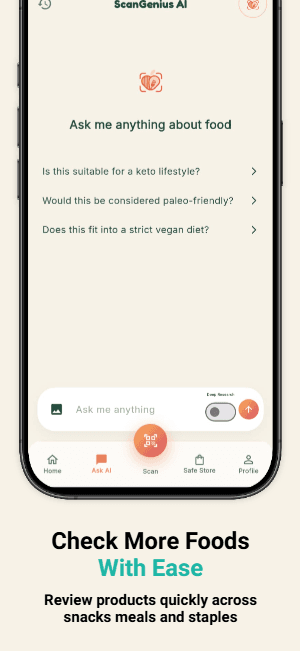
Then ScanGenius AI Insight adds context without a simplistic good-or-bad score. It explains, for example, that a shirataki noodle is a NOVA 3 or 4 product with minimal digestible carbohydrate, and that the Nutri-Score alone does not reflect keto fit. It shows the trade-offs and leaves the decision with you. For households with mixed needs, one scan can return results like ‘Fails for Sri (Gluten),’ so a keto parent, a celiac child, and a soy-allergic partner are all checked at once. Eleven languages with real-time in-app translation help anyone shopping with imported or multilingual packaging.
4. Related Food Safety & Dietary Guides
- Best Food Allergy Scanner App – Scan Food Labels Instantly — Food Allergy & Sensitivity Scanner Hub
- The 7 Best Free Food Scanner Apps of 2026 — best free food scanner apps
- Choosing the Best Barcode Scan App for Your Health — guide to choosing a barcode scanner app
- Food Scan Genius: World’s #1 Food Ingredient Scanner App — Food Scan Genius scanner app
5. Scientific & Health Authority References
- FDA Food Allergen Labeling & Consumer Protection Act (FALCPA)
- European Food Safety Authority (EFSA) Additive Safety Regulations
- PubMed Research on Ultra-Processed Foods & Gut Microbiome Disruption
- World Health Organization Guidelines on Healthy Diets & Saturated Fats
6. How to Scan in 3 Simple Steps
- Download Food Scan Genius free on iOS or Android. There are no paywalls on the core features, and no card is required.
- Set up your profile: choose a low-carb or keto-aligned dietary profile, add any allergies or conditions such as gluten or soy, and use ‘Add Your Own Custom Sensitivity’ to flag items like seed oils, carrageenan, or specific fibers. Add family members in Multi-Household Profiles if you shop for more than one person.
- Scan the pasta barcode in about 2 seconds. You will get an instant audit trail with sub-ingredient breakdown, named fail attribution, NOVA 1-4 classification, Nutri-Score, and ScanGenius AI Insight, so you can compare total carbs, serving size, and fillers before it reaches your cart.
Instant Keto & Sugar Audit Trail
7. Frequently Asked Questions (FAQ)
What is the best store-bought keto friendly pasta?
There is no single winner, because it depends on your goals and sensitivities. Konjac (shirataki) and hearts of palm noodles are usually the lowest in digestible carbohydrate, while soy or edamame pastas and wheat-protein pastas offer a firmer bite but differ in allergens and gluten. Formulas change, so scan the exact package with Food Scan Genius to see sub-ingredients, a NOVA classification, and whether it fits your profile before you buy.
How do I calculate real net carbs on keto friendly pasta?
Start with total carbohydrate on the Nutrition Facts panel and the serving size, then decide which fibers and sugar alcohols you personally subtract. The FDA has no official definition of net carbs, so brand claims vary. Check the ingredients for isolated fibers or resistant starches, and judge the number against your own glucose or ketone readings. Food Scan Genius shows the full ingredient breakdown so you can see what is behind the math.
Is keto friendly pasta gluten-free?
Not necessarily. Many low-carb pastas get their texture from vital wheat gluten or wheat protein, which is pure gluten. Under FALCPA, wheat must be declared, but the front of the package may not say so. If you have celiac disease or a wheat allergy, set a gluten profile in Food Scan Genius. Multi-Household Profiles will then show a named result such as ‘Fails for Sri (Gluten)’ for each family member.
Can Food Scan Genius check keto pasta for additives like gums or seed oils?
Yes. The NutriGraph Database covers 5,000,000+ verified UPC/EAN barcodes with recursive sub-ingredient parsing, and the Custom Sensitivity feature lets you flag specific additives, dyes, or seed oils on top of 39 built-in dietary profiles. ScanGenius AI Insight adds balanced context, including NOVA 1-4 and Nutri-Score, so you understand what an ingredient is and why it is there. The app is free, in 11 languages, with no paywall on core scanning.
Know What’s In Your Food Before You Buy — Scan Free Today
Never second-guess confusing grocery labels again. Download Food Scan Genius to uncover hidden additives, toxic dyes, and allergens for the whole household before you buy.