1. Navigating Kashrut Integrity in 2026: The Growing Complexity of Modern Ultra-Processed Foods
Maintaining a strictly kosher (Kashrut) diet in today’s global marketplace is both a sacred commitment and a complex logistical challenge. Whether you observe strict rabbinic supervision (Hechshers) for religious devotion, or choose kosher-certified foods for health, cleanliness, and ethical transparency, grocery shopping requires constant vigilance. For generations, kosher consumers relied on familiar front-of-pack emblems—such as the OU, OK, Star-K, or KOF-K—or printed paper booklets published by local rabbinical councils. However, as global food manufacturing has shifted toward complex ultra-processed formulations, manual ingredient checking has become increasingly prone to human error.
Modern food science frequently utilizes multi-tiered ingredient supply chains, obscure chemical derivatives, and imported processing aids. A packaged snack that appears entirely plant-based on its primary panel can harbor uncertified animal-derived clarifying agents, hidden emulsifiers, or cross-contaminated dairy derivatives. Even under regulatory standards like the FDA Food Allergen Labeling & Consumer Protection Act (FALCPA), food manufacturers are only mandated to explicitly call out major food allergens (such as milk, eggs, peanuts, and crustaceans). Critical kosher compliance factors—such as non-kosher beef or pork gelatin, insect-derived colorings, or meat-and-dairy equipment cross-contact—frequently fall outside standard regulatory allergen warnings.
International trade compounds this difficulty. European imports and specialty goods utilize differing ingredient naming conventions, E-number systems, and labeling loopholes regulated under the European Food Safety Authority (EFSA) Additive Safety Regulations. An ingredient considered harmless in one country might contain uncertified porcine enzymes or non-kosher tallow derivatives in another. Relying purely on visual inspection while standing in a busy supermarket aisle leads to shopper fatigue, anxiety, and inadvertent dietary breaches.
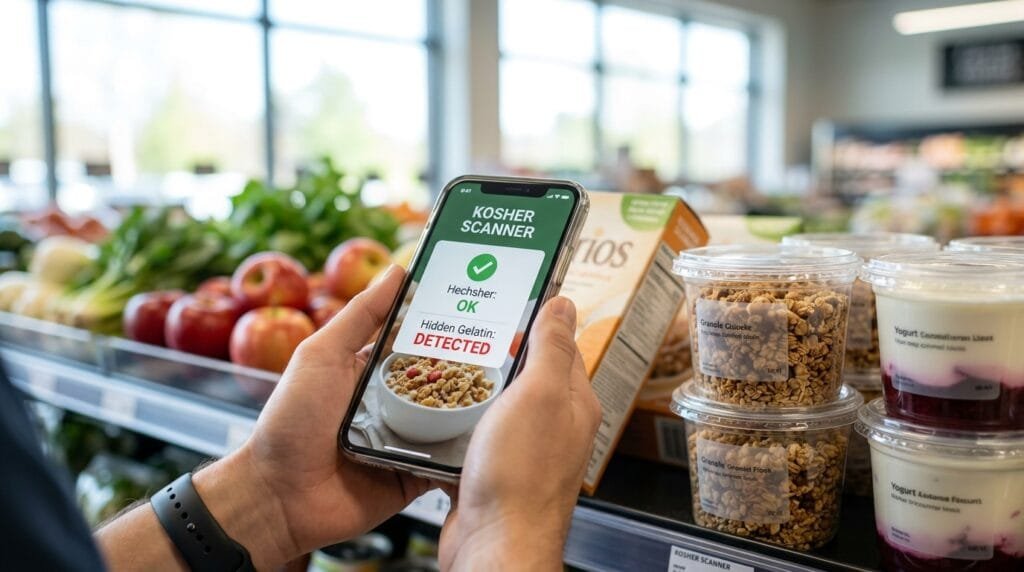
To safeguard Kashrut integrity without spending hours researching individual chemical compounds, modern shoppers require digital precision. A dedicated, highly intelligent kosher food scanner app bridge the gap between complex industrial supply chains and religious dietary rules, instant-auditing thousands of sub-ingredients in a single tap.
Scan Any Food for Kosher Food Scanner App in 2 Seconds Free
Never second-guess confusing grocery labels again. Download Food Scan Genius to uncover hidden additives, toxic dyes, and allergens for the whole household before you buy.


2. Deceptive Labeling & Hidden Non-Kosher Ingredients: What Your Eyes Miss
The primary hazard for kosher shoppers is not the obvious non-kosher item, but rather the silent micro-ingredient hidden inside benign-looking processed foods. Emerging PubMed Research on Ultra-Processed Foods & Gut Microbiome Disruption demonstrates how heavily industrial processing isolates proteins, fatty acids, and colorants into microscopic additives. Without advanced technology, identifying the raw biological origins of these isolates is nearly impossible.
When utilizing a high-performance kosher food scanner app, shoppers gain visibility into deceptive labeling practices and regulatory loopholes that conceal non-kosher elements. Below are the six most common hidden Kashrut traps found in everyday packaged foods:
- Non-Kosher Gelatin (Collagen Hydrolysates): Widely used as a gelling agent in yogurts, fruit snacks, marshmallows, and capsule coatings. Unless explicitly certified by a recognized rabbinical board, commercially processed gelatin is overwhelmingly derived from non-kosher slaughtered cattle hides or porcine (pig) skin.
- Mono- and Diglycerides (E471): Common emulsifiers added to baked goods, peanut butters, and ice creams to prolong shelf-life. These fatty acids can be derived from either vegetable oils or non-kosher animal fats (tallow/lard), yet standard labels rarely distinguish the origin source.
- Carmine / Cochineal (E120): A vibrant red natural food dye harvested from crushed female scale insects (Dactylopius coccus). Under Jewish law, insect consumption is strictly prohibited, rendering products with carmine non-kosher regardless of other organic or natural claims.
- Hidden Dairy Derivatives in “Pareve” Products: Casein, caseinate, whey, and lactose are frequently added as binders or flavor enhancers in potato chips, crackers, and margarine. A subtle presence of dairy invalidates a product’s Pareve (neutral) status, which directly impacts consumers adhering to World Health Organization Guidelines on Healthy Diets & Saturated Fats who balance milk and meat meal timings.
- Shellac / Confectioner’s Glaze (E904): A resinous secretion from the Kerria lacca insect used to impart a shiny glaze to candies, shiny apples, and pharmaceutical pills. Its kosher status requires rigorous rabbinic review and exact extraction process verification.
- Uncertified Wine Vinegar & Tartaric Acid: Derivatives of grape processing (Stam Yainam) require strict kosher oversight from pressing to bottling. Non-kosher wine vinegar, tartaric acid, or grape juice concentrate present in salad dressings, barbecue sauces, or fruit juices immediately render the entire product non-kosher.
3. Food Scan Genius vs. Competitors: A Superior Technological Advantage
| Feature / Capability | Food Scan Genius | Fig App | Spoonful | Manual Label Reading |
|---|---|---|---|---|
| Core Pricing | 100% Free Core (No Paywall) | $59.99/yr Paywall | Limited Free Scans | Free (Time Costly) |
| Database Size & Parsing | NutriGraph (5M+ Barcodes) + AST Parsing | Limited Database | Moderate Database | N/A (Human Sight) |
| Deep Sub-Ingredient Parsing | Recursive Sub-AST Extraction | Basic String Match | Basic String Match | Impossible (Hidden) |
| Multi-Household Profiles | Yes (“Fails for David: Non-Kosher Gelatin”) | Single Profile Only | Single Profile Only | Manual Coordination |
| Global Language Support | 11 Languages + Real-Time Translation | English Only | English Only | Requires Dictionary |
| Objective Quality Metrics | NOVA 1-4 + Nutri-Score + AI Context | Proprietary Score | Simplified Red/Green | None |
When selecting a reliable kosher food scanner app, technological architecture dictates dietary safety. Unlike standard scanner applications that rely on surface-level keyword matching or charge steep annual fees ($59.99/year paywalls like Fig), Food Scan Genius (scangeni.us) is powered by the enterprise-grade NutriGraph Database. Encompassing over 5,000,000 verified UPC/EAN global barcodes, NutriGraph utilizes Abstract Syntax Tree (AST) recursive parsing. This means when a complex product lists “Natural Flavors (contains gelatin derivatives)” or ambiguous emulsifiers, the system unmasks sub-ingredients down to their fundamental biological sources in under two seconds.
Beyond basic binary checking, Food Scan Genius introduces ScanGenius AI Insight. Rather than offering simplistic, moralizing food scores, the platform provides objective scientific and rabbinical clarity, incorporating recognized NOVA 1-4 ultra-processing classifications and international Nutri-Score standards. For families managing complex homes, our Multi-Household Family Profiles screen for the entire family in a single scan—delivering precise named failure attributions such as “Fails for Sarah (Non-Kosher Gelatin)” or “Fails for Aaron (Dairy Cross-Contact)”. Coupled with 100% free core power and real-time translation across 11 global languages, Food Scan Genius empowers observant consumers everywhere with ultimate peace of mind.
4. Related Food Safety & Dietary Guides
- Best Food Allergy Scanner App – Scan Food Labels Instantly — Food Allergy & Sensitivity Scanner Hub
- The 7 Best Free Food Scanner Apps of 2026 — best free food scanner apps
- Choosing the Best Barcode Scan App for Your Health — guide to choosing a barcode scanner app
- Food Scan Genius: World’s #1 Food Ingredient Scanner App — Food Scan Genius scanner app
5. Scientific & Health Authority References
- FDA Food Allergen Labeling & Consumer Protection Act (FALCPA)
- European Food Safety Authority (EFSA) Additive Safety Regulations
- PubMed Research on Ultra-Processed Foods & Gut Microbiome Disruption
- World Health Organization Guidelines on Healthy Diets & Saturated Fats
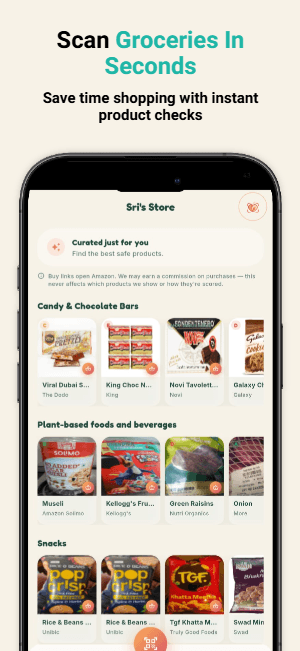
6. How to Scan in 3 Simple Steps
- Step 1: Download Food Scan Genius for free on iOS or Android (100% free core power with zero paywalls).
- Step 2: Set up your Multi-Household Profile by selecting ‘Kosher (Strict)’, ‘Kosher (Pareve Only)’, or customizing sensitivities for specific additives, dyes, and seed oils.
- Step 3: Point your camera at any packaged barcode to scan in 2 seconds and receive an instant, deep AST recursive ingredient audit with clear Hechsher and non-kosher gelatin flags.
Instant Kosher & Additive Audit Trail
7. Frequently Asked Questions (FAQ)
How does a kosher food scanner app detect hidden non-kosher gelatin?
Food Scan Genius utilizes the enterprise NutriGraph Database with recursive AST parsing. Instead of just reading the word ‘gelatin’, the app analyzes parenthetical sub-ingredients and chemical manufacturing profiles to determine whether gelatin is sourced from kosher-certified fish/bovine sources or non-kosher porcine derivatives.
Can Food Scan Genius recognize kosher status on international imported products?
Yes! Food Scan Genius supports over 5,000,000 global UPC/EAN barcodes and features real-time in-app translation across 11 global languages. It reads foreign additive codes, such as European E-numbers (e.g., E120 carmine, E471 mono-glycerides), unmasking hidden non-kosher processing aids regardless of country of origin.
Is Food Scan Genius really 100% free compared to apps like Fig or Spoonful?
Absolutely. Food Scan Genius provides 100% Free Core Power with zero paywalls. While alternative apps charge up to $59.99/year or limit your free daily scans, Food Scan Genius gives you unlimited access to barcode scanning, deep sub-ingredient unmasking, and household dietary screening without requiring a subscription.
How do Multi-Household Family Profiles work when scanning for Kosher restrictions?
In the app settings, you can create separate dietary profiles for every member of your family (e.g., Strict Kosher, Dairy-Free Kosher, or Custom Additive Sensitivities). When you scan a product barcode, Food Scan Genius audits the item against all profiles simultaneously and displays personalized failure alerts like ‘Fails for Sri (Gluten)’ or ‘Fails for Eli (Non-Kosher Gelatin)’.
Take Control of Kosher Food Scanner App — Scan Free Today
Never second-guess confusing grocery labels again. Download Food Scan Genius to uncover hidden additives, toxic dyes, and allergens for the whole household before you buy.