
1. Why Choosing a Lactose-Free Infant Formula Feels So Overwhelming in 2026
If you are standing in the formula aisle at 2 a.m. with a fussy, gassy baby on your shoulder, you already know how heavy this decision feels. Shelves are packed with words like ‘Sensitive,’ ‘Gentle,’ ‘Comfort,’ and ‘Easy Digest,’ and every one of them seems to promise relief. Many parents tell us the hardest part is not the cost. It is the fear of picking the wrong one and prolonging a baby’s discomfort. That fear is valid, and you are not overreacting by reading every label twice.
Here is the clinical context that gets lost in marketing. True lactose intolerance in infants is uncommon. It is most often temporary, for example after a stomach bug that irritates the gut lining. Primary congenital lactase deficiency and galactosemia are rare but serious conditions that need specialist supervision. Far more often, fussiness, spit-up, and loose stools have other causes, including a cow’s milk protein allergy. A lactose free infant formula made with cow’s milk protein will not help a baby with a milk protein allergy, and it can make things worse. That is why pediatricians usually ask for a full history before suggesting any switch, and why we encourage you to call yours before changing formulas.
When pediatricians do discuss lactose-free options, they typically sort them into a few categories. Milk-based lactose-free formulas, such as Similac Sensitive and Pro-Sensitive or Earth’s Best Sensitivity, swap lactose for other carbohydrates. Soy-based formulas, such as Enfamil ProSobee, Similac Soy Isomil, and Gerber Good Start Soy, are lactose-free as well. Extensively hydrolyzed formulas, such as Nutramigen and Alimentum, are lactose-free and also break down milk proteins for babies with allergy concerns. We mention these as categories families commonly discuss, not as endorsements. Formulations change, so verify every current label, and let your pediatrician match the category to your baby.
Label law adds another layer. Milk and soy are both major allergens under the FDA Food Allergen Labeling & Consumer Protection Act (FALCPA), so they must be declared. The law does not tell you whether a product is lactose-free, protein-free, or suitable for your baby’s diagnosis. The World Health Organization Guidelines on Healthy Diets & Saturated Fats remind us that breast milk is the ideal infant food where possible. When it is not possible or not enough, a safe, well-matched formula is a perfectly good way to nourish your baby. You are doing right by your child either way.
Scan Any Label for Hidden Additives and Allergens — Free
Never second-guess confusing grocery labels again. Download Food Scan Genius to uncover hidden additives, toxic dyes, and allergens for the whole household before you buy.


2. Deceptive Labeling and Sneaky Details Hiding in Lactose-Free Formula
Lactose-free formulas are some of the most heavily regulated foods on the shelf, but regulation is not the same as clarity. Here are the label details that most often confuse parents. Several of them are easy to catch once you know to look.
- ‘Lactose-free’ does not mean ‘milk-free.’ Many lactose-free formulas still use intact cow’s milk protein. They suit a baby with lactose intolerance but are not safe for a baby with a diagnosed cow’s milk protein allergy. Always check the protein source line.
- ‘Gentle,’ ‘Comfort,’ and ‘Sensitive’ are marketing words, not standards. Some products with these names are reduced-lactose, not lactose-free. Only the ingredient list and the manufacturer’s lactose statement tell you which one you are holding.
- Replacement carbohydrates. When lactose is removed, something else supplies the carbohydrate. Common substitutes are corn syrup solids, maltodextrin, and sucrose in some products. These are permitted and nutritionally purposeful in infant formula, but some families want to know about them, especially with a corn sensitivity or a family preference.
- Soy protein isolate. Soy-based formulas are lactose-free by design. Soy is also a major allergen, and a share of babies with milk allergy react to soy as well. Soy formula is generally not recommended for premature infants, so this is a decision to make with your pediatrician.
- Vegetable oil blends. Fat in formula often comes from a mix such as palm olein, soy, coconut, and high-oleic sunflower or safflower oils. Families avoiding specific seed oils or palm-derived ingredients rarely find this on the front of the package.
- Imported and translated labels. During shortages, many parents buy formula made for other markets. These labels may be in another language and follow different rules, such as the European Food Safety Authority (EFSA) Additive Safety Regulations, which differ from US standards on permitted additives and thickeners. Check your pediatrician’s guidance before using any imported product.
It also helps to put the ‘processed’ conversation in perspective. Infant formula is, by nature, an industrially formulated food, and no responsible label should shame a parent for using it. Research such as PubMed Research on Ultra-Processed Foods & Gut Microbiome Disruption concerns the broader adult food environment and is not a verdict on infant formula. The practical takeaway is narrower and more useful: know exactly what is in the can, confirm it matches your pediatrician’s plan, and watch for ingredient changes between batches or product lines.
3. Head-to-Head: Food Scan Genius vs. Other Ways to Vet Formula Labels
| Dimension | Food Scan Genius | Manual Label Reading | Fig | Spoonful |
|---|---|---|---|---|
| Cost | 100% free core features, zero paywalls | Free, but costs time and energy | About $59/yr | Limited scans on free tier |
| Database and ingredient depth | NutriGraph: 5,000,000+ verified UPC/EAN barcodes with recursive sub-ingredient parsing | Only what you can read and recognize | Ingredient-based screening | Barcode-based screening |
| Personalization | 39 dietary profiles plus custom sensitivities (palm oil, seed oils, corn-derived ingredients, additives) | Memory and a notes app | Profile-based | Profile-based |
| Household screening | Multi-household profiles with named fail attribution, such as ‘Fails for Mia (Lactose)’ | One person, one label at a time | Varies by plan | Varies by plan |
| Language support | 11 global languages with real-time in-app translation | Requires you to translate yourself | Limited | Limited |
The key technical difference is how ingredients are read. Formula labels are dense with compound ingredients, such as ‘nonfat milk,’ ‘vegetable oil blend,’ or ‘protein hydrolysate,’ that contain their own sub-ingredients. NutriGraph uses recursive abstract syntax tree (AST) parsing to open each of these layers instead of matching surface keywords. Across a database of more than 5,000,000 verified UPC and EAN barcodes, that means a milk-derived component buried inside a longer ingredient string is far less likely to slip past you. Multi-household profiles help when the people in your home have different needs. One scan can flag that a product fails for the baby (lactose) while passing for a sibling, and it names who the product fails for.
ScanGenius AI Insight adds the nuance that a pass/fail icon cannot. Infant formula will almost always land at NOVA 4 on the 1-4 scale because of how it is manufactured. The AI Insight presents that classification alongside the Nutri-Score as context, not as a moral judgment about your choices. It might note that a formula uses corn syrup solids as its carbohydrate, that its protein source is cow’s milk, or that it contains a soy-derived oil, and it leaves the decision with you and your pediatrician. Food Scan Genius is an informational tool and never replaces medical advice. It gives you a faster, clearer way to verify that what is in your hand matches the plan your care team made.
4. Related Food Safety & Dietary Guides
- Best Food Allergy Scanner App – Scan Food Labels Instantly — Food Allergy & Sensitivity Scanner Hub
- The 7 Best Free Food Scanner Apps of 2026 — best free food scanner apps
- Choosing the Best Barcode Scan App for Your Health — guide to choosing a barcode scanner app
- Food Scan Genius: World’s #1 Food Ingredient Scanner App — Food Scan Genius scanner app
5. Scientific & Health Authority References
- FDA Food Allergen Labeling & Consumer Protection Act (FALCPA)
- European Food Safety Authority (EFSA) Additive Safety Regulations
- PubMed Research on Ultra-Processed Foods & Gut Microbiome Disruption
- World Health Organization Guidelines on Healthy Diets & Saturated Fats
6. How to Scan in 3 Simple Steps
- Download Food Scan Genius free on iOS or Android. There is no paywall, no scan cap, and no credit card required for core features.
- Set up your baby’s profile. Choose the lactose or dairy profile from the 39 supported options, add soy or corn if your pediatrician has flagged them, and use ‘Add Your Own Custom Sensitivity’ for palm oil, specific seed oils, or additives. Add other family members to the multi-household profiles.
- Scan the formula barcode in about 2 seconds. You get an instant audit trail showing which ingredients triggered a flag, who in the household it fails for, and the AI Insight context with NOVA and Nutri-Score. Then confirm your choice with your pediatrician.
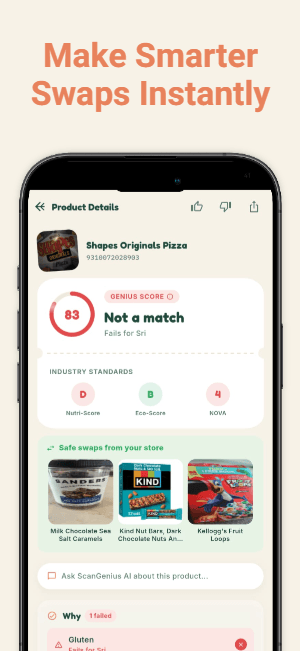
Instant Lactose-Free Audit Trail
7. Frequently Asked Questions (FAQ)
Which lactose free infant formula do pediatricians recommend?
There is no single best option, because the right formula depends on why your baby needs lactose-free feeding. Pediatricians commonly discuss milk-based lactose-free formulas (for example, Similac Sensitive or Earth’s Best Sensitivity), soy-based formulas (for example, Enfamil ProSobee), and extensively hydrolyzed formulas (for example, Nutramigen or Alimentum) when a milk protein allergy is suspected. Food Scan Genius helps you verify the ingredients and flag milk, soy, or custom sensitivities on any barcode, but the choice of formula should come from your pediatrician.
Is lactose-free formula the same as dairy-free or hypoallergenic formula?
No. A lactose free infant formula removes the milk sugar but often keeps cow’s milk protein, so it is not safe for a baby with a cow’s milk protein allergy. Dairy-free soy formulas and extensively hydrolyzed formulas are designed for different needs. Under FALCPA, milk and soy must be declared as allergens, but the label does not say whether a product fits your baby’s diagnosis. In Food Scan Genius you can run both a lactose profile and a dairy profile so the scan shows whether a product fails for one or both.
Can I switch my baby to a lactose-free formula on my own?
It is best to talk to your pediatrician first. Symptoms like fussiness, gas, blood in the stool, or poor weight gain can have causes unrelated to lactose, including milk protein allergy, reflux, or infection. Switching without guidance can mask symptoms or delay a needed diagnosis. Once your pediatrician has made a plan, Food Scan Genius helps you confirm that each product you consider matches it, and the audit trail gives you something concrete to bring to appointments.
Can Food Scan Genius help if I buy imported formula with labels in another language?
Yes, it can help you read the label. Food Scan Genius supports 11 global languages with real-time in-app translation, so you can scan a barcode and see the ingredients and flags in your own language. Imported products may follow different regulations, such as EU additive rules overseen by EFSA, than US-made formula. Check with your pediatrician before using any imported formula, and use the scan to understand what is in it, not as a substitute for medical guidance.
Know What’s In Your Food Before You Buy — Scan Free Today
Never second-guess confusing grocery labels again. Download Food Scan Genius to uncover hidden additives, toxic dyes, and allergens for the whole household before you buy.
Related guides