
1. Why Oatmeal Is So Confusing for Gluten-Free Shoppers in 2026
You read the labels, call the manufacturers, and keep your pantry safe. Then you reach the oatmeal aisle, and the advice contradicts itself. One source says oatmeal is gluten free. A friend with celiac disease says a bowl of oats left her sick for three days. Both can be true, and that is why this question is so frustrating. If you have felt anxious standing in front of a shelf of oats, your caution is reasonable.
Here is the clinical picture. Pure oats do not contain the gluten proteins of wheat, barley, or rye that trigger celiac disease. Oats contain avenin, a related protein. Most people with celiac disease tolerate it, but a small minority react to it, so your gastroenterologist should guide whether oats belong in your diet. The larger and more common risk is cross-contact. Oats are often grown in rotation with wheat and barley, harvested with shared equipment, and moved through shared trucks, silos, and mills. A few stray kernels can push a serving past safe limits. The Celiac Disease Foundation Threshold Requirements resource explains the testing standards and the widely used 20 parts per million benchmark for gluten-free labeling.
The stakes are real. For people with celiac disease, repeated low-level exposure can damage the small intestine even when symptoms are mild or absent. People with non-celiac gluten sensitivity may deal with bloating, fatigue, headaches, and brain fog. Oatmeal also has a strong health reputation. The World Health Organization Guidelines on Healthy Diets & Saturated Fats encourage whole grains and less free sugar, and oats fit that pattern well. But a nutritious grain is not automatically a safe grain for your body, and a breakfast that is healthy on paper can still be a problem for you.
That is why a shopper-first approach matters. Food Scan Genius is built on the NutriGraph Database, with more than 5,000,000 verified UPC/EAN barcodes and recursive sub-ingredient parsing. It checks the oat container in your hand against your own profile. You do not have to rely on a front-of-pack claim or a half-remembered forum post.
Scan Any Label for Hidden Additives and Allergens — Free
Never second-guess confusing grocery labels again. Download Food Scan Genius to uncover hidden additives, toxic dyes, and allergens for the whole household before you buy.


2. Where Gluten Hides in Oatmeal: Cross-Contact, Flavorings, and Label Loopholes
If you are asking whether oatmeal is gluten free, the honest answer is that plain oats are gluten free in theory, but the finished product on the shelf is a different matter. These are the most common ways gluten reaches a bowl of oatmeal.
- Field and harvest cross-contact: Oats are commonly rotated with wheat and barley and cut with shared combines. Stray grains can end up in the oat supply before the oats reach a factory.
- Shared milling, storage, and transport: Even clean oats can be contaminated at a facility that also processes wheat, barley, or rye. Conventional oats are rarely handled with gluten-free protocols.
- Barley malt and malt flavorings: Flavored instant packets sometimes use barley malt extract or malt-based flavoring. Barley malt is a gluten source, and it can appear in the middle of a long ingredient list.
- Vague terms like natural flavors: A short flavor line can hide complex sub-ingredients. Following those components to their sources takes more than a skim of the front panel.
- Labels that sound safe but are not: Whole grain, heart healthy, and wheat-free do not mean gluten-free. A wheat-free product can still contain barley or rye, and a precautionary may-contain statement is not a guarantee in either direction.
- Mix-ins and toppings: Cookie pieces, granola clusters, and baking-style additions in oat cups and packets can bring in wheat flour even when the oat base is clean.
Another factor is how the oats were made safe. Some brands use purity-protocol oats, grown and handled separately from gluten grains. Others use mechanical or optical sorting to remove stray grains from conventional oats. Both approaches can meet the labeling standard, but individuals differ in which one they feel comfortable with. This is a good question to bring to your care team.
Flavored instant oatmeal also raises a processing question beyond gluten. Many single-serve packets contain emulsifiers, thickeners, sweeteners, and flavor systems. The European Food Safety Authority (EFSA) Additive Safety Regulations show how rigorously additives are evaluated, and the PubMed Research on Ultra-Processed Foods & Gut Microbiome Disruption is a useful read on ultra-processed foods and gut health. That matters for people with celiac disease, who are often already working to heal their gut.
3. Food Scan Genius vs. Other Ways to Vet Oatmeal
| Dimension | Food Scan Genius | Fig | Spoonful | Manual Label Reading |
|---|---|---|---|---|
| Cost | 100% free core features, zero paywalls | $59/yr subscription | Limited scans | Free, but time-intensive |
| Ingredient depth | 5,000,000+ verified barcodes with recursive sub-ingredient parsing | Varies by plan | Varies by plan | Only what you can read and recognize |
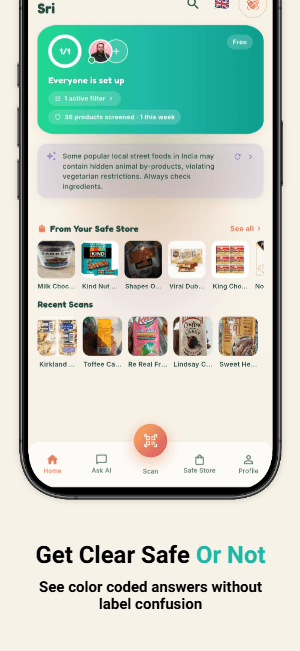
| Family screening | Multi-household profiles, one scan, named results such as Fails for Sri (Gluten) | Varies by plan | Varies by plan | Re-check the label for each person |
| Profiles and custom sensitivities | 39 dietary profiles plus custom sensitivities | Varies by plan | Varies by plan | Depends on your memory |
| Languages and context | 11 languages with real-time translation, ScanGenius AI Insight, NOVA 1-4, Nutri-Score | Varies by plan | Varies by plan | Limited to the label language |
The difference comes down to depth. A simple keyword search on an ingredient list can miss a flavoring made of several components that trace back to barley. NutriGraph parses nested sub-ingredients recursively, so a malt-derived component inside a flavor blend is still evaluated against your profile. Pick the Celiac or Gluten-Free profile, or add a custom sensitivity for something else you avoid. When you scan a canister of rolled oats, the result reflects the full ingredient tree and not only the headline claim.
ScanGenius AI Insight then adds context without moralizing. It will not hand you a single good-or-bad score. It explains what it found: the oats carry a gluten-free claim, or a malt flavoring is present, or the product is highly processed. NOVA 1-4 classification shows that plain rolled oats sit far from a sugary instant packet, and Nutri-Score adds nutritional context. For a household where one person has celiac disease and others do not, the multi-household profile screens everyone in one scan and names who is affected, such as Fails for Sri (Gluten). With 11 supported languages and real-time in-app translation, international labels and multilingual families are covered too. A scan is a decision-support tool and does not replace your physician’s guidance.
4. Related Food Safety & Dietary Guides
- Best Food Allergy Scanner App – Scan Food Labels Instantly — Food Allergy & Sensitivity Scanner Hub
- The 7 Best Free Food Scanner Apps of 2026 — best free food scanner apps
- Choosing the Best Barcode Scan App for Your Health — guide to choosing a barcode scanner app
- Food Scan Genius: World’s #1 Food Ingredient Scanner App — Food Scan Genius scanner app
5. Scientific & Health Authority References
- Celiac Disease Foundation Threshold Requirements
- European Food Safety Authority (EFSA) Additive Safety Regulations
- PubMed Research on Ultra-Processed Foods & Gut Microbiome Disruption
- World Health Organization Guidelines on Healthy Diets & Saturated Fats
6. How to Scan in 3 Simple Steps
- Download Food Scan Genius free on iOS or Android. There are no paywalls on core features and no scan caps to ration.
- Set up your profile. Choose the Celiac or Gluten-Free profile from the 39 dietary options, add any custom sensitivities (for example a specific additive or seed oils), and add family members under your household so each person is screened.
- Scan the oatmeal barcode and get a result in about two seconds. Review the named pass or fail for each person, the sub-ingredient audit trail, the ScanGenius AI Insight, and the NOVA and Nutri-Score context before it goes in your cart.
Instant Gluten-Free Audit Trail
7. Frequently Asked Questions (FAQ)
Is oatmeal gluten free for people with celiac disease?
Pure oats do not contain wheat, barley, or rye gluten, which is why people say oatmeal is gluten free. But conventional oats are often cross-contaminated during farming, transport, and milling. For celiac disease, look for oats labeled gluten-free that meet the 20 ppm standard, and confirm with your doctor that oats are right for you. Food Scan Genius checks the barcode against the Celiac or Gluten-Free profile and flags added barley malt or other gluten-containing ingredients.
What is avenin, and can it cause reactions even in certified gluten-free oats?
Avenin is the protein in oats that is similar to gluten proteins. Most people with celiac disease tolerate it, but a small minority react to it even when the oats are uncontaminated. If you keep having symptoms on certified gluten-free oats, talk to your gastroenterologist about testing and about whether to remove oats. Food Scan Genius cannot predict an avenin reaction, but you can add oats as a custom sensitivity and have every oat product flagged for you.
Does wheat-free or made with whole grain oats mean the oatmeal is gluten-free?
No. A wheat-free product can still contain barley or rye ingredients, and whole grain describes the grain content, not gluten safety. Gluten-free labeling is a separate claim that depends on testing and manufacturing controls. Food Scan Genius looks past front-of-pack wording to the full ingredient breakdown and shows a pass or fail against your profile.
Can Food Scan Genius screen oatmeal for my whole family, including those who do not need gluten-free?
Yes. With multi-household family profiles, you can give each person their own dietary settings and screen a product for everyone in one scan. The result names who is affected, for example Fails for Sri (Gluten) while the others pass. The core features are free, with 39 dietary profiles, custom sensitivities, and 11 languages with real-time translation. Use it as a tool to support decisions, and keep following your healthcare provider’s advice for celiac disease.
Know What’s In Your Food Before You Buy — Scan Free Today
Never second-guess confusing grocery labels again. Download Food Scan Genius to uncover hidden additives, toxic dyes, and allergens for the whole household before you buy.