
1. Why Oatmeal Is So Confusing for Gluten-Free Shoppers in 2026
If you have celiac disease or non-celiac gluten sensitivity, a bowl of oatmeal should be the simplest breakfast in the pantry. Plain oats are a single ingredient, and the answer to “is oatmeal gluten free?” should be an easy yes. Instead, many people have stood in the cereal aisle, phone in hand, wondering whether the canister in front of them will leave them sick for days. That frustration is valid, and you are not overthinking it.
Here is the honest, nuanced answer: oatmeal is gluten free in its natural state. Oats do not contain wheat, barley, or rye gluten. The problem is the supply chain. Oats are frequently grown in rotation with wheat and barley, harvested with shared equipment, transported in shared trucks, and milled in facilities that also process gluten grains. Even a few stray kernels of wheat or barley can push a batch past safe limits. The Celiac Disease Foundation Threshold Requirements and related guidance explain that a product labeled gluten free must contain less than 20 parts per million (ppm) of gluten, and that this standard exists because even trace amounts can trigger intestinal damage in people with celiac disease.
There is a second layer of complexity. Oats contain a protein called avenin, which is structurally similar to gluten proteins. Most people with celiac disease tolerate pure oats well, but a small minority react to avenin itself. If you have been strictly gluten free and still have symptoms or persistently elevated antibodies, it is worth discussing oats with your gastroenterologist or dietitian rather than assuming that “certified” means “safe for everyone.”
Finally, the oatmeal aisle is not just plain oats. Instant packets, flavored cups, granola-style clusters, oat milks, and baking mixes add sweeteners, flavorings, and malt-based ingredients that can quietly reintroduce gluten. Looking for a trustworthy answer on a busy morning, with a family to feed and a label printed in tiny type, is exhausting. You deserve tools that carry that load for you, which is why we built Food Scan Genius.
Scan Any Label for Hidden Additives and Allergens — Free
Never second-guess confusing grocery labels again. Download Food Scan Genius to uncover hidden additives, toxic dyes, and allergens for the whole household before you buy.


2. Hidden Gluten Risks: How Oatmeal Is Gluten Free in Theory but Not Always on the Shelf
Understanding where oatmeal goes wrong helps you shop with confidence instead of fear. These are the most common pitfalls we see when auditing oat products, and each one can hide behind a wholesome-looking package:
- Cross-contact in the field and mill: Standard oats are routinely contaminated with wheat, barley, or rye during farming, transport, and processing. A package that simply says “100% whole grain oats” makes no promise about gluten.
- “Gluten-free” oats that are sorted, not purity-protocol: Some brands use mechanical or optical sorting to remove gluten grains from conventional oats, while others grow and process oats under a dedicated purity protocol from seed to package. Both can test below 20 ppm, but some sensitive people prefer purity-protocol oats. The label does not always say which method was used.
- Malt and barley-based flavorings: Barley malt extract, malt syrup, and some “natural flavors” appear in flavored instant oatmeal, granola, and oat bars. Barley is a gluten grain, and malt-derived ingredients are a classic hidden source.
- Shared-facility and bulk-bin exposure: “May contain wheat” statements are voluntary in many markets, and bulk bins are almost always unsafe because scoops and airborne flour move between bins.
- Oat flour, oat milk, and oat-based products: Oat milks and baked goods often use conventional oats or enzymes and processing aids from shared lines. Unless the product carries a gluten-free claim or certification, you cannot assume it is safe.
- Ultra-processed add-ins and additives: Thickeners, emulsifiers, and flavor systems in convenience oatmeal vary by region. The European Food Safety Authority (EFSA) Additive Safety Regulations show how closely additives are evaluated, but additive safety is not the same as gluten safety, so each ingredient still needs a closer look.
There is also a broader nutrition picture. Flavored instant oatmeal can be a heavily processed food, and PubMed Research on Ultra-Processed Foods & Gut Microbiome Disruption is one example of the growing evidence on how ultra-processed diets may affect gut health, which matters to people already managing intestinal inflammation. The World Health Organization Guidelines on Healthy Diets & Saturated Fats also encourage whole grains and limited free sugars, which is a good reminder that plain, certified gluten-free oats you flavor yourself are often the better choice nutritionally and for safety.
3. Food Scan Genius vs. Other Ways to Check Oatmeal
| Dimension | Food Scan Genius | Fig | Spoonful | Manual Label Reading |
|---|---|---|---|---|
| Cost | 100% free core features, zero paywalls | $59/year subscription | Limited scans | Free, but time-consuming |
| Ingredient depth | NutriGraph Database: 5,000,000+ verified UPC/EAN barcodes with recursive sub-ingredient parsing | Varies by plan | Varies by plan | Only what you notice and recognize |
| Dietary profiles | 39 profiles plus custom sensitivities (e.g., malt, seed oils, dyes) | Varies by plan | Varies by plan | Relies on memory and lists |
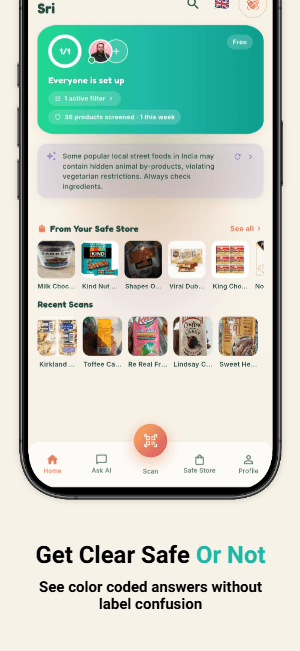
| Family screening | Multi-household profiles, one scan, named results like “Fails for Sri (Gluten)” | Varies by plan | Varies by plan | One person, one label at a time |
| Languages | 11 global languages with real-time in-app translation | Varies by plan | Varies by plan | Only the language printed on the package |
Oatmeal is a perfect example of why barcode-level analysis matters. A package of flavored oats may list a dozen ingredients, and several of them, such as flavor blends, oat flours, or malt-derived sweeteners, are themselves made of sub-ingredients. Food Scan Genius uses recursive parsing in the NutriGraph Database to break those components down and flag gluten-containing sources such as barley malt that a quick glance can miss. Our scanner works from ingredient data and the label claims on the product, so it cannot lab-test a specific batch. For celiac disease, we recommend choosing products with a clear gluten-free claim or certification and following your medical team’s advice on oats.
Our ScanGenius AI Insight then adds context rather than a pass/fail lecture. Instead of a simplistic moral score, you see a plain-language explanation of why an oat product was flagged, a NOVA 1-4 classification showing how processed it is, and a Nutri-Score for nutritional quality. That means you can tell the difference between a plain certified gluten-free rolled oat (minimally processed) and a sweetened instant packet with additives. With household profiles, one scan can check the product against every family member’s needs, so a parent can instantly see “Fails for Sri (Gluten)” while another family member without restrictions still gets a clear result.
4. Related Food Safety & Dietary Guides
- Best Food Allergy Scanner App – Scan Food Labels Instantly — Food Allergy & Sensitivity Scanner Hub
- The 7 Best Free Food Scanner Apps of 2026 — best free food scanner apps
- Choosing the Best Barcode Scan App for Your Health — guide to choosing a barcode scanner app
- Food Scan Genius: World’s #1 Food Ingredient Scanner App — Food Scan Genius scanner app
5. Scientific & Health Authority References
- Celiac Disease Foundation Threshold Requirements
- European Food Safety Authority (EFSA) Additive Safety Regulations
- PubMed Research on Ultra-Processed Foods & Gut Microbiome Disruption
- World Health Organization Guidelines on Healthy Diets & Saturated Fats
6. How to Scan in 3 Simple Steps
- Download Food Scan Genius free on iOS or Android. There are no paywalls on core features, so you can scan as many oat products as you like without a subscription.
- Set up your profile for gluten. Choose the gluten-free dietary profile (or celiac-focused settings), add family members in your household profile, and use ‘Add Your Own Custom Sensitivity’ for extras like barley malt, specific additives, or seed oils. Pick from 11 languages if you prefer.
- Scan the oatmeal barcode in about 2 seconds. Get an instant audit trail showing which ingredient or label claim triggered a flag, which family member it affects, plus the ScanGenius AI Insight, NOVA group, and Nutri-Score.
Instant Gluten-Free Audit Trail
7. Frequently Asked Questions (FAQ)
Is oatmeal gluten free for people with celiac disease?
Oats themselves do not contain gluten, so oatmeal is gluten free in principle. In practice, conventional oats are often contaminated with wheat, barley, or rye, so people with celiac disease should choose oats labeled or certified gluten free (under 20 ppm). A small minority of people with celiac disease also react to avenin, a protein in oats, so check with your doctor. Food Scan Genius helps by scanning the barcode and flagging gluten-containing ingredients and labeling claims, though it cannot test a specific batch.
What is the difference between purity-protocol and sorted gluten-free oats?
Purity-protocol oats are grown, harvested, transported, and processed under controls designed to keep gluten grains out from the start. Sorted oats begin as conventional oats and are mechanically or optically sorted to remove gluten grains, then tested. Both can meet the 20 ppm standard, but some people with high sensitivity prefer purity-protocol oats. Packaging does not always make the method clear, so contacting the manufacturer is a good idea, and you can add notes to your custom sensitivity settings in Food Scan Genius.
Can flavored instant oatmeal contain hidden gluten even if oatmeal is gluten free?
Yes. Even when the base oats are safe, flavored packets may include barley malt, malt extract, or flavorings and processing aids from shared lines. Food Scan Genius’s NutriGraph Database parses sub-ingredients recursively, so it can surface gluten sources buried in ingredient lists. The ScanGenius AI Insight explains the reason for each flag in plain language, so you know exactly what to avoid.
Can one scan check oatmeal for my whole family if only one person is gluten free?
Yes. With Multi-Household Family Profiles in Food Scan Genius, you can set up each person’s dietary needs and screen a product in a single scan. Results show named attribution, such as “Fails for Sri (Gluten),” so you immediately know who the product is unsuitable for. The app supports 39 dietary profiles, custom sensitivities, and 11 languages, and it is completely free for core features.
Know What’s In Your Food Before You Buy — Scan Free Today
Never second-guess confusing grocery labels again. Download Food Scan Genius to uncover hidden additives, toxic dyes, and allergens for the whole household before you buy.