
1. Why Buying Oats and Gluten Free Is Still So Frustrating in 2026
You have probably stood in the cereal aisle holding two nearly identical bags of oats. One has a bold gluten-free banner and the other says nothing, though both list a single ingredient: oats. If that moment left you wondering whether you were being careful or just paranoid, you are not alone. Plain oats are naturally free of gluten, yet the question of oats and gluten free safety is one of the most confusing in the grocery store, and the confusion has a real cause.
Oats are usually grown in rotation with wheat and barley, harvested with shared combines, hauled in shared trucks, and milled in shared facilities. A few stray kernels of wheat, barley, or rye are enough to push a bowl of porridge past a safe level for someone with celiac disease. The Celiac Disease Foundation Threshold Requirements reflect the widely used standard of less than 20 parts per million of gluten for a gluten-free claim. Meeting that standard with a crop this exposed takes deliberate work from the grower to the packaging line.
The emotional cost is real too. For many families, oatmeal is a comfort food, a budget-friendly breakfast, and a reliable fiber source. Having it turn into a source of fear is exhausting. Many people with celiac disease or non-celiac gluten sensitivity describe label-reading fatigue: the sense that every purchase needs a detective’s attention. Parents shopping for a gluten-free child while feeding everyone else face the added worry of keeping the household’s pantry consistent.
This guide gives you five concrete things to look for, so you can shop with confidence instead of anxiety. It also shows how a barcode scan can do the heavy lifting. A brief note first: this article is educational and does not replace advice from your gastroenterologist or registered dietitian, especially on whether oats belong in your diet at all.
Scan Any Label for Hidden Additives and Allergens — Free
Never second-guess confusing grocery labels again. Download Food Scan Genius to uncover hidden additives, toxic dyes, and allergens for the whole household before you buy.


2. The Five Things to Check: Where Labels Hide the Risk
Each of these five checks addresses a specific loophole or point of confusion in how oats reach the shelf. Think of them as a checklist you can run in under a minute.
- 1. A certified gluten-free seal, not just a claim. A manufacturer can legally label oats gluten free if finished products test under 20 ppm, but a third-party certification adds independent audits and often a stricter limit. The Gluten-Free Certification Organization, for example, uses 10 ppm. A seal tells you someone besides the brand verified the process.
- 2. Purity protocol versus mechanically sorted oats. Purity protocol oats come from dedicated fields, equipment, and storage designed to keep gluten grains out. Mechanically or optically sorted oats begin as conventional oats, and sorting machines remove foreign grains. Both can legally be labeled gluten free if the final product tests compliant, but the term purity protocol has no single legal definition. Check the brand’s website or customer service for how the oats are handled. Some people with celiac disease prefer purity protocol oats, and your care team can advise you.
- 3. The full ingredient list on flavored, instant, and baked products. A plain bag is one thing. Instant packets, granola, bars, and overnight oat cups add oat flour, malt extract, barley malt, crisped rice with malt syrup, and flavorings. Under U.S. allergen rules, wheat must be declared, but barley and rye can hide behind terms like malt or flavor. Wheat-free does not mean gluten free.
- 4. Facility and cross-contact statements. Phrases like may contain wheat or made in a facility that processes wheat are voluntary advisories rather than standardized thresholds. Their absence does not guarantee safety, and their presence is a prompt to look for batch testing information or a certification.
- 5. Your personal tolerance, including avenin. Oats contain avenin, a protein similar to gluten. A small subset of people with celiac disease react to it even when the oats are free of contamination. Ask your clinician before introducing oats, and track symptoms and follow-up testing as they advise.
Beyond gluten, it helps to look at what else sits in the bowl. Many flavored oat products are heavily processed, with added sugars, emulsifiers, and flavor systems. Regulators such as the EU publish detailed lists, and the European Food Safety Authority (EFSA) Additive Safety Regulations are a useful reference if you want to understand how additives are evaluated. Dietary guidance also matters, and the World Health Organization Guidelines on Healthy Diets & Saturated Fats offer a sensible frame for the added sugars and fats in sweetened oat products. Gluten-free does not automatically mean nutritious, and a label can be both compliant and heavily processed.
3. Head-to-Head: Food Scan Genius vs. Other Ways to Vet Oats
| Dimension | Food Scan Genius | Fig | Spoonful | Manual Label Reading |
|---|---|---|---|---|
| Cost | 100% free core features, zero paywalls | Premium plan around $59/yr | Limited scans | Free, but costs time |
| Ingredient depth | NutriGraph Database with 5,000,000+ verified barcodes and recursive sub-ingredient parsing | Ingredient-based screening | Ingredient-based screening | Depends on your knowledge of terms like malt |
| Dietary profiles | 39 profiles plus custom sensitivities (seed oils, dyes, additives) | Preset profiles | Preset profiles | Only what you remember |
| Family screening | Multi-household profiles, one scan, named results like Fails for Sri (Gluten) | Individual-focused | Individual-focused | Manual comparison per person |
| Context and language | ScanGenius AI Insight, NOVA 1-4, Nutri-Score, 11 languages with real-time translation | Varies | Varies | Only the label’s language |
Most oat mistakes happen in the sub-ingredients, not the front of the package. A granola bar might list a crisp or a flavor blend that itself contains barley malt or wheat-derived components. Food Scan Genius runs on the NutriGraph Database, which holds more than 5,000,000 verified UPC/EAN barcodes. Its recursive parsing breaks compound ingredients into their parts, so a hidden source of gluten inside a sub-ingredient is surfaced rather than skipped. Because the core app is entirely free, there is no cap on how many oat products you can check during a single shopping trip.
The ScanGenius AI Insight adds the context a pass/fail check cannot. It explains why a product was flagged, whether the concern is a gluten-containing ingredient, an advisory statement, or a flavor of unclear origin. It also pairs the result with a NOVA 1-4 classification and a Nutri-Score, without reducing the product to a single moralizing number. This matters because research, including this PubMed Research on Ultra-Processed Foods & Gut Microbiome Disruption, is exploring how highly processed foods may affect gut health, a topic of special interest to people already managing digestive conditions. A plain certified oat and a sweetened instant oat cup can both be gluten free and still sit at very different points on the NOVA scale. The app shows you both facts and leaves the decision to you. Your custom sensitivities, such as seed oils or specific dyes, are checked in the same scan, and the interface works in 11 languages with real-time translation, which helps when you buy imported oat products.
4. Related Food Safety & Dietary Guides
- Best Food Allergy Scanner App – Scan Food Labels Instantly — Food Allergy & Sensitivity Scanner Hub
- The 7 Best Free Food Scanner Apps of 2026 — best free food scanner apps
- Choosing the Best Barcode Scan App for Your Health — guide to choosing a barcode scanner app
- Food Scan Genius: World’s #1 Food Ingredient Scanner App — Food Scan Genius scanner app
5. Scientific & Health Authority References
- Celiac Disease Foundation Threshold Requirements
- European Food Safety Authority (EFSA) Additive Safety Regulations
- PubMed Research on Ultra-Processed Foods & Gut Microbiome Disruption
- World Health Organization Guidelines on Healthy Diets & Saturated Fats
6. How to Scan in 3 Simple Steps
- Download Food Scan Genius free on iOS or Android. Core features are unlocked from day one, with no subscription and no scan limits.
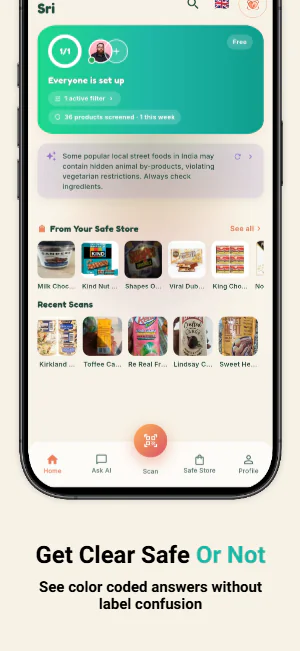
- Set up your profile for oats and gluten free shopping: select the gluten and celiac-related dietary profile from the 39 available, add custom sensitivities such as specific additives or seed oils, and create named profiles for each family member in your household.
- Scan the oat product’s barcode and get a result in about 2 seconds. You will see an instant audit trail showing exactly which ingredient or sub-ingredient triggered a flag, such as Fails for Sri (Gluten), with ScanGenius AI Insight, NOVA, and Nutri-Score for context.
Instant Gluten-Free Audit Trail
7. Frequently Asked Questions (FAQ)
Are oats naturally gluten free?
Yes, pure oats do not contain gluten, but they are frequently cross-contacted with wheat, barley, or rye in fields, transport, and milling. That is why the phrase oats and gluten free is not automatic. Look for a certified gluten-free seal or a compliant gluten-free claim of under 20 ppm. Scanning the barcode with Food Scan Genius shows you whether the product’s ingredients and sub-ingredients raise any gluten flags for your profile.
What is the difference between purity protocol oats and sorted oats?
Purity protocol oats are grown, harvested, and processed with dedicated systems to keep gluten grains away from the crop. Sorted oats start as conventional oats and pass through mechanical or optical sorters that remove foreign grains. Either can be labeled gluten free if the final product meets the legal limit, but there is no single legal definition of purity protocol. Check the manufacturer’s information, and ask your clinician which approach suits you.
Can people with celiac disease eat certified gluten-free oats?
Many people with celiac disease tolerate uncontaminated oats, but a small subset react to avenin, an oat protein similar to gluten. Because of this, you should discuss oats with your gastroenterologist or dietitian before adding them and agree on how to monitor symptoms. Food Scan Genius can help you screen products for gluten sources, but it does not replace medical guidance.
How does Food Scan Genius help with flavored oat products and family shopping?
Flavored oat packets, bars, and granolas often contain malt, barley-derived flavors, or oat flour of unknown handling. Food Scan Genius uses the NutriGraph Database with recursive sub-ingredient parsing to look inside those components. With multi-household profiles, one scan screens everyone at once and names who is affected, for example Fails for Sri (Gluten). It is free, supports 39 dietary profiles plus custom sensitivities, and works in 11 languages.
Know What’s In Your Food Before You Buy — Scan Free Today
Never second-guess confusing grocery labels again. Download Food Scan Genius to uncover hidden additives, toxic dyes, and allergens for the whole household before you buy.