
1. Why Choosing Plant-Based Foods for Weight Loss Feels Harder Than It Should in 2026
If you have ever stood in a grocery aisle holding a package with a leaf on the front and wondered whether it will help or hurt your goals, you are not alone. Plant-based eating has gone mainstream, and the shelves are crowded with products promising to be ‘clean,’ ‘natural,’ and ‘guilt-free.’ Yet many people who switch to a plant-forward diet still struggle to lose weight, and they often blame themselves. In most cases the problem is not willpower. It is that ‘plant-based’ describes where ingredients come from, not how a food will behave in your body.
The research behind this is worth understanding. Whole and minimally processed plant foods such as legumes, vegetables, intact whole grains, fruit, nuts, and seeds are rich in fiber, water, and volume, which tend to support fullness. Plant-based foods that have been heavily reformulated are a different story. A well-known controlled feeding study indexed in PubMed Research on Ultra-Processed Foods & Gut Microbiome Disruption found that participants ate more calories and gained weight on an ultra-processed diet compared with a minimally processed one, even when the meals were matched for presented sugar, fat, and fiber. A vegan cookie, a plant-based nugget, and a dairy-free ice cream can all land in the ultra-processed category.
The World Health Organization Guidelines on Healthy Diets & Saturated Fats emphasize plenty of vegetables, fruit, legumes, nuts, and whole grains while limiting free sugars, salt, and saturated fat. That is a useful compass, but it does not tell you whether the oat-based frozen meal in your cart fits it. Labels run long, ingredient names are technical, and front-of-pack claims are written by marketing teams rather than dietitians.
There is an emotional layer too. Many shoppers are managing more than weight: a gluten sensitivity, a soy or tree-nut allergy, a family member with different needs, or simply a tight budget. Plant-based staples often rely on soy, wheat, and nuts, which are common allergens, as Food Allergy Research & Education (FARE) Clinical Standards make clear. You deserve a way to shop that respects the whole picture, without shame and without a second job as a label detective.
Scan Any Label for Hidden Additives and Allergens — Free
Never second-guess confusing grocery labels again. Download Food Scan Genius to uncover hidden additives, toxic dyes, and allergens for the whole household before you buy.


2. The Label Traps Hiding Inside ‘Healthy’ Plant-Based Products
Plant-based food for weight loss works best when it is built on recognizable ingredients. The challenge is that processed plant-based products can look nutritious while behaving like any other energy-dense snack. Here are the most common traps, and why none of them make a product ‘bad’ on their own. They are simply context worth seeing before you buy.
- The ‘plant-based’ halo: The claim is not tightly tied to nutrition. A product can be fully plant-based and still be high in refined starch, added sugar, sodium, and refined oils. The claim tells you what it excludes, not what it delivers.
- Refined oils as the main ingredient: Meat and dairy alternatives often use coconut, palm, sunflower, or other oils for texture and mouthfeel. This can make a product calorie-dense and high in saturated fat, which the WHO advises limiting. Coconut oil in particular can push saturated fat up in ‘vegan cheese’ and creamers.
- Isolated proteins and texturizers: Pea protein isolate, soy protein isolate, methylcellulose, and modified starches create a meat-like bite. They are not inherently harmful, but they signal a heavily engineered product, often classified as NOVA group 4.
- Added sugars under many names: Agave, brown rice syrup, date syrup, and evaporated cane juice appear in plant-based yogurts, granolas, bars, and milks. They can sound wholesome while still counting as free sugars.
- Additives with regulatory nuance: Gums, emulsifiers, flavors, and colors are common in plant-based formulations. Many are authorized under frameworks like the European Food Safety Authority (EFSA) Additive Safety Regulations, which re-evaluate additives over time. Authorized does not mean everyone wants them, and some shoppers prefer to limit specific ones.
- Serving size sleight of hand: A ‘light’ granola or nut-based snack may list a small serving that few people eat. Calories per realistic portion often tell a different story than the front of the pack.
Nutrient density matters as much as ingredient lists. Low-calorie plant foods with fiber and protein, such as lentils, chickpeas, edamame, tofu, tempeh, oats, berries, leafy greens, and cruciferous vegetables, are generally the strongest foundation. Compare them against packaged substitutes for context rather than treating every processed item as off-limits. Flexible, sustainable eating beats perfection.
3. Food Scan Genius vs. Other Ways to Check Plant-Based Products
| Dimension | Food Scan Genius | Fig | Spoonful | Manual Label Reading |
|---|---|---|---|---|
| Cost | 100% free core features, zero paywalls | Around $59/yr for full access | Limited scans | Free, but costs time |
| Database & ingredient depth | NutriGraph: 5M+ verified UPC/EAN barcodes with recursive sub-ingredient parsing | Barcode-based lookup | Barcode-based lookup | Depends on your own expertise |
| Dietary profiles | 39 profiles plus custom sensitivities (seed oils, dyes, additives) | Preset profile options | Preset profile options | Whatever you remember |
| Family screening | Multi-household profiles, one scan, named results like ‘Fails for Sri (Gluten)’ | Check current plan | Check current plan | Re-check per person |
| Context & languages | ScanGenius AI Insight, NOVA 1-4, Nutri-Score, 11 languages with real-time translation | Varies by plan | Varies by plan | Only the language printed on the pack |
The biggest technological difference is how ingredients are read. Plant-based products frequently contain compound ingredients, such as a ‘seasoning blend’ or ‘vegetable protein’ that hides its own sub-ingredient list. The NutriGraph Database, with more than 5,000,000 verified UPC/EAN barcodes, uses recursive AST parsing to unpack those layers, so a soy derivative or a specific oil nested inside a blend is surfaced rather than missed. That is especially useful if you are managing a soy or wheat allergy alongside a weight goal, or avoiding seed oils through a custom sensitivity.
Instead of a single pass/fail number, ScanGenius AI Insight offers nuanced context: what the NOVA 1-4 classification means for that food, how its Nutri-Score compares, and which ingredients drive the result. A frozen veggie burger might show NOVA 4 but still be a reasonable convenience choice for a busy week, while a sweetened oat drink might look healthier than it is. We do not moralize or assign a guilt score. We give you the information and trust you to decide. With 11 global languages and real-time in-app translation, this clarity also works on imported products and in multilingual households.
4. Related Food Safety & Dietary Guides
- Best Food Allergy Scanner App – Scan Food Labels Instantly — Food Allergy & Sensitivity Scanner Hub
- The 7 Best Free Food Scanner Apps of 2026 — best free food scanner apps
- Choosing the Best Barcode Scan App for Your Health — guide to choosing a barcode scanner app
- Food Scan Genius: World’s #1 Food Ingredient Scanner App — Food Scan Genius scanner app
5. Scientific & Health Authority References
- Food Allergy Research & Education (FARE) Clinical Standards
- European Food Safety Authority (EFSA) Additive Safety Regulations
- PubMed Research on Ultra-Processed Foods & Gut Microbiome Disruption
- World Health Organization Guidelines on Healthy Diets & Saturated Fats
6. How to Scan in 3 Simple Steps
- Download Food Scan Genius free on iOS or Android. There is no paywall on core features, so you can scan as much as you need.
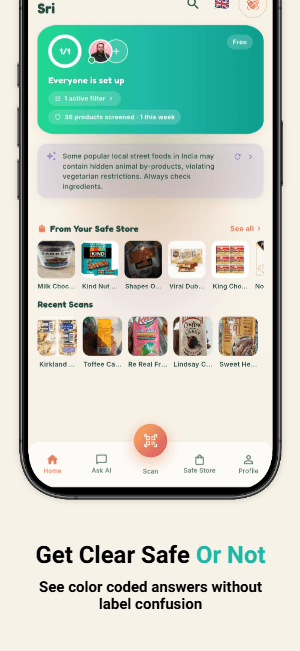
- Set up your profile for plant-based eating and weight goals. Choose from 39 dietary profiles (for example vegan, vegetarian, gluten-free, or soy-free), then add custom sensitivities such as seed oils, specific dyes, or additives. Add household members so everyone is screened at once.
- Scan any barcode in about 2 seconds. You instantly get an audit trail showing flagged ingredients, NOVA 1-4 classification, Nutri-Score, named fail attribution (like ‘Fails for Sri (Gluten)’), and ScanGenius AI Insight to help you decide.
Instant Nut Allergen Audit Trail
7. Frequently Asked Questions (FAQ)
Can plant based food for weight loss really work, or is it just a trend?
It can work, particularly when the diet centers on minimally processed foods such as legumes, vegetables, fruit, whole grains, nuts, and seeds. These foods are typically high in fiber and water, which supports fullness. Results depend on overall calorie balance, food quality, and sustainability, not the ‘plant-based’ label alone. Food Scan Genius helps by showing the NOVA classification and Nutri-Score for packaged items, so you can separate whole-food staples from heavily processed look-alikes.
Are vegan meat and dairy alternatives good for weight loss?
It depends on the product. Some are reasonable, protein-rich convenience foods, while others are high in refined oils, sodium, or added sugars and are very calorie-dense. Comparing similar products side by side is more useful than judging a whole category. Scanning with Food Scan Genius reveals sub-ingredients, NOVA 1-4 level, and Nutri-Score, and ScanGenius AI Insight explains the context so you can choose the version that best fits your goals.
How do I manage allergies or family differences while eating plant-based for weight loss?
Many plant-based staples contain soy, wheat, or tree nuts, which are common allergens, so careful screening is important. Food Scan Genius supports Multi-Household Family Profiles, letting you screen the whole family in one scan and see named results such as ‘Fails for Sri (Gluten).’ For clinical allergy guidance, always consult your allergist and rely on resources like FARE. The app is a shopping aid, not a replacement for medical advice.
Does Food Scan Genius cost anything, and does it work in other languages?
Core features are 100% free with zero paywalls, unlike Fig at about $59 per year or Spoonful’s limited scans. The app supports 11 global languages with real-time in-app translation and offers 39 dietary profiles plus custom sensitivities. This makes it practical for anyone building a plant based food for weight loss routine, including multilingual households and shoppers reading imported labels.
Know What’s In Your Food Before You Buy — Scan Free Today
Never second-guess confusing grocery labels again. Download Food Scan Genius to uncover hidden additives, toxic dyes, and allergens for the whole household before you buy.