1. Why Avoiding Red Dye 40 in Food Is So Challenging in 2026
You are standing in the cereal aisle, phone in one hand, a restless child in the cart. You flip the box over and find a wall of tiny type. If you have ever tried to remove red dye 40 in food from your household, you know how draining this is. The dye turns up in products that are not red at all, and the label that looked fine last month may have been reformulated. If you feel you need a chemistry degree just to buy snacks, you are not imagining the difficulty, and you are not failing.
Red 40 (FD&C Red No. 40, also called Allura Red AC) is one of the most widely used synthetic dyes in the United States. Regulators consider it safe at approved intake levels. Both the FDA and the EU use an acceptable daily intake of 7 mg per kg of body weight. Even so, the picture is not simple. A 2021 review by California’s environmental health office concluded that synthetic food dyes can be associated with behavioral effects in some children. Under European Food Safety Authority (EFSA) Additive Safety Regulations, foods containing E129 (the EU code for Red 40) must carry a warning that the colour may affect activity and attention in children. Most children are not affected. But if you have watched your own child react, you deserve tools that take that seriously rather than dismiss it.
The rules are also changing. In 2025 the FDA announced plans to phase out petroleum-based dyes, and it revoked authorization for Red No. 3. Several states have passed their own limits, particularly for school foods. Many of these transitions are gradual or voluntary, so store shelves hold a mix of reformulated and legacy products. Packaging often looks identical either way.
Many shoppers also assume dyes get the bold-print treatment that allergens get under the FDA Food Allergen Labeling & Consumer Protection Act (FALCPA). They do not. FALCPA covers major allergens, while color additives are listed by name in the ingredient list with no special emphasis. Red 40 is also a common marker of heavily formulated products. The PubMed Research on Ultra-Processed Foods & Gut Microbiome Disruption link above points to a controlled feeding trial showing that ultra-processed diets led people to eat more calories. That trial did not test dyes, and the microbiome is a still-developing area of study. It does show why many families look at the whole formulation, not one ingredient. The World Health Organization Guidelines on Healthy Diets & Saturated Fats take a similar pattern-based view.
Scan Any Label for Hidden Additives and Allergens — Free
Never second-guess confusing grocery labels again. Download Food Scan Genius to uncover hidden additives, toxic dyes, and allergens for the whole household before you buy.


2. Where Red Dye 40 Hides: Label Names and Loopholes
In the US, certified colors like Red 40 generally have to be named in the ingredient list. That does not make them easy to find. Here are the places shoppers most often miss it:
- Many aliases. Look for FD&C Red No. 40, Red 40, Allura Red AC, C.I. 16035, and E129 on imported products. A scan that matches only the words ‘Red 40’ can miss the others.
- Lake versions. ‘Red 40 Lake’ or ‘FD&C Red No. 40 Aluminum Lake’ is the same dye bound to a substrate. It is common in coatings, sprinkles, cereal pieces, and chewable products, and people often skim past it.
- ‘Contains one or more of’ lists. Manufacturers sometimes list several colors (Red 40, Yellow 5, Blue 1) as interchangeable. The specific package may contain any combination, so you cannot be certain which dyes are in it.
- Buried sub-ingredients. Icings, candy inclusions, seasonings, sauces, and coatings are compound ingredients with their own parenthetical lists. The dye may sit two levels down. This is where recursive ingredient parsing outperforms a quick skim.
- Foods that are not red. Red 40 is blended with other dyes to produce brown, orange, purple, and green. It appears in pickles, salad dressings, flavored yogurts, chip seasonings, sports drinks, protein bars, and some cereals. Color is not a reliable warning sign.
- Flavor and size variants. Different flavors, seasonal editions, and multipack sizes often share nearly identical packaging while using different color systems. A product you checked once may not match the one in your hand.
‘No artificial colors’ and ‘natural’ claims add another layer. The first is a specific claim you can check against the ingredient list. ‘Natural’ has no strict meaning on most foods. The reliable method is to read the ingredient list itself. That list is also what EFSA’s additive framework relies on in Europe, where the E-number and warning text make dyes easier to spot. Imported products may carry either style of labeling, which is another reason a multilingual, database-backed check helps.
3. Food Scan Genius vs. Other Ways to Check for Red Dye 40
| Dimension | Food Scan Genius | Fig | Spoonful | Manual Label Reading |
|---|---|---|---|---|
| Cost | 100% free core features, no paywalls | Paid subscription (about $59/yr) | Limited scans | Free, but costs time |
| Database | NutriGraph: 5,000,000+ verified UPC/EAN barcodes | Proprietary product database | Proprietary product database | The physical package |
| Hidden sub-ingredients | Recursive AST parsing of nested ingredients | Varies by product | Varies by product | Easy to miss in dense type |
| Custom sensitivities & family use | 39 dietary profiles plus custom sensitivities; multi-household profiles with named fail attribution | Profile-based filtering | Profile-based filtering | You track each person in your head |
| Languages | 11 languages with real-time in-app translation | Limited | Limited | Only the language printed on the package |
Food Scan Genius is built on the NutriGraph Database, which holds more than 5,000,000 verified UPC and EAN barcodes. Its recursive parsing opens compound ingredients like ‘coating (sugar, Red 40 Lake)’ and flags the dye wherever it sits in the structure. You can use the 39 built-in dietary profiles or add a custom sensitivity for Red 40, Allura Red, E129, or any other dye or additive you want to avoid. With multi-household profiles, one scan checks everyone at once. The result names who it affects, for example ‘Fails for Sri (Gluten)’ or ‘Fails for Maya (Red 40)’. Real-time translation in 11 languages helps with imported products and multilingual households.
Flagging an ingredient is only part of the job. ScanGenius AI Insight explains what was found and why it matters, including how the dye fits into the product’s overall formulation. Each scan also shows a NOVA 1-4 classification and a Nutri-Score, so you see the processing level and nutritional profile next to the dye result. There is no single pass/fail score that makes you feel guilty over a snack. A scanner works from database data, so for unbarcoded items such as bakery goods or restaurant food, and any time a product seems to have changed, check the physical ingredient list as well.
4. Related Food Safety & Dietary Guides
- Sulphite Sensitivity & Preservative Checker — Sulphite Sensitivity Scanner Guide
- Sugar Sensitivity & Sweetener Guide — Sugar Sensitivity Scanner Guide
- FSG Labels Defined: Nutri-Score, NOVA & Additive Safety Guide — Food Label Definitions & Nutri-Score Guide
- Spanish Yellow & Tartrazine Allergy Dangers — tartrazine (Yellow 5) allergy risks
5. Scientific & Health Authority References
- FDA Food Allergen Labeling & Consumer Protection Act (FALCPA)
- European Food Safety Authority (EFSA) Additive Safety Regulations
- PubMed Research on Ultra-Processed Foods & Gut Microbiome Disruption
- World Health Organization Guidelines on Healthy Diets & Saturated Fats
6. How to Scan in 3 Simple Steps
- Download Food Scan Genius free on iOS or Android. Core features have no paywall and no scan limit, so you can audit your whole pantry without a subscription.
- Set up your profile for this specific goal. Add a custom sensitivity for Red 40 and its aliases (Allura Red AC, E129, Red 40 Lake). Layer on any of the 39 dietary profiles you need, and create named household profiles so one scan screens every family member.
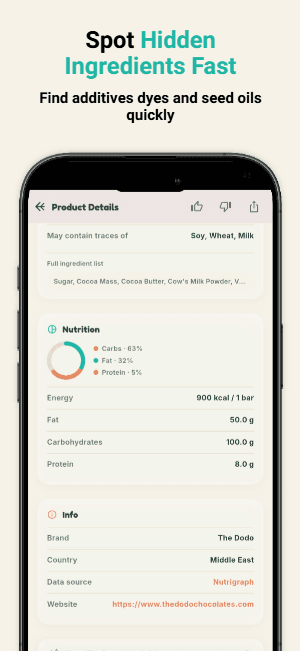
- Scan any barcode in about two seconds. You get an instant ingredient audit showing where Red 40 appears, including nested sub-ingredients, plus AI Insight, NOVA, and Nutri-Score. If a product has no barcode or looks reformulated, confirm against the printed label.
Personalized Match & AI Insight
7. Frequently Asked Questions (FAQ)
What names does red dye 40 go by on ingredient lists?
Red 40 in food can appear as FD&C Red No. 40, Red 40, Allura Red AC, C.I. 16035, E129 (in the EU and on many imports), and lake forms such as ‘Red 40 Aluminum Lake’. It may also sit in a parenthetical list inside a compound ingredient like icing or seasoning. Food Scan Genius checks the common names and the nested sub-ingredients that are easy to miss when reading by hand.
Is red dye 40 banned in the US or Europe?
No. Red 40 is still authorized in the US and the EU. In the US it is approved by the FDA, which announced a plan in 2025 to phase out petroleum-based dyes and revoked Red No. 3. In the EU it is approved as E129, and foods containing it must carry a warning about possible effects on children’s activity and attention. Some US states have restricted it in school foods. Because rules vary by place and are changing, scanning each product is more dependable than relying on assumptions.
Can I avoid red dye 40 in food if I only buy products that are not red?
Not reliably. Red 40 is often blended with other dyes to make brown, orange, purple, or green, and it appears in foods like pickles, salad dressings, yogurts, chip seasonings, and sports drinks. Flavor variants of one brand can also differ. In Food Scan Genius you can add Red 40 as a custom sensitivity, and the scan checks the full ingredient structure instead of relying on how the food looks.
Can Food Scan Genius check my whole family at once if each person has different needs?
Yes. With multi-household family profiles, one scan screens the product against every named profile. If one child avoids Red 40 and another family member avoids gluten, the result shows named attribution such as ‘Fails for Sri (Gluten)’. You can combine any of the 39 dietary profiles with custom sensitivities. All of this is part of the free core app. For unbarcoded foods, always read the printed ingredient list too.
Know What’s In Your Food Before You Buy — Scan Free Today
Never second-guess confusing grocery labels again. Download Food Scan Genius to uncover hidden additives, toxic dyes, and allergens for the whole household before you buy.