1. What MSG Really Means on an Ingredient List (and Why It Is So Hard to Spot)
What is MSG on a food label? MSG = monosodium glutamate, the sodium salt of the amino acid glutamic acid, added as a flavor enhancer and listed by name or as E621. In plain terms, it is purified glutamate bound to sodium. Glutamate itself occurs naturally in tomatoes, Parmesan, mushrooms, and seaweed, and our bodies make it too. MSG is the concentrated, manufactured version, usually produced by fermenting starches or sugars. Where it is added directly, U.S. rules require it to be named as ‘monosodium glutamate.’ In the EU and many other regions it appears as E621, part of the E620 to E625 family of glutamates.
If you are trying to limit MSG, the name on the label is only half the story. Many products avoid the words ‘monosodium glutamate’ yet still deliver free glutamate through other ingredients, such as yeast extract or hydrolyzed protein. Then a bold ‘No MSG’ banner on the front of the pack sends you back to a back panel full of unfamiliar terms. If you have ever stood in a store wondering whether a soup, chip, or seasoning blend is safe for your family, that frustration is reasonable. The labeling system was never designed to make this easy.
The clinical picture is also less dramatic than the internet suggests. In the U.S., the FDA classifies MSG as generally recognized as safe. The European Food Safety Authority (EFSA) Additive Safety Regulations framework led to a 2017 re-evaluation of glutamates that set a group acceptable daily intake of 30 mg per kg of body weight. Some people still report short-lived reactions after large amounts, such as headache, flushing, or tingling, even though controlled studies have not consistently reproduced them. Your experience is valid whatever the studies show, and you deserve to avoid an ingredient without having to decode the label by hand.
Sodium is a second reason people check for MSG. Gram for gram, MSG carries roughly a third of the sodium of table salt, but it still adds to your daily total. The World Health Organization Guidelines on Healthy Diets & Saturated Fats stress keeping sodium low as part of a healthy pattern. Whether you avoid MSG because of sensitivity, sodium goals, or a preference for simpler ingredient lists, the first step is knowing every name it travels under.
Scan Any Label for Hidden Additives and Allergens — Free
Never second-guess confusing grocery labels again. Download Food Scan Genius to uncover hidden additives, toxic dyes, and allergens for the whole household before you buy.


2. The Sneaky Ingredient Names That Can Mean Hidden Glutamate
Understanding what MSG is on a food label starts with one distinction. Regulators require added MSG to be declared by name, but ingredients that contain naturally occurring or process-created free glutamate generally are not required to say ‘MSG.’ These are the names and loopholes to watch for:
- Hydrolyzed proteins: Hydrolyzed vegetable protein, hydrolyzed soy protein, and hydrolyzed corn or wheat protein are made by breaking proteins into amino acids, which releases free glutamate. Under the FDA Food Allergen Labeling & Consumer Protection Act (FALCPA), the source allergen (soy, wheat, milk) must be declared, so these ingredients are easy to find.
- Yeast extract and autolyzed yeast: Yeast extract, autolyzed yeast extract, and torula yeast are common ‘savory’ ingredients rich in free glutamate. They appear in broths, snack seasonings, plant-based meats, and frozen meals, and they sound wholesome.
- Protein isolates and caseinates: Soy protein isolate, textured protein, and sodium or calcium caseinate can release free glutamate during processing. The amount varies by product, so these are ‘possible’ sources rather than guaranteed ones.
- ‘Natural flavors,’ ‘flavoring,’ and ‘spices’: These umbrella terms can include glutamate-rich components without naming them. Added MSG itself should still be declared, but a long flavor blend is a reason to look more closely.
- E-numbers E620 to E625: In Europe and many import markets, E620 (glutamic acid), E621 (monosodium glutamate), E622 (monopotassium glutamate), E623 (calcium diglutamate), E624 (monoammonium glutamate), and E625 (magnesium diglutamate) all signal added glutamates. Flavor boosters such as E627 and E631 (disodium guanylate and inosinate) are not MSG, but they are often paired with it.
- ‘No MSG’ and ‘No added MSG’ claims: The FDA’s position is that these claims should not appear on foods whose ingredients, such as hydrolyzed protein, contain MSG. Still, front-of-pack wording is marketing, not a guarantee. Always check the ingredient list.
Glutamate-boosted foods also tend to be heavily processed. Large studies, including PubMed Research on Ultra-Processed Foods & Gut Microbiome Disruption and related work, have made ultra-processing a growing focus of nutrition science. That does not mean MSG causes those outcomes. It means a savory flavor system can signal a product built for palatability, so an ingredient list is worth a second look. Naturally glutamate-rich whole foods like tomatoes, aged cheese, and mushrooms are a different matter, and most people with a suspected sensitivity can discuss those with a clinician.
3. Head-to-Head: Scanning With Food Scan Genius vs. Other Ways to Check for MSG
| Dimension | Food Scan Genius | Fig | Spoonful | Manual Label Reading |
|---|---|---|---|---|
| Cost | 100% free core features, no paywalls | About $59/year | Limited scans | Free, but time-consuming |
| Hidden-name detection | Recursive sub-ingredient parsing across the NutriGraph Database (5M+ barcodes) | Profile-based flagging | Basic flagging | Depends on your memory |
| Custom sensitivities | 39 dietary profiles plus ‘Add Your Own Custom Sensitivity’ | Preset diet profiles | Preset filters | Not applicable |
| Family screening | Multi-household profiles with named fail attribution | Individual-focused | Individual-focused | One label at a time |
| Languages | 11 global languages with real-time in-app translation | Limited | Limited | You translate yourself |
Spotting MSG is hard because the ingredient may sit inside another ingredient. A seasoning blend can contain yeast extract, and a ‘natural flavor’ can have its own sub-components. Food Scan Genius is powered by the NutriGraph Database, with more than 5,000,000 verified UPC/EAN barcodes and recursive parsing that digs into those nested sub-ingredients rather than reading only the top line. Create a custom sensitivity for ‘MSG and free glutamates,’ and a scan can flag E621, hydrolyzed vegetable protein, autolyzed yeast, and other matches in one pass. Your household profiles work the same way, so one scan can return a result like ‘Fails for Sri (MSG)’ while showing that the product passes for everyone else.
Flagging an ingredient is not the same as understanding it. ScanGenius AI Insight adds context instead of a single judgmental score. It can explain, for example, that a product contains yeast extract as a probable free-glutamate source, show its NOVA 1-4 classification and Nutri-Score, and leave the decision to you. A tomato sauce with naturally occurring glutamate is a different situation from a snack seasoned with added E621, and the app is built to show that difference without moralizing. With 11 supported languages and real-time translation, imported products and foreign-language labels become readable too.
4. Related Food Safety & Dietary Guides
- Sulphite Sensitivity & Preservative Checker — Sulphite Sensitivity Scanner Guide
- Sugar Sensitivity & Sweetener Guide — Sugar Sensitivity Scanner Guide
- FSG Labels Defined: Nutri-Score, NOVA & Additive Safety Guide — Food Label Definitions & Nutri-Score Guide
- Spanish Yellow & Tartrazine Allergy Dangers — tartrazine (Yellow 5) allergy risks
5. Scientific & Health Authority References
- FDA Food Allergen Labeling & Consumer Protection Act (FALCPA)
- European Food Safety Authority (EFSA) Additive Safety Regulations
- PubMed Research on Ultra-Processed Foods & Gut Microbiome Disruption
- World Health Organization Guidelines on Healthy Diets & Saturated Fats
6. How to Scan in 3 Simple Steps
- Download Food Scan Genius free on iOS or Android. There is no paywall on core features, so you can scan as many products as you like.
- Set up your profile: choose from 39 dietary profiles, then use ‘Add Your Own Custom Sensitivity’ to enter MSG, E621, yeast extract, hydrolyzed protein, or any other additive you want flagged. Add family members under your household so each person is screened by name.
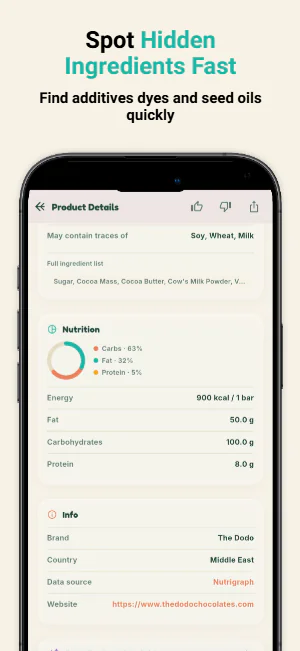
- Scan the barcode in about 2 seconds. You get an instant audit trail showing which ingredient triggered a flag, the sub-ingredient it came from, and ScanGenius AI Insight with NOVA and Nutri-Score context.
Personalized Match & AI Insight
7. Frequently Asked Questions (FAQ)
What is MSG on a food label, and how is it written?
MSG = monosodium glutamate, the sodium salt of glutamic acid. On U.S. labels, added MSG must be listed as ‘monosodium glutamate.’ In the EU and many other markets it appears as E621, within the E620 to E625 glutamate group. Food Scan Genius recognizes these names and flags them against your custom sensitivity.
Does ‘No MSG’ on the package mean the food has no glutamate?
Not necessarily. The FDA’s position is that ‘No MSG’ or ‘No added MSG’ should not be used on foods with ingredients that contain MSG, such as hydrolyzed protein. Yeast extract, protein isolates, and flavor blends can still contribute free glutamate. Foods like tomatoes and Parmesan also contain it naturally. Scanning with a custom MSG sensitivity in Food Scan Genius checks the whole ingredient list rather than relying on the front-of-pack claim.
Is MSG safe to eat?
The FDA considers MSG generally recognized as safe. EFSA’s 2017 re-evaluation set a group acceptable daily intake of 30 mg per kg of body weight for glutamates. Some people report short-term symptoms such as headache or flushing, though controlled studies have not consistently confirmed them. If you suspect a sensitivity, talk to a clinician. Food Scan Genius can help you avoid MSG and glutamate-rich ingredients while you work out what affects you.
Can Food Scan Genius screen my whole family for MSG in one scan?
Yes. With multi-household family profiles, you can give each person their own sensitivities, such as MSG for one person and gluten for another. A single scan shows who a product works for and who it does not, with named results like ‘Fails for Sri (MSG).’ The core features are free, and the app supports 11 languages with real-time translation, so it also helps with imported products.
Know What’s In Your Food Before You Buy — Scan Free Today
Never second-guess confusing grocery labels again. Download Food Scan Genius to uncover hidden additives, toxic dyes, and allergens for the whole household before you buy.