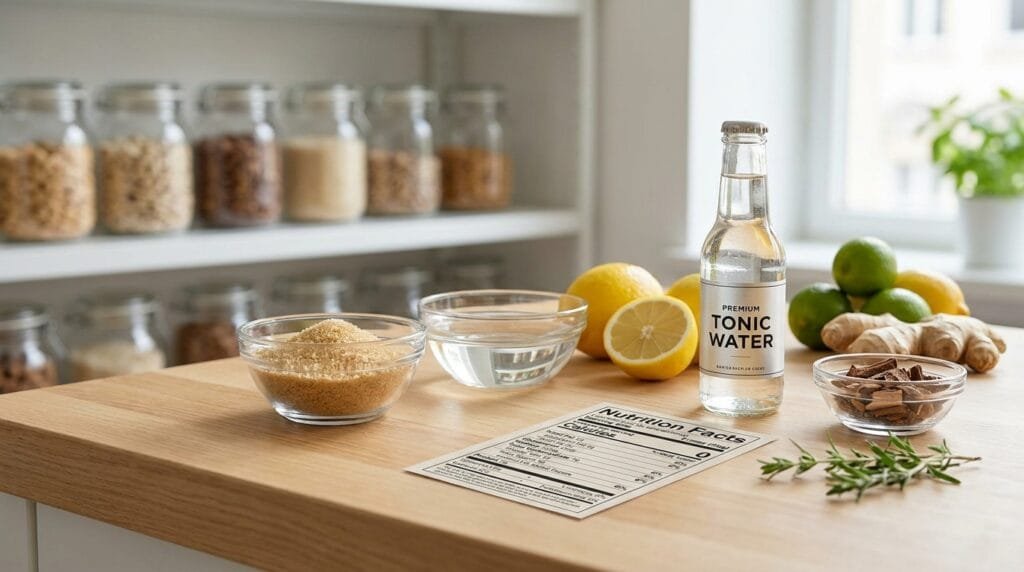
A standard 12-fluid-ounce (355 ml) can of tonic water contains 124 to 130 calories, 32 to 33 grams of carbohydrates (all from added sugar), 0 grams of fat, 0 grams of protein, and approximately 40 to 45 milligrams of sodium.
The Biochemical and Regulatory Anatomy of Tonic Water
Tonic water occupies a unique place in the beverage industry: while it is poured, packaged, and carbonated identically to club soda and sparkling water, its nutritional architecture closely mirrors full-sugar carbonated soft drinks like cola and lemon-lime soda. The modern formulation of commercial tonic water consists primarily of carbonated water, a caloric sweetener (typically high-fructose corn syrup in the United States or sucrose derived from sugar beet or sugar cane in Europe), citric acid, natural flavors, sodium benzoate or potassium sorbate as a preservative, and quinine hydrochloride or quinine sulfate as the signature bittering agent. Because quinine imparts an aggressively astringent, intensely bitter profile, substantial amounts of concentrated carbohydrates are required to achieve a palatably balanced flavor profile.
The signature component of tonic water—quinine—is an alkaloid naturally extracted from the bark of the cinchona tree, originally native to the Andean forests of South America. Historically, British colonial officers stationed in 19th-century India blended prophylactic therapeutic doses of pulverized cinchona bark with water, sugar, and gin to mask its severe bitterness, creating the prototype for the modern gin and tonic. In contemporary manufacturing, however, quinine concentrations are tightly governed by global food authorities rather than medicinal dosing protocols. Under United States Food and Drug Administration (FDA) regulation 21 CFR 172.575, quinine is limited to a maximum concentration of 83 parts per million (ppm), which equates to approximately 83 milligrams per liter or roughly 29.5 milligrams per 12-fluid-ounce serving. Similarly, the European Food Safety Authority (EFSA) Additive Safety Regulations classify quinine as a restricted flavoring substance, limiting it to a maximum of 100 mg/kg in non-alcoholic beverages to prevent cardiovascular and hematological side effects associated with excessive pharmacological alkaloid exposure.
From a macronutrient perspective, tonic water contains zero dietary fat, zero saturated fat, zero dietary fiber, and zero protein. Micronutrient presence is almost exclusively limited to sodium, introduced via water treatment minerals and sodium-based preservatives such as sodium benzoate or sodium citrate. A standard commercial container delivers between 1.5% and 2% of the daily recommended limit for sodium. The metabolic impact of tonic water is therefore dictated entirely by its sugar content. Consuming a single 12-ounce can yields approximately 32 grams of free sugars, which represents over 60% of the maximum daily allowance recommended by the World Health Organization Guidelines on Healthy Diets & Saturated Fats for an average 2,000-calorie adult diet. Because these dissolved sugars lack any matrix of dietary fiber or protein to slow gastric emptying, they produce an acute glycemic response comparable to conventional sodas.
Specialty categories of tonic water deviate slightly from this baseline. “Light” or “Refreshingly Light” formulations typically replace roughly half of the caloric sweetener with fruit sugars or non-nutritive sweeteners, dropping the carbohydrate content to approximately 15 to 18 grams per 12 ounces (55 to 70 calories). True “Diet” or “Zero Sugar” tonic waters replace the sugar completely with synthetic high-intensity sweeteners such as aspartame, sucralose, or acesulfame potassium, reducing total calories to zero. However, the presence of dissolved mineral salts and quinine remains constant across standard, light, and zero-calorie variants.
Deciphering the Label: Real-World Commercial Tonic Waters
When reading tonic water packaging, consumers encounter distinct differences between regional regulatory labeling frameworks and product tiers. In the United States, the Food and Drug Administration mandates that beverages packaged in containers between 12 and 20 fluid ounces display nutritional data for the entire single-serve container on the Nutrition Facts panel, rather than splitting it into arbitrary 8-fluid-ounce portions. On a standard 12-ounce (355 ml) can of mass-market brands like Schweppes Tonic Water or Canada Dry Tonic Water in the US, the panel lists 130 calories, 33 grams of total carbohydrates, 32 to 33 grams of “Total Sugars,” and 32 to 33 grams of “Added Sugars” (representing approximately 65% of the Daily Value). The ingredient statement lists carbonated water and high-fructose corn syrup as the top two ingredients, followed by citric acid, sodium benzoate, and quinine.
In contrast, European Union and United Kingdom nutritional declarations, governed by EU Regulation No 1169/2011, require nutritional declarations to be standardized per 100 milliliters. A European consumer reviewing a standard glass bottle of Schweppes Indian Tonic Water will see the energetic value printed as 146 kJ (34 kcal) per 100 ml, with carbohydrates at 8.2 grams and sugars at 8.2 grams per 100 ml. For a standard 200 ml single-serve European mixer bottle, this equates to 68 calories and 16.4 grams of sugar. Furthermore, European formulations of mass-market tonics frequently combine sucrose with low-calorie artificial sweeteners such as sodium saccharin or acesulfame K to stay under regional sugar tax thresholds, an adaptation that significantly shifts the chemical composition compared to its North American counterpart.
Craft and premium mixer brands present a different nutritional profile due to their reliance on unrefined cane sugars or botanical syrups rather than corn syrup. For instance, Fever-Tree Premium Indian Tonic Water lists cane sugar rather than high-fructose corn syrup; on a US 200 ml (6.8 fl oz) glass bottle, Fever-Tree reports 70 calories, 17 grams of total carbohydrates, and 15 grams of added sugars (amounting to 8.5 grams of sugar per 100 ml). Premium brands like Q Spectacular Tonic Water rely on organic agave nectar instead of cane sugar, reducing the caloric profile to 45 calories and 11 grams of carbohydrates per 200 ml serving, accompanied by a lower glycemic index due to agave’s higher fructose-to-glucose ratio. When auditing bar stock or supermarket purchases, scanning the barcode with the Food Scan Genius app instantly breaks down the caloric density and flags sweeteners or sodium levels across different container sizes.
For consumers with sensitivities or metabolic restrictions, scanning the ingredient list beneath the Nutrition Facts panel is essential. Individuals monitoring their digestive responses often track the processing degree of food additives; clinical perspectives discussed in PubMed Research on Ultra-Processed Foods & Gut Microbiome Disruption suggest that heavily processed additives and non-nutritive artificial sweeteners found in diet tonics can alter gut microbial balance differently than natural cane sugar. Additionally, those tracking plant-based allergens should review botanical disclosures; while pure quinine is a standardized chemical extract, boutique craft tonics frequently incorporate real cinchona bark infusions alongside extracts of lemongrass, elderflower, or citrus peel. According to Food Allergy Research & Education (FARE) Clinical Standards, identifying proprietary botanical flavorings is critical for individuals prone to cross-reactive botanical contact allergies or rare hematological quinine hypersensitivities (such as quinine-induced thrombocytopenia).
| Product & Serving Size | Calories (kcal) | Total Sugars (g) | Sodium (mg) | Primary Sweetener | Quinine Status |
|---|---|---|---|---|---|
| Schweppes Tonic Water (US, 12 fl oz / 355 ml) | 130 | 33 | 45 | High-Fructose Corn Syrup | Present (≤83 ppm) |
| Canada Dry Tonic Water (US, 12 fl oz / 355 ml) | 130 | 33 | 40 | High-Fructose Corn Syrup | Present (≤83 ppm) |
| Fever-Tree Indian Tonic (US, 6.8 fl oz / 200 ml) | 70 | 15 | 0 | Cane Sugar | Present (Natural Cinchona) |
| Fever-Tree Refreshingly Light (US, 6.8 fl oz / 200 ml) | 35 | 7.6 | 0 | Fruit Sugar (Fructose) | Present (Natural Cinchona) |
| Q Spectacular Tonic (US, 6.8 fl oz / 200 ml) | 45 | 11 | 0 | Organic Agave Nectar | Present (Natural Cinchona) |
| Schweppes Slimline / Diet (UK/US, 12 fl oz / 355 ml) | 0–4 | 0 | 55 | Aspartame / Acesulfame K | Present (≤83 ppm) |
| Generic / Store Brand Tonic (US, 12 fl oz / 355 ml) | 120–130 | 32–34 | 35–50 | High-Fructose Corn Syrup | Present (≤83 ppm) |
| Standard Club Soda (For Comparison, 12 fl oz) | 0 | 0 | 75 | None | None |
Common Misconceptions: Tonic Water vs. Club Soda and Seltzer
The single most widespread misconception regarding tonic water is the assumption that it is a variant of plain sparkling water, seltzer, or club soda, and therefore contains negligible or zero calories. Because tonic water is clear, bubbly, and sold in the carbonated water aisle, consumers frequently order or purchase it under the impression that it behaves metabolically like mineral water. In reality, regular tonic water has virtually the same caloric and sugar density as Coca-Cola (which has 39 grams of sugar per 12 ounces compared to tonic’s 33 grams). Substituting tonic water for club soda in mixed drinks or everyday hydration can inadvertently introduce hundreds of surplus calories and substantial spikes in blood glucose.
A second common mistake involves the therapeutic belief that drinking commercial tonic water can prevent or treat nocturnal leg cramps or provide prophylaxis against malaria. While the pharmaceutical drug quinine sulfate is prescribed in therapeutic doses of 200 mg to 324 mg up to three times daily for chloroquine-resistant malaria, commercial tonic water contains less than 30 mg of quinine per 12-ounce can. To reach a minimum therapeutic medicinal dose, an individual would need to consume roughly 3 to 10 liters of commercial tonic water per day—an intake that would introduce between 250 and 800 grams of refined sugar. Furthermore, the FDA has repeatedly issued public health warnings against off-label consumption of quinine for leg cramps due to the risks of severe adverse reactions, including cardiac arrhythmias, renal impairment, and microangiopathy.
Finally, many consumers mistakenly believe that “diet” tonic water is chemically identical to regular tonic water minus the sugar. However, the elimination of nutritive sugar fundamentally alters the viscosity and acidity balance of the beverage. To compensate for the loss of physical mouthfeel and the aggressive bitterness of quinine that sugar normally masks, manufacturers of diet tonic waters significantly adjust the levels of citric acid, sodium citrate, and artificial bitter-masking agents. As a consequence, diet tonics frequently exhibit a higher sodium content than standard full-calorie formulations, a relevant factor for individuals maintaining clinically restricted low-sodium diets.
Frequently asked questions
How many calories are in an 8-ounce glass of regular tonic water?
An 8-fluid-ounce (240 ml) glass of regular commercial tonic water contains roughly 83 to 90 calories and 21 to 22 grams of sugar. The caloric density stems entirely from added sugars such as high-fructose corn syrup or sucrose.
Does tonic water contain any caffeine?
No, traditional tonic water does not contain caffeine. Its bitter flavor profile is produced entirely by quinine extracted from cinchona bark or synthesized food-grade quinine salts, combined with citric acid.
How much quinine is in an average bottle of tonic water?
In the United States and the European Union, food safety laws limit quinine in tonic water to roughly 83 to 100 parts per million. A typical 12-fluid-ounce (355 ml) can contains approximately 25 to 30 milligrams of quinine.
Can tonic water help relieve nighttime leg cramps?
No, the amount of quinine in commercial tonic water is far too low to provide reliable clinical relief from muscle cramps. Medical authorities strongly advise against using tonic water or unregulated quinine for cramps due to cardiovascular and hematological risks.
What is the primary difference between club soda and tonic water?
Club soda is water carbonated with added mineral salts (such as potassium bicarbonate or potassium sulfate) and contains zero calories, zero sugar, and zero quinine. Tonic water is a sweetened carbonated soft drink containing around 33 grams of sugar and 130 calories per 12-ounce serving along with bitter quinine.
References
- Food Allergy Research & Education (FARE) Clinical Standards
- European Food Safety Authority (EFSA) Additive Safety Regulations
- PubMed Research on Ultra-Processed Foods & Gut Microbiome Disruption
- World Health Organization Guidelines on Healthy Diets & Saturated Fats
Related guides
- Best Food Allergy Scanner App – Scan Food Labels Instantly — Food Allergy & Sensitivity Scanner Hub
- The 7 Best Free Food Scanner Apps of 2026 — best free food scanner apps
- Choosing the Best Barcode Scan App for Your Health — guide to choosing a barcode scanner app
- Food Scan Genius: World’s #1 Food Ingredient Scanner App — Food Scan Genius scanner app
Check Any Label Against 5 Million Products — Free
Never second-guess confusing grocery labels again. Download Food Scan Genius to uncover hidden additives, toxic dyes, and allergens for the whole household before you buy.