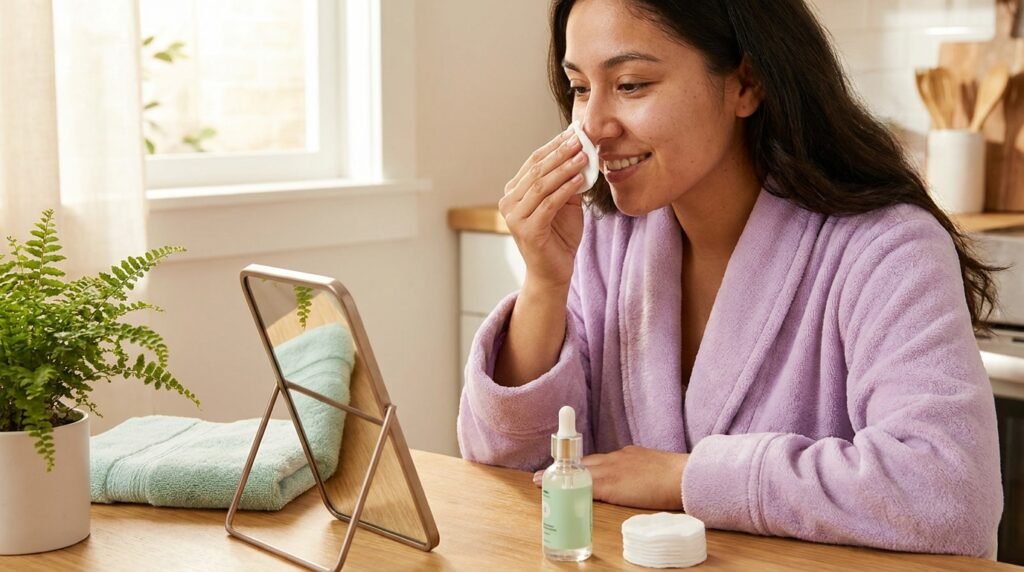
1. The short answer: it helps with appearance, not permanence
Salicylic acid can make sebaceous filaments less visible by dissolving oil and loosening debris inside the pore, but it cannot remove them permanently. They are normal pore structures and refill, usually within weeks.
Sebaceous filaments are thin columns of sebum mixed with shed keratinocytes that line the inside of a pore and guide oil to the surface. Everyone has them. They are most noticeable on the nose, central cheeks and chin, where sebaceous glands are largest and pores are widest. They typically look flat, evenly spaced and pale yellow, grey or skin-toned. That differs from a blackhead (an open comedone), which is a raised, darker plug formed when a blockage oxidizes at the surface.
Salicylic acid is a beta hydroxy acid (BHA). It is lipophilic, meaning it dissolves in oil, so it can travel into sebum-filled pores more readily than water-soluble alpha hydroxy acids such as glycolic or lactic acid. Inside the pore it loosens the bonds between dead cells and has a mild keratolytic effect. The result is a thinner, less compacted filament and often a smoother-looking pore.
Be realistic about the evidence. Most clinical data on salicylic acid concerns acne and comedones, not filaments specifically. Reduced visibility is a reasonable expectation; a lasting change in pore size is not. Pore diameter is influenced by genetics, sebum output, age and sun damage, and no topical changes the underlying structure. If a product promises to permanently shrink or erase pores, the claim goes beyond the evidence.
2. Choosing a formula: concentration, pH and format
Three variables decide whether a salicylic acid product is useful or merely irritating: strength, pH and how long it stays on the skin.
- Concentration: Leave-on products for acne-prone or congested skin generally sit between 0.5% and 2%. In the US, over-the-counter acne monographs permit 0.5–2%. Start at the low end if your skin is sensitive or you already use other exfoliating actives. Higher strengths used in clinics, such as peels, are a different category and should be done by a professional.
- pH: Salicylic acid has a pKa of about 3, and it needs to be at or below roughly pH 4 to stay mostly in its active, un-ionized form. Many effective leave-on formulas fall around pH 3–4. Brands rarely print pH on the pack. If it is not listed, check the brand’s website or customer service rather than assuming. A product labelled as a BHA exfoliant with no pH information is a reasonable cue to ask.
- Format: A leave-on liquid, gel or lotion gives longer contact time than a cleanser. A 2% cleanser rinsed off after 30 seconds delivers much less than a 2% leave-on. Cleansers suit very sensitive skin or beginners; leave-ons are the stronger option for filaments.
Reading the label correctly matters. In the US, products regulated as acne drugs list salicylic acid and its percentage under Drug Facts as an active ingredient. Cosmetic-category products in the UK and EU only list it in the ingredient list (INCI) and often do not state the percentage. In that case, position helps only roughly: the nearer the top, the higher the amount, though anything above 1% is generally listed before the ingredients present at 1% or less.
Watch for look-alikes. Betaine salicylate is a gentler salicylate salt but is less well studied for exfoliation. Willow bark extract contains variable and often low levels of salicin, so it is not a reliable substitute. Capryloyl salicylic acid (a lipophilic derivative) is marketed as milder, though comparative evidence is thinner than for salicylic acid itself. None of these can be assumed to behave like 1–2% salicylic acid at a suitable pH.
Finally, consider the rest of the formula. Alcohol-heavy toners can strip skin and prompt more oil production in some people, while soothing and barrier-supporting ingredients such as glycerin, panthenol or ceramides can make a stronger BHA more tolerable.
3. Interactions and layering order
This is where most routines go wrong. Salicylic acid works well alone but is easy to stack with too many other exfoliating or drying actives. The usual result is a stinging, tight, flaky face that produces more visible pores, not fewer.
Combinations to avoid or space out:
- Retinoids (adapalene 0.1%, retinol, tretinoin): Both increase turnover and dryness. They can be combined by some people under guidance, but most do better alternating nights. Retinoids are also useful for filaments in their own right, so you may not need both every day.
- AHAs (glycolic, lactic, mandelic) and other BHAs: Layering them multiplies exfoliation without clear extra benefit. Choose one main exfoliant per session.
- Benzoyl peroxide: Often prescribed alongside salicylic acid for acne, but the combination is drying. Use at different times of day unless directed by a clinician. Benzoyl peroxide can also degrade tretinoin, though not adapalene.
- L-ascorbic acid (vitamin C): It works best at a pH below about 3.5, so it is also an acidic, potentially irritating product. Many people do better with vitamin C in the morning and BHA in the evening.
Combinations that usually work well: niacinamide (commonly 2–5%) can support the barrier and may help with oil and the look of pores. Hyaluronic acid, glycerin and ceramide moisturizers cushion dryness. The old rule that niacinamide and acids cannot be mixed because of pH is largely overstated for modern formulas, though if you flush or sting, separate them.
Layering order: apply thinnest to thickest. In the evening: cleanse, then salicylic acid on dry skin, then a hydrating serum if used, then moisturizer. Wait a few minutes after the acid so the skin surface settles. If using a retinoid on a different night, keep the BHA night otherwise simple. In the morning: gentle cleanse or rinse, antioxidant serum if used, moisturizer, then broad-spectrum SPF 30 or higher. Exfoliating acids can increase sensitivity to UV, so daily sunscreen is not optional.
Checking all this across a full shelf of products is tedious, since actives hide in cleansers, toners and treatments. Scanning each barcode in Skin Scan Genius can show which of your existing products already contain exfoliating acids or retinoids before you add a BHA.
4. How to use it, and when another approach fits better
Begin with a patch test on the jawline or behind the ear for a few days. Then apply to the affected areas, usually the nose and central face, two or three evenings per week. If your skin tolerates it after two to three weeks, increase to alternate nights. Daily use is acceptable for some skin types but is not necessary, and more is not better. Judge results after six to eight weeks, not days, because filaments will look better soon after use and then gradually refill.
Stop or reduce use if you notice persistent burning, peeling, a tight shiny look or new small bumps. Those are signs of barrier irritation. People with a known aspirin or salicylate allergy should avoid it. If you are pregnant or breastfeeding, ask your doctor or pharmacist before using it, particularly at higher strengths or over large areas.
Salicylic acid is not the only option, and it is not always the best one:
- Topical retinoids speed up cell turnover and can reduce the look of congestion over time. They are slower and more irritating at first.
- Azelaic acid (often 10% over the counter, higher by prescription) is another choice if you are prone to redness.
- Clay masks absorb surface oil briefly but do not change the pore.
- Pore strips and squeezing pull out filaments temporarily but can irritate the skin, enlarge the opening and leave marks. They will refill regardless.
If your bumps are inflamed, painful, widespread, or you also have persistent redness or flushing, the issue may be acne or rosacea rather than ordinary filaments. Rosacea, eczema, perioral dermatitis and similar conditions can be worsened by exfoliating acids. See a dermatologist for diagnosis and a tailored plan, including professional extractions if appropriate.
Before buying, compare the percentage, the likely pH and whether the product overlaps with actives you already use. A tool such as Skin Scan Genius can do that comparison from the barcode, but the same check can be done manually if you read the label carefully.
Check it against your own routine. Skin Scan Genius reads a product’s full INCI list and flags conflicts with the actives you already use, by skin type and concern.
Frequently asked questions
Does salicylic acid remove sebaceous filaments permanently?
No. Sebaceous filaments are a normal part of pore anatomy and refill with sebum and dead cells, typically within weeks. Salicylic acid can make them less noticeable while you keep using it, but the effect fades if you stop.
How often should I use salicylic acid for sebaceous filaments?
Most people start with two or three evenings a week and increase only if their skin stays comfortable. Daily use is possible for oily, tolerant skin but is rarely needed. Reduce frequency if you see dryness, peeling or stinging.
Is a 2% salicylic acid product better than 0.5%?
Not automatically. A higher percentage can exfoliate more but is also more likely to irritate, and a well-formulated 0.5–1% leave-on at a suitable pH can work better than a poorly formulated 2% product. Format and pH matter as much as the number.
Can I use salicylic acid with retinol or niacinamide?
Niacinamide generally pairs well with salicylic acid. Retinol and salicylic acid together raise the risk of dryness and irritation, so alternating nights is the more common approach. Introduce one active at a time and always use daily sunscreen.