1. Why Shopping for Whole Foods Plant Based Food Is Harder Than It Looks in 2026
You decide to eat more whole foods plant based food. You picture lentils, leafy greens, oats and ripe fruit. Then you reach the store and the aisles tell a different story. A box with a leaf on the front turns out to contain isolates, gums and flavor systems. A “plant-powered” label sits on a snack that has more in common with candy than with a carrot. If you’ve left a store feeling more confused than when you walked in, you’re in good company, and it isn’t a personal failing. Marketing language moves faster than label regulation, and the front of a package is built to persuade, not to inform.
The clinical context matters here. The World Health Organization Guidelines on Healthy Diets & Saturated Fats consistently emphasize vegetables, fruits, legumes, nuts and whole grains as the foundation of a healthy diet. That is the core of a whole foods plant based pattern. But “plant based” on a package is not a regulated nutritional category. A product can be fully vegan and still be high in sodium, refined starches and additives. Anyone managing a condition such as hypertension, IBS, celiac disease or a food allergy needs more than a green leaf icon to decide what goes in the cart.
Allergies add another layer. Plant-based substitutes often lean on soy, wheat, tree nuts, peanuts or sesame to replace dairy, egg and meat. Under the FDA Food Allergen Labeling & Consumer Protection Act (FALCPA), major allergens must be declared in plain language. That protection has limits, though. It doesn’t cover every sensitivity, and it doesn’t make a long ingredient panel any easier to read on a crowded Saturday with a toddler in the cart.
Here is a practical starting list of true whole foods plant based staples, mostly NOVA Group 1 foods that are unprocessed or minimally processed:
- Produce: leafy greens, cruciferous vegetables, root vegetables, berries, citrus, bananas, apples (fresh or plain frozen)
- Legumes: dried or canned lentils, chickpeas, black beans, split peas (choose low-sodium cans)
- Whole grains: rolled oats, brown rice, quinoa, barley, farro, buckwheat
- Nuts and seeds: raw or dry-roasted almonds, walnuts, chia, flax, pumpkin seeds
- Minimally processed helpers: plain tofu or tempeh, unsweetened soy milk, tahini, nut butter with only nuts (and salt if you like)
The challenge is the in-between products: breads, sauces, plant milks, frozen meals and “meat alternatives.” That’s where a quick, reliable label check pays off.
Scan Any Label for Hidden Additives and Allergens — Free
Never second-guess confusing grocery labels again. Download Food Scan Genius to uncover hidden additives, toxic dyes, and allergens for the whole household before you buy.


2. Sneaky Ingredients and Label Loopholes Hiding in “Plant Based” Products
A short ingredient list is usually a good sign for whole foods plant based food, but length isn’t the only thing to watch. Where an ingredient comes from, how it was processed, and whether it hides inside another ingredient all matter. Research such as the PubMed Research on Ultra-Processed Foods & Gut Microbiome Disruption has pushed many people to look beyond calories and ask how much industrial processing sits behind a product. Here are the most common traps we see:
- “Natural flavors”: A catch-all term that can cover dozens of compounds. It rarely tells you whether the flavor carries a soy, nut or other sensitivity-relevant carrier, or whether it comes from a source that conflicts with your values.
- Compound ingredients: “Seasoning blend,” “spice mix” and “vegetable broth” can contain their own sub-ingredients, such as yeast extract, maltodextrin or added oils. These are easy to skim past on a busy shop.
- Protein isolates and texturizers: Pea protein isolate, methylcellulose and modified starches make plant-based burgers and nuggets convincing. They also push those products into NOVA Group 4, even though the front of the box says “plant based.”
- Refined oils and added sugars: Many plant-based creamers, dressings and snacks rely on seed oils, syrups or concentrated juice for texture and taste. That runs against the “whole food” idea, and many shoppers avoid these ingredients on purpose.
- Precautionary “may contain” statements: Cross-contact warnings for nuts, wheat or sesame are generally voluntary and inconsistent. A product can be vegan and still be unsafe for someone with a severe allergy.
- Additive rules that differ by region: A colorant or preservative accepted in one market may be restricted in another. The European Food Safety Authority (EFSA) Additive Safety Regulations are a useful reference point, especially for imported products and for travelers shopping abroad.
None of these should make you anxious about food. They’re reasons to check, not reasons to panic. A product with a few of these flags may still fit your needs, and the right answer depends on your own goals, health conditions and household.
3. Food Scan Genius vs. Other Ways to Vet Plant-Based Products
| Dimension | Food Scan Genius | Fig | Spoonful | Manual Label Reading |
|---|---|---|---|---|
| Cost | 100% free core features, zero paywalls | $59/yr for full access | Limited scans | Free, but costs time |
| Dietary Profiles | 39 profiles plus custom sensitivities (seed oils, dyes, specific additives) | Preset diet and allergen filters | Preset filters | Depends on your own memory |
| Sub-Ingredient Depth | Recursive AST parsing of compound ingredients | Varies by product | Varies by product | Easy to miss nested ingredients |
| Family Screening | Multi-household profiles, one scan, named results (“Fails for Sri (Gluten)”) | Profile-based, one at a time | Profile-based, one at a time | Re-read for every person |
| Languages and Context | 11 languages with real-time translation, NOVA 1-4, Nutri-Score and AI Insight | Limited language support | Limited language support | Only languages you read |
Food Scan Genius runs on the NutriGraph Database, which holds more than 5,000,000 verified UPC/EAN barcodes. Its recursive AST parsing doesn’t stop at the first line of an ingredient list. If “seasoning” contains a sub-ingredient with a hidden oil or an allergen, the parser keeps unpacking until it reaches the bottom. For whole foods plant based food, that depth is what separates a product that is genuinely simple from one that only looks simple. With 39 dietary profiles, including vegan and vegetarian options, plus the ability to add your own custom sensitivity, you can flag exactly what matters to you, whether that’s seed oils, a specific dye or a single additive.
The ScanGenius AI Insight adds context instead of a verdict. You get the NOVA 1-4 classification and the Nutri-Score side by side with a plain-language explanation, not a simplistic good-or-bad number. A plain tofu block and a heavily formulated plant-based nugget can both be vegan, and the Insight helps you see why they’re different. Family Profiles let you screen your whole household in a single scan, with results like “Fails for Sri (Gluten),” so nobody has to guess who a product doesn’t work for. In-app translation across 11 languages helps when you’re reading imported products or shopping with relatives who read another language at home.
4. Related Food Safety & Dietary Guides
- Best Food Allergy Scanner App – Scan Food Labels Instantly — Food Allergy & Sensitivity Scanner Hub
- The 7 Best Free Food Scanner Apps of 2026 — best free food scanner apps
- Choosing the Best Barcode Scan App for Your Health — guide to choosing a barcode scanner app
- Food Scan Genius: World’s #1 Food Ingredient Scanner App — Food Scan Genius scanner app
5. Scientific & Health Authority References
- FDA Food Allergen Labeling & Consumer Protection Act (FALCPA)
- European Food Safety Authority (EFSA) Additive Safety Regulations
- PubMed Research on Ultra-Processed Foods & Gut Microbiome Disruption
- World Health Organization Guidelines on Healthy Diets & Saturated Fats
6. How to Scan in 3 Simple Steps
- Download Food Scan Genius free on iOS or Android. There’s no paywall on core features, so you can start scanning right away.
- Set up your profiles. Choose from 39 dietary profiles (such as vegan, vegetarian, gluten-free or nut-free), add household members, and create custom sensitivities like seed oils or a specific dye for your whole foods plant based food goals.
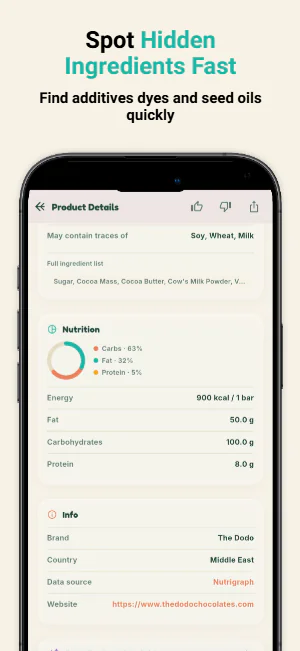
- Scan any barcode in about two seconds. You’ll see an instant audit trail showing which ingredient triggered a flag, the NOVA 1-4 group, the Nutri-Score, and the ScanGenius AI Insight, with named results for each family member.
Personalized Match & AI Insight
7. Frequently Asked Questions (FAQ)
What counts as a whole foods plant based food?
A whole foods plant based food is a plant-derived food that is unprocessed or minimally processed, such as vegetables, fruits, legumes, whole grains, nuts and seeds. Packaged items like plain tofu, tempeh or unsweetened soy milk can also fit if the ingredient list is short. In Food Scan Genius, most of these appear as NOVA Group 1 or 2, and the app flags when a “plant based” product moves into NOVA 4.
Is every vegan product also a whole foods plant based food?
No. Vegan means no animal-derived ingredients, but it says nothing about how processed a product is. Many vegan cookies, nuggets and frozen meals contain refined oils, isolates and additives. Food Scan Genius shows the NOVA classification and Nutri-Score alongside your vegan profile so you can tell the difference, and the ScanGenius AI Insight explains the reasoning without labeling a food as simply good or bad.
Can I scan packaged foods for hidden allergens or seed oils?
Yes. The NutriGraph Database covers more than 5,000,000 verified UPC/EAN barcodes, and its recursive AST parsing looks inside compound ingredients such as spice blends and broths. You can also add a custom sensitivity for things like seed oils, specific dyes or additives. Keep in mind that precautionary “may contain” statements are generally voluntary, so people with severe allergies should still check manufacturer information.
Does Food Scan Genius cost anything, and can my whole family use it?
The core features are 100% free with no paywalls, unlike Fig at $59 per year or Spoonful with its limited scans. Multi-Household Family Profiles let you screen every person in your home with a single scan, and the app names who a product fails for, such as “Fails for Sri (Gluten).” The interface and results can also be translated in real time across 11 languages.
Know What’s In Your Food Before You Buy — Scan Free Today
Never second-guess confusing grocery labels again. Download Food Scan Genius to uncover hidden additives, toxic dyes, and allergens for the whole household before you buy.
Photo by Vanessa Loring on Pexels