1. The 6-Month Iron Crisis: Navigating Infant Nutrition Without Parental Burnout
At around six months of age, an infant’s biological relationship with nutrition undergoes an abrupt and critical shift. Full-term infants are born with internal iron reserves accrued during the third trimester, but by the midpoint of their first year, these neonatal stores become virtually depleted. Because human breast milk, while immunologically unmatched, contains relatively low concentrations of iron (approximately 0.35 milligrams per liter), introducing infant foods high in iron becomes an urgent physiological mandate rather than a casual developmental milestone. Iron is the fundamental catalytic engine driving rapid oligodendrocyte maturation, myelin synthesis in the central nervous system, and systemic oxygen transport. Prolonged iron insufficiency during this critical developmental window can induce irreversible cognitive, motor, and neurobehavioral deficits that persist long into childhood.
Faced with this clinical reality, modern parents find themselves caught between two equally demanding paradigms: the domestic labor of preparing homemade purées or the perceived convenience and hidden compromises of commercial baby food. Handcrafting balanced meals from organic chicken livers, grass-fed beef, soaked lentils, and steamed spinach offers complete transparency over ingredients, but it requires hours of procurement, precise batch-steaming, puréeing, and hygienic portioning. For working families and caregivers already coping with chronic sleep deprivation, spending three hours every Sunday preparing single-ounce purees is often an unsustainable logistical burden that leads directly to parental burnout.
Conversely, turning to commercial baby food aisles presents an entirely different spectrum of anxiety. Commercial pouches and jars market themselves with pastoral imagery and confident developmental claims, yet parents are left guessing about actual nutrient density, bioavailability, and hidden processing aids. The World Health Organization Guidelines on Healthy Diets & Saturated Fats emphasize the necessity of foundational, minimally processed complimentary feeding to prevent early metabolic derangements and micronutrient deficiencies. When grocery shelves are crowded with shelf-stable squeeze pouches that boast spinach on the front label but deliver ninety percent high-sugar apple concentrate on the ingredient deck, parental trust inevitably erodes.
Compounding this dilemma is emerging evidence detailing the vulnerability of the immature infant digestive system. Recent clinical literature, such as PubMed Research on Ultra-Processed Foods & Gut Microbiome Disruption, underscores how industrial emulsifiers, de-characterized fruit purees, and ultra-processed food matrix modifications can alter early intestinal barrier function and perturb the fledgling microbiome. Navigating the store-bought landscape requires looking beyond clever front-of-package marketing to decipher the precise nutritional reality inside the packaging.
Scan Any Label for Hidden Additives and Allergens — Free
Never second-guess confusing grocery labels again. Download Food Scan Genius to uncover hidden additives, toxic dyes, and allergens for the whole household before you buy.


2. Deceptive Labeling, Heavy Metals, and the Bioavailability Trap in Commercial Baby Foods
Procuring adequate iron for an infant is not simply a matter of calculating gross milligrams listed on a nutrition facts panel; it is fundamentally a matter of biochemical bioavailability. Dietary iron exists in two distinct forms: heme iron (derived from animal hemoglobin and myoglobin, absorbed at a rate of 15% to 35% independent of meal composition) and non-heme iron (derived from plant tissues and synthetic fortificants, absorbed at a meager 2% to 10%). The absorption of non-heme iron is exceptionally fragile, easily inhibited by phytates in whole grains and polyphenols, while requiring synergistic co-factors like ascorbic acid (Vitamin C) to convert ferric iron ($Fe^{3+}$) to the absorbable ferrous ($Fe^{2+}$) state. Commercial formulations frequently obscure these physiological nuances behind misleading product designs and legal labeling loopholes.
- Front-Panel Deception and The ‘Produce Wash’ Effect: Commercial squeeze pouches routinely feature prominent labels like ‘Beef, Kale & Quinoa,’ leading parents to believe their child is receiving a bioavailable, heme-rich meal. In reality, sub-ingredient regulatory rules allow manufacturers to formulate products where the primary component (often 75% to 85% by volume) is sweet, low-cost apple or pear purée, with pureed beef accounting for less than 3% to 5% of total mass. This dilution renders the actual iron contribution clinically negligible while habituating the infant palate exclusively to intense sweetness.
- Phytate-Rich, Unfermented Grain Fortification: Many shelf-stable dry infant cereals rely on non-heme electrolytic iron or ferric orthophosphate blended into unfermented, un-sprouted oat or soy flours. These flours are naturally concentrated with phytic acid (myo-inositol 1,2,3,4,5,6-hexakisphosphate), a powerful chelator that binds mineral cations in the infant lumen, rendering the fortified iron insoluble and largely excreted without absorption.
- Extreme Retort Over-Processing: Commercial glass jars and plastic pouches undergo high-heat, high-pressure retort sterilization to guarantee a 12-to-24-month room-temperature shelf life. This extreme thermal processing denatures natural enzymatic structures, degrades naturally occurring native Vitamin C co-factors essential for non-heme iron reduction, and fundamentally alters the matrix of the food, transforming real vegetables into ultra-processed, hyper-palatable purées.
- Unintentional Heavy Metal Concentrations: Root vegetables and monoculture rice commonly used as thickening bases in commercial iron-fortified purees naturally bioaccumulate toxic heavy metals—specifically inorganic arsenic, cadmium, lead, and mercury—from industrial agricultural soils. Without rigorous batch-level third-party testing, reliance on conventional commercial purees can inadvertently expose developing neural pathways to neurotoxic contaminants.
- Undeclared Processing Aids and Cross-Contamination Risks: Under the FDA Food Allergen Labeling & Consumer Protection Act (FALCPA), manufacturers are legally mandated to declare major food allergens, but processing aids, shared-line trace contaminants, and complex emulsification carriers used in lipid-soluble vitamin sprays often slip below mandatory disclosure thresholds. For an infant with an evolving immune barrier, these trace sub-ingredients pose silent inflammatory risks.
- Additive-Driven Texture Manipulation: To prevent syneresis (liquid separation) during extended shelf storage, manufacturers frequently incorporate modified food starches, locust bean gum, or guar gum. While clearing the European Food Safety Authority (EFSA) Additive Safety Regulations for general toxicity thresholds, these supplemental hydrocolloids can accelerate transit time or coat mucosal villi, inadvertently compromising delicate micronutrient absorption kinetics in the infant duodenum.
3. Bridging the Gap: How Food Scan Genius Outperforms Outdated Screening Methods
| Feature / Capability | Food Scan Genius | Fig App | Spoonful | Manual Label Reading |
|---|---|---|---|---|
| Core Price Structure | 100% Free Core (No Paywalls) | $59.99/year subscription | Freemium (Capped Scans/Mo) | Free (High Time Cost) |
| Database Scale & Parsing | 5M+ UPCs (NutriGraph AST Engine) | Curated Grocery Database | Limited Regional Grocers | None (Human Eye Scan) |
| Multi-Family Member Profiles | Yes (Named Alerts: e.g., ‘Leo: Dairy’) | Single Profile Focused | Single Profile Only | Mental Tracking Only |
| Processing & Quality Context | NOVA 1-4 + Nutri-Score + AI Context | Diet Suitability Flags Only | Diet Suitability Tiers | Subjective Interpretation |
| Custom Sensitivity Matching | 39 Profiles + Infinite Custom Inputs | Preset Ingredient Filters | Preset Diet Systems | Error-Prone Memory Checks |
When standing in the grocery aisle with an irritable infant, parents do not have the time to manually cross-reference twenty-line ingredient manifests, calculate non-heme absorption inhibitors, or memorize alternate designations for industrial thickeners. This is where Food Scan Genius redefines nutritional safety. Powered by the enterprise-grade NutriGraph Database—encompassing over 5,000,000 verified UPC/EAN barcodes worldwide—the platform utilizes proprietary Abstract Syntax Tree (AST) recursive parsing to scrutinize complex sub-ingredient strings. Instead of just reading surface terms, the engine unpacks nested declarations (such as ‘natural flavorings’ or ‘fortified grain bases’) to expose synthetic chelators, sneaky preservatives, and hidden seed oils that compromise infant gastrointestinal health.
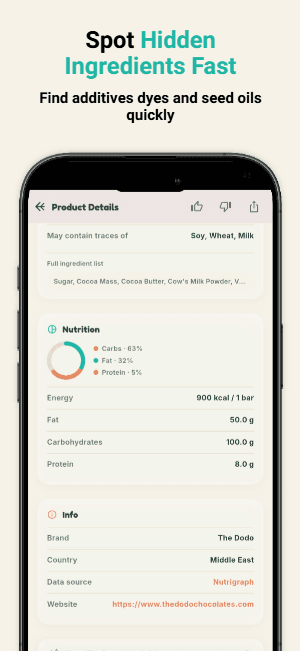
Unlike simplistic barcode scanners that assign arbitrary, moralizing ‘health scores’ out of 100, Food Scan Genius delivers objective, medically grounded intelligence. Through ScanGenius AI Insight, parents receive transparent, nuanced evaluations incorporating official NOVA 1–4 ultra-processing classifications and validated Nutri-Score data. Furthermore, our Multi-Household Family Profiles allow a parent to scan a pouch once and instantly receive named fail attribution—clearly displaying whether a product is iron-rich and safe for the infant while flagging ‘Fails for Sri (Gluten)’ or ‘Fails for Marcus (Sesame).’ Operating with 100% free core power with zero paywalled scans and featuring real-time translation across 11 global languages, Food Scan Genius empowers parents to blend the time-saving convenience of commercial foods with the clean ingredient integrity of homemade cooking.
4. Related Food Safety & Dietary Guides
- Best Food Allergy Scanner App – Scan Food Labels Instantly — Food Allergy & Sensitivity Scanner Hub
- The 7 Best Free Food Scanner Apps of 2026 — best free food scanner apps
- Choosing the Best Barcode Scan App for Your Health — guide to choosing a barcode scanner app
- Food Scan Genius: World’s #1 Food Ingredient Scanner App — Food Scan Genius scanner app
5. Scientific & Health Authority References
- FDA Food Allergen Labeling & Consumer Protection Act (FALCPA)
- European Food Safety Authority (EFSA) Additive Safety Regulations
- PubMed Research on Ultra-Processed Foods & Gut Microbiome Disruption
- World Health Organization Guidelines on Healthy Diets & Saturated Fats
6. How to Scan in 3 Simple Steps
- Download the Food Scan Genius app for free on iOS or Android—unlocking enterprise-grade scanning with zero paywalls or subscription gates.
- Configure your Family Profile: add your infant’s nutritional parameters, activate iron-deficiency screening, and toggle customized sensitivities for hidden thickeners, seed oils, or specific food allergens.
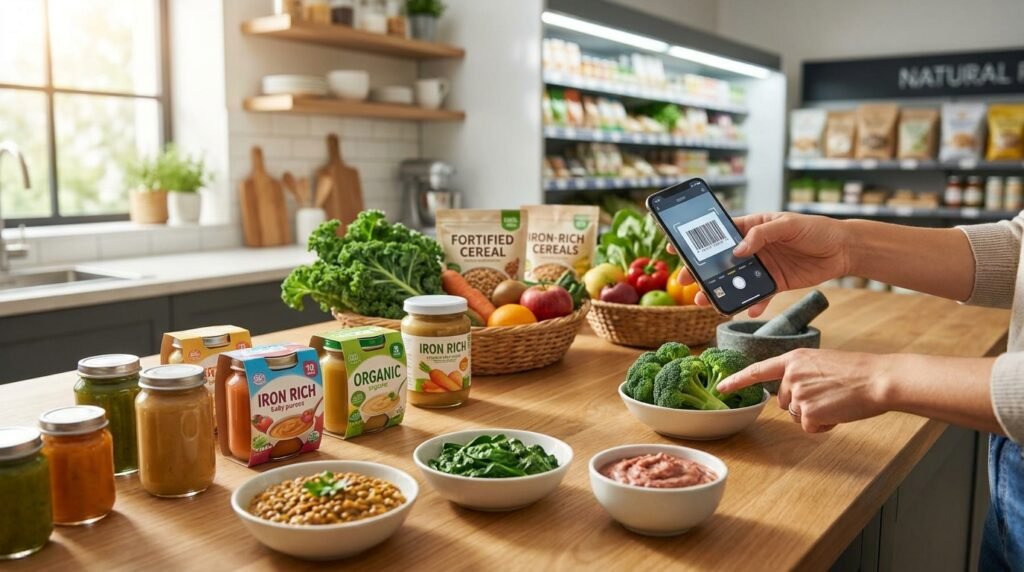
- Scan any store-bought infant food barcode in under two seconds to view instant AST recursive ingredient breakdowns, NOVA 1-4 processing tiers, and ScanGenius AI bioavailability insights.
Personalized Match & AI Insight
7. Frequently Asked Questions (FAQ)
What makes infant foods high in iron so critical after six months of age?
Babies are born with natural iron stores acquired during gestation, but these reserves steadily decline and become essentially depleted between four and six months. Breast milk contains minimal iron, making dietary replenishment essential. Adequate iron is required for synthesis of hemoglobin and for healthy neurological development, specifically myelin sheath formation in the brain. Without sufficient iron intake from diverse complimentary foods, infants risk iron-deficiency anemia, which can cause long-term cognitive and developmental delays.
Is homemade baby food always better for iron levels than store-bought options?
Not necessarily. While homemade baby food gives parents absolute control over whole-food ingredients and eliminates industrial processing aids, plant-based homemade purees (such as pureed spinach, peas, or sweet potatoes) supply non-heme iron, which has low natural bioavailability (often below 5%). If parents do not properly combine these plant foods with Vitamin C or incorporate heme sources like braised beef or pasture-raised poultry livers, the actual absorbed iron may fall short of infant daily requirements. Commercial baby foods are frequently fortified, but may contain excess sugars, thickeners, or high-heat degraded nutrients. Food Scan Genius helps bridge this gap by auditing store-bought formulations instantly.
How does Food Scan Genius identify whether a store-bought baby food actually contains enough bioavailable iron?
Food Scan Genius utilizes the NutriGraph Database and recursive Abstract Syntax Tree (AST) parsing to evaluate not just the front-label claims, but the entire sub-ingredient hierarchy. The app breaks down whether the iron source is heme-based (meat/poultry) or non-heme based (iron salts like electrolytic iron or ferrous fumarate), flags whether potent inhibitors like phytic acid flours or high-calcium dairy blends are present, and highlights whether natural ascorbic acid (Vitamin C) is included to assist absorption. This clinical context is delivered cleanly via ScanGenius AI Insight.
Why do commercial baby food pouches list meat on the front but show fruits first on the ingredient list?
Food manufacturers often utilize naming conventions permitted under current labeling guidelines that allow them to highlight appealing ingredients like ‘Beef’ or ‘Turkey’ on the front panel, even if the primary base by weight is water and sweet fruit purees like apple, pear, or banana. This keeps production costs down and ensures the baby readily accepts the sweet taste, but it dramatically lowers the iron density of the meal. Scanning the barcode with Food Scan Genius exposes the true ingredient weight distribution immediately, protecting parents from misleading packaging.
Know What’s In Your Food Before You Buy — Scan Free Today
Never second-guess confusing grocery labels again. Download Food Scan Genius to uncover hidden additives, toxic dyes, and allergens for the whole household before you buy.