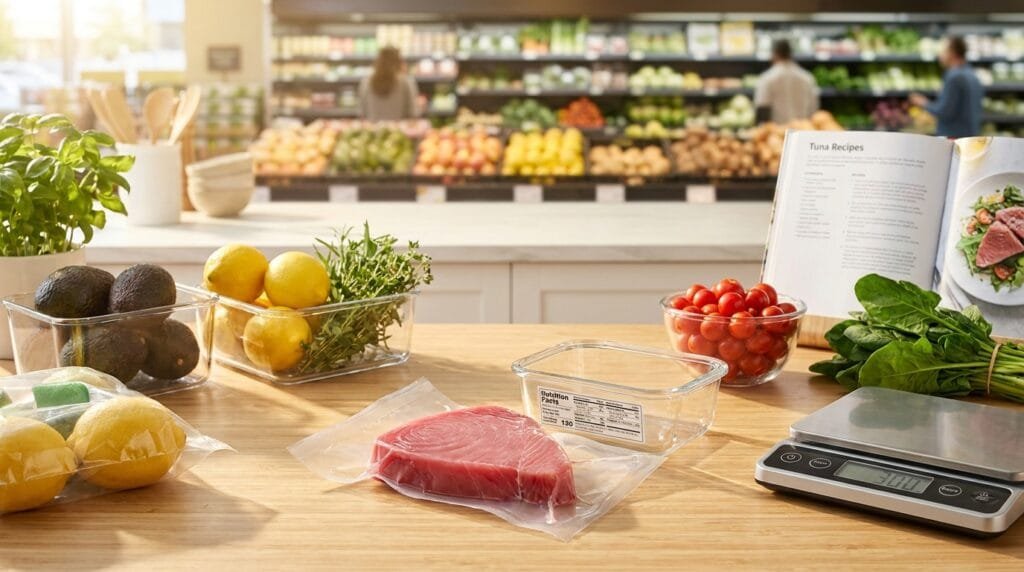
A raw 6-ounce (170-gram) yellowfin tuna steak contains approximately 185 to 220 calories, with 42 grams of protein and under 2 grams of fat. Grilled or seared plain without added cooking oils, that same steak provides roughly 225 calories.
Nutritional Breakdown by Tuna Species, Thermal Moisture Loss, and Culinary Fats
Tuna steaks do not carry a single uniform calorie value because the term encompasses multiple biologically distinct species of pelagic fish, each exhibiting substantially different lipid profiles. The overwhelming majority of retail tuna steaks sold in western supermarkets are yellowfin (Thunnus albacares), often marketed culinarily by its Hawaiian name, ahi. According to the United States Department of Agriculture (USDA) FoodData Central foundation data, raw yellowfin tuna muscle tissue provides approximately 109 kilocalories per 100 grams, containing 24.4 grams of complete protein, 0.49 grams of total lipid, and zero carbohydrates. When scaled to standard retail portions, an uncooked 4-ounce (113-gram) portion yields approximately 123 calories, a 6-ounce (170-gram) steak provides 185 calories, and an 8-ounce (227-gram) cut provides 247 calories. However, if the steak is sourced from albacore (Thunnus alalunga) or Pacific bluefin (Thunnus orientalis), energy density rises dramatically. Albacore yields approximately 172 calories per 100 grams due to its higher intramuscular fat content (over 7 grams of lipids per 100 grams), while premium cuts of bluefin, particularly the ventral abdominal cuts known as belly or toro, can exceed 240 calories per 100 grams.
Understanding caloric density also requires accounting for moisture loss during thermal preparation. Raw tuna muscle consists of roughly 74% to 76% water by mass. When subjected to dry-heat cooking methods such as grilling, broiling, or skillet-searing, myofibrillar proteins (actin and myosin) denature and contract, expelling free and bound intracellular moisture. A 170-gram raw yellowfin steak typically shrinks to approximately 130 to 135 grams when cooked to medium-rare or medium doneness. Because water contains zero kilocalories, the absolute caloric value of the tuna steak remains unchanged by the evaporation process itself; however, the relative energy concentration increases. On a cooked-weight basis, yellowfin tuna yields approximately 132 to 140 calories per 100 grams. A consumer weighing their steak on a kitchen scale after grilling must apply cooked nutritional baselines rather than raw baselines to avoid undercounting their caloric intake by roughly 20% to 25%.
The biochemical structure of tuna lipids further distinguishes it from terrestrial animal proteins. The lean tissue of yellowfin tuna contains negligible quantities of saturated triglycerides and is predominantly composed of long-chain polyunsaturated omega-3 fatty acids, specifically eicosapentaenoic acid (EPA) and docosahexaenoic acid (DHA). Incorporating marine sources rich in long-chain polyunsaturated fats while keeping saturated fat low aligns directly with established nutritional frameworks, including the World Health Organization Guidelines on Healthy Diets & Saturated Fats, which emphasize replacing saturated animal fats with polyunsaturated options to maintain cardiovascular integrity. Consequently, the low baseline caloric density of yellowfin makes it one of the most protein-dense whole foods available, generating over 89% of its total caloric load directly from amino acids.
Caloric inflation in prepared tuna steaks almost exclusively arises from exogenous lipid additions, commercial marinades, and chemical moisture-binding solutions. Fresh retail tuna is frequently enhanced or glazed before sale. Lower-grade frozen tuna steaks are sometimes soaked in water and sodium tripolyphosphate solutions to artificially bloat the wet weight before freezing, which leaches out during cooking, or subjected to industrial marinades containing maltodextrin, high-fructose corn syrup, and emulsified seed oils. These ultra-processed additions fundamentally change the dietary impact of the meal beyond basic calories, an issue highlighted by clinical trials cataloged in PubMed Research on Ultra-Processed Foods & Gut Microbiome Disruption, which demonstrates that industrial processing agents can negatively alter human metabolic signaling and intestinal homeostasis compared to whole, unadulterated animal proteins.
Deciphering Retail Tuna Steak Labels: US Nutrition Panels vs. EU/UK Standards
When examining tuna steaks in retail environments, shoppers encounter sharply divergent labeling conventions depending on geographical jurisdiction and regulatory mandates. In the United States, the Food and Drug Administration (FDA) governs packaged seafood labeling via Title 21 of the Code of Federal Regulations (21 CFR 101.9). Under FDA guidelines, the Reference Amount Customarily Consumed (RACC) for raw or cooked finfish is established at 85 grams cooked or 113 grams (4 ounces) raw. For example, a bag of Kirkland Signature Wild Frozen Ahi Tuna Steaks (sold at Costco) lists a single serving size as 4 ounces (113 grams), declaring 130 calories, 0.5 grams of fat, and 29 grams of protein. Similarly, Trader Joe’s Wild Caught Yellowfin Tuna Steaks states 120 calories and 1 gram of fat per 4-ounce raw serving. However, the individual vacuum-sealed steaks inside these bags are rarely exactly 4 ounces; they routinely weigh between 6 ounces (170 grams) and 8 ounces (227 grams). A consumer who prepares and eats an entire single vacuum-sealed steak from either brand is actually consuming between 180 and 260 calories, effectively consuming 1.5 to 2.0 stated servings.
In contrast, products marketed in the United Kingdom and the European Union adhere to Regulation (EU) No 1169/2011 on the provision of food information to consumers. These regulations legally mandate that nutritional values must be declared per 100 grams (100g) of product as sold, presented alongside energy declarations in both kilojoules (kJ) and kilocalories (kcal). When examining fresh yellowfin tuna at major UK retailers like Waitrose or Tesco, the label explicitly lists raw yellowfin at approximately 458 kJ / 108 kcal per 100g. While UK and EU brands may optionally provide a “per portion” column—often designating an arbitrary portion size such as 120g or 140g—the per-100g metric remains non-negotiable. This standardization prevents the common US labeling trap where manufacturers manipulate serving sizes downward to advertise lower single-digit calorie or fat figures.
Another critical packaging nuance centers on moisture retainers and gas treatment disclosures. In the United States and global export markets, frozen yellowfin tuna is frequently treated with filtered smoke or carbon monoxide (CO) gas to stabilize myoglobin molecules, preserving a bright ruby-red appearance that mimics fresh catch. When examining frozen retail products such as Sea Cuisine or store-brand frozen loins, the ingredient deck will frequently disclose “Filtered Wood Smoke (to retain natural color)” alongside sodium polyphosphates. In Europe, the use of carbon monoxide on fresh or frozen fish is strictly barred under the European Food Safety Authority (EFSA) Additive Safety Regulations, because artificial color fixation can mask microbial spoilage and the formation of toxic histamine (scombroid poisoning). Furthermore, phosphate treatments cause fish muscle tissue to absorb and retain extraneous water; once thawed and cooked, this retained moisture rapidly drains away, leaving the final cooked steak significantly lighter than anticipated.
Accurately logging these portions requires scrutinizing both the net weight printed on the front carton and the specific metric declared in the nutrition facts panel. When cross-referencing pre-seasoned or marinated frozen tuna steaks with the Food Scan Genius mobile app, consumers often detect that added sesame glazes, teriyaki marinades, or cooking fats have elevated an otherwise lean, 130-calorie fish portion into a 320-calorie meal containing upwards of 12 grams of added sugars and 14 grams of lipids. Verifying whether a label’s calorie metric corresponds to the raw fish alone or includes the accompanying liquid tare weight prevents significant dietary miscalculations.
| Tuna Species & State | Portion Size | Calories (kcal) | Protein (g) | Total Fat (g) | Primary Culinary Use |
|---|---|---|---|---|---|
| Yellowfin (Ahi), Raw | 100 g (3.5 oz) | 109 | 24.4 | 0.5 | Sashimi, Poke, Raw Base |
| Yellowfin (Ahi), Raw | 170 g (6.0 oz) | 185 | 41.5 | 0.8 | Standard Raw Retail Steak |
| Yellowfin (Ahi), Grilled/Seared Plain | 135 g (Cooked from 6 oz) | 225 | 41.5 | 1.1 | Dry-heat sear, no added oil |
| Yellowfin, Pan-Seared in 1 tbsp Olive Oil | 149 g (Cooked from 6 oz + fat) | 344 | 41.5 | 15.1 | Traditional pan-fry preparation |
| Albacore, Raw | 100 g (3.5 oz) | 172 | 25.2 | 7.2 | White tuna steaks, high omega-3 |
| Albacore, Raw | 170 g (6.0 oz) | 292 | 42.8 | 12.2 | Standard Raw Retail Cut |
| Pacific Bluefin (Akami / Lean Cut), Raw | 100 g (3.5 oz) | 144 | 23.3 | 4.9 | Loin steaks, sushi cuts |
| Pacific Bluefin (Otoro / Fatty Belly), Raw | 100 g (3.5 oz) | 280 | 18.5 | 22.0 | High-end belly cuts |
| Bigeye Tuna, Raw | 100 g (3.5 oz) | 125 | 28.0 | 1.0 | Grilling, searing loins |
| Skipjack Tuna, Raw | 100 g (3.5 oz) | 103 | 22.0 | 1.0 | Light loins, canned pack base |
Common Calorie Miscalculations and Preparation Errors
The single most widespread error when tabulating tuna steak calories occurs during the pan-searing process. Because tuna steak is exceptionally lean, culinary recipes universally advocate coating the fish in cooking oil or melting butter in a heavy cast-iron skillet to prevent the exterior from tearing and sticking. A standard single tablespoon (14 grams) of extra virgin olive oil, avocado oil, or toasted sesame oil contributes precisely 119 to 124 kilocalories and 14 grams of pure fat. When a cook pours two tablespoons of oil into a pan to sear a 6-ounce yellowfin steak, the fish can absorb between 40% and 70% of that cooking medium depending on surface temperature and searing duration. As a consequence, a baseline 185-calorie raw cut frequently reaches the plate containing anywhere from 300 to 350 calories. If the cook fails to measure the remaining cooking oil and deduct it from the nutritional tally, their caloric entry will be understated by more than 50%.
A secondary tracking mistake stems from conflating canned tuna metrics with whole-muscle tuna steaks. Commercial canned tuna is typically processed from skipjack (Katsuwonus pelamis) or flaked albacore that undergoes high-pressure steam retorting twice inside sealed aluminum cans. Canned “light” tuna packed in spring water contains roughly 86 calories per 100 grams drained, whereas canned tuna packed in vegetable oil retains substantial fat inside the porous muscle flakes even after vigorous draining, yielding approximately 198 calories per 100 grams. Translating the calorie values of drained canned tuna directly to a fresh or thawed yellowfin tuna steak results in distorted calculations, as fresh yellowfin possesses a firmer muscle matrix, lower moisture content than water-packed canned fish, and different whole-tissue density.
Finally, cooks regularly overlook the hidden caloric load embedded within marinades, glazes, and topical coatings. Traditional preparations often call for crusting tuna steaks in whole white or black sesame seeds prior to searing. A seemingly modest 2-tablespoon coating of sesame seeds introduces roughly 104 calories and 9 grams of lipid before any pan oil is introduced. Similarly, standard Asian-style marinades combining low-sodium soy sauce, mirin, brown sugar, honey, and grated ginger introduce fast-digesting carbohydrates that caramelize under high heat. A 30-minute soak in a sweetened soy-mirin marinade can add between 40 and 90 calories per steak in residual surface sugars alone. Moreover, commercial seafood processing and handling requires strict adherence to hygiene standards to prevent allergen cross-contact, as detailed by the Food Allergy Research & Education (FARE) Clinical Standards, reminding consumers that marinades incorporating sesame, soy, or shared allergen equipment carry clinical and dietary implications that extend well beyond macronutrient logs.
Frequently asked questions
How many calories are in an 8-ounce yellowfin tuna steak?
A raw 8-ounce (227-gram) yellowfin tuna steak contains approximately 247 calories, 55 grams of protein, and 1.1 grams of fat. If cooked plain without added fats, it retains essentially the same caloric value despite shrinking in weight to around 6.2 ounces due to water evaporation.
Does searing or grilling a tuna steak reduce its calories?
No, cooking does not reduce calories. The thermal process causes water loss through evaporation and protein contraction, which reduces physical weight but does not eliminate macronutrients. If cooked in butter, olive oil, or marinades, the steak will absorb dietary fats and increase in total calories.
Why does albacore tuna steak have more calories than yellowfin?
Albacore contains a significantly higher concentration of natural intramuscular fat than yellowfin. Raw albacore contains over 7 grams of fat per 100 grams (yielding 172 calories), whereas yellowfin contains less than 1 gram of fat per 100 grams (yielding roughly 109 calories).
How many calories does pan-searing in olive oil add to a tuna steak?
One level tablespoon of olive oil contains 119 calories. Depending on the skillet temperature and whether excess oil is blotted off, a tuna steak typically absorbs between 40% and 75% of the pan oil, which adds roughly 50 to 90 calories to the final cooked dish.
Should I weigh my tuna steak raw or cooked when tracking calories?
Weighing raw is the most accurate method because standard food database entries default to raw, untrimmed states. If you weigh the steak after cooking, you must specifically look up entries labeled ‘cooked, dry heat’ to account for the roughly 20% to 25% moisture loss that concentrates the remaining nutrients.
References
- Food Allergy Research & Education (FARE) Clinical Standards
- European Food Safety Authority (EFSA) Additive Safety Regulations
- PubMed Research on Ultra-Processed Foods & Gut Microbiome Disruption
- World Health Organization Guidelines on Healthy Diets & Saturated Fats
Related guides
- Best Food Allergy Scanner App – Scan Food Labels Instantly — Food Allergy & Sensitivity Scanner Hub
- The 7 Best Free Food Scanner Apps of 2026 — best free food scanner apps
- Choosing the Best Barcode Scan App for Your Health — guide to choosing a barcode scanner app
- Food Scan Genius: World’s #1 Food Ingredient Scanner App — Food Scan Genius scanner app
Check Any Label Against 5 Million Products — Free
Never second-guess confusing grocery labels again. Download Food Scan Genius to uncover hidden additives, toxic dyes, and allergens for the whole household before you buy.