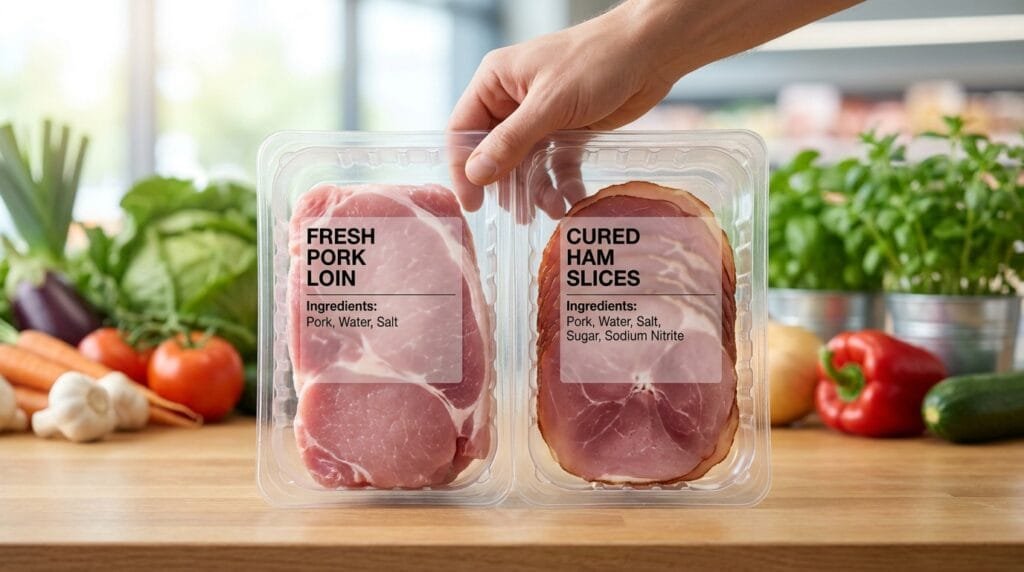
Ham is pork, but pork is not always ham. Ham specifically refers to the hind leg cut of a pig (swine). Most ham is cured or smoked, whereas pork encompasses any culinary meat derived from domestic pigs, including loins, chops, and belly.
Anatomical Cuts, Curing Methods, and Regulatory Definitions
In botanical and culinary taxonomy, the relationship between pork and ham is a category-to-subset distinction: all ham is pork, but not all pork is ham. Pork is the culinary term for the meat of the domestic swine (Sus domesticus), covering every cut from snout to tail. Ham, however, is strictly limited to an anatomical location. Under United States Department of Agriculture regulations outlined in 9 CFR § 319.104, a cut of meat cannot be labeled simply as “ham” unless it is prepared from the hind leg of a swine carcass. Meat taken from the front leg, belly, loin, or jowl cannot legally bear the unqualified name “ham.”
Processing represents the second major differentiator. While standard pork cuts like pork chops, tenderloin, and ribs are generally sold raw and uncured (“fresh pork”), the vast majority of commercial ham undergoes a curing process involving salt, sodium nitrite, and occasionally sugars or smoke. Curing chemically alters the muscle protein structure and prevents bacterial contamination, notably by inhibiting Clostridium botulinum. Within the European Union, curing agents such as potassium nitrate (E252) and sodium nitrite (E250) fall under the European Food Safety Authority (EFSA) Additive Safety Regulations, which set strict maximum residual levels to protect consumer health while ensuring microbiological stability.
An exception to the curing norm is “fresh ham,” which is simply an uncured, raw hind leg roast. Fresh ham has the pale grey-to-white color of cooked pork roast rather than the persistent pink hue of cured ham, which is produced by nitric oxide binding to myoglobin. From a nutritional perspective, fresh cuts of pork loin provide lean protein with baseline sodium levels around 50 to 70 mg per 100 g. Conversely, curing increases the sodium content of ham tenfold to anywhere between 800 and 1,500 mg per 100 g. The World Health Organization Guidelines on Healthy Diets & Saturated Fats recommend limiting daily sodium intake to under 2,000 mg, making the distinction between fresh cuts of pork and processed ham critical for cardiovascular management.
Reading Real Labels: US PFF Classes vs. European Standards
When navigating the packaged deli aisle, the word “Ham” is heavily qualified by regulatory moisture requirements. In the United States, the USDA grades cured ham products according to their Protein Fat-Free (PFF) percentage, which calculates how much water has been pumped into the meat during processing. A product labeled strictly as “Ham” (such as traditional bone-in holiday hams) must have a minimum PFF of 20.5%, meaning virtually no added water weight. A step down is “Ham with Natural Juices” (PFF 18.5%), followed by “Ham Water Added” (PFF 17.0%), such as standard pre-sliced lunchmeats from brands like Oscar Mayer Deli Fresh. Products with a PFF below 17.0% must be labeled “Ham and Water Product,” which often consists of chopped ham pieces mechanically bound together with texturizers and up to 35% added solution.
A major packaging divergence occurs between standard American cured hams and European dry-cured specialties. Consider traditional Italian Prosciutto di Parma: protected under Protected Designation of Origin (PDO) laws, its ingredient panel lists only two items: pork hind leg and Mediterranean sea salt, aged for a minimum of 400 days. There are no nitrates, added water, or chemical binding agents. In contrast, mass-market industrial deli hams—such as commercial honey or smoked hams—frequently incorporate sodium phosphates, carrageenan, modified cornstarch, and artificial smoke flavoring to bind retained water into a stable emulsion. The presence of non-meat fillers and binders means consumers with specific dietary restrictions must scan ingredient statements carefully. Scanning packaged cold cuts using Food Scan Genius allows buyers to immediately detect additives, added sugars, and allergen derivatives that manufacturers often include in composite ham products.
Label reading also demands attention to allergen disclosures and processing aids. Under the FDA Food Allergen Labeling & Consumer Protection Act (FALCPA), glaze components on prepared hams must clearly declare major allergens such as wheat (often found in modified food starches or soy-sauce-derived glazes). Furthermore, the structural degradation found in water-heavy, sectioned-and-formed lunch meats places them into the ultra-processed food (UPF) category. Emerging biomedical reviews, such as PubMed Research on Ultra-Processed Foods & Gut Microbiome Disruption, demonstrate how continuous exposure to dietary emulsifiers, phosphates, and high-salt matrices common in industrial reconstituted deli meats can alter intestinal microflora compared to consuming minimally processed, single-ingredient whole-muscle pork cuts.
| Product / Cut Type | Anatomical Origin | Curing Method | USDA Minimum PFF | Typical Sodium (per 100g) |
|---|---|---|---|---|
| Fresh Pork Loin | Dorsal muscle (back) | None (Uncured, raw) | N/A (Fresh meat) | 50–65 mg |
| Fresh Ham (Green Ham) | Hind leg of swine | None (Uncured, raw) | N/A (Fresh meat) | 55–70 mg |
| Ham (Unqualified) | Hind leg of swine | Wet cure or dry cure | 20.5% | 850–1,100 mg |
| Ham with Natural Juices | Hind leg of swine | Wet brine injection | 18.5% | 900–1,200 mg |
| Ham Water Added | Hind leg of swine | Wet brine injection | 17.0% | 1,000–1,350 mg |
| Ham & Water Product | Hind leg fragments | Restructured emulsion | < 17.0% | 1,100–1,500 mg |
| Prosciutto / Country Ham | Hind leg of swine | Dry salt cure & aged | Exempt (moisture lost) | 1,800–2,600 mg |
Common Confusions: Picnic Ham, Turkey Ham, and Restructured Loaves
A frequent point of confusion among grocery shoppers is the cut marketed as “Picnic Ham.” Anatomically, a picnic ham is not ham at all; it is a cut taken from the upper front leg and shoulder of the pig, formally designated as the “pork shoulder picnic.” While it is frequently cured and smoked to mimic the flavor and texture of authentic ham, USDA labeling guidelines forbid selling it as simply “ham.” The word “shoulder” or “picnic” must appear with equal prominence on the label. Shoulder meat features more connective tissue, a higher fat profile, and distinct grain structures compared to the leaner, denser muscle tissue of the true hind leg.
Another common misinterpretation arises with non-pork poultry alternatives, primarily “Turkey Ham.” Consumers sometimes wonder whether turkey ham contains a mixture of pork and turkey. By federal definition (9 CFR § 381.171), turkey ham contains zero pork. It is made entirely from cured, smoked, and cooked meat taken exclusively from the thigh muscle of a turkey. It was formulated as a pork alternative for individuals adhering to religious dietary laws (such as Halal or Kosher practices) or those seeking lower-fat cold cuts, but the inclusion of the word “ham” strictly describes the style of preparation—cured dark meat processed to mimic the taste and texture of pig leg ham.
Finally, consumers often mistake whole-muscle ham for “sectioned and formed” or “chopped and formed” ham. Whole-muscle hams retain the natural grain of one or more whole muscles from the hind leg. In contrast, sectioned and formed hams are created by taking smaller chunks or trimmings of cured pork leg, mechanically tumbling them to extract the protein myosin, and pressing them into molds to be cooked. When sliced, whole-muscle ham displays a natural, irregular grain with intact fat lines, whereas restructured ham presents a uniform, rubbery cross-section without distinct muscle division.
Frequently asked questions
Is bacon the same thing as ham?
No. In the United States, bacon is prepared from the fatty pork belly, whereas ham is exclusively harvested from the pig’s hind leg. Both are typically cured and smoked, but bacon contains substantially higher fat levels (around 40% to 50% fat by weight) compared to whole-muscle ham (often under 5% to 10% fat).
Is ham strictly forbidden in Halal and Kosher diets?
Yes. Because ham is harvested from swine (pork), it is strictly non-kosher (treif) under Jewish kashrut laws and haram under Islamic dietary laws. Products labeled “turkey ham” or “beef ham” do not contain pork and may be consumed if the poultry or beef was slaughtered according to religious standards.
What is the difference between fresh ham and cured ham?
Fresh ham is an uncooked, uncured rear leg of a pig. When roasted, it tastes and looks like standard pork roast, with pale grey-white meat. Cured ham has been treated with salt and sodium nitrites, which preserves the meat, imparts a salty-savory flavor profile, and permanently fixes its color to pink.
What does ‘ham with natural juices’ mean on grocery packaging?
This USDA classification indicates the ham has been cured using brine injection but retains a Protein Fat-Free (PFF) level of at least 18.5%. It contains only a modest amount of added water (typically around 7% to 8%), resulting in a firmer texture than cheaper ‘ham water added’ options.
Is prosciutto considered pork or ham?
Prosciutto is both: it is pork, and it is an authentic ham. Prosciutto is the Italian culinary term for ham, made exclusively by dry-curing the whole hind leg of a pig with sea salt over an extended aging period ranging from 9 months to 3 years.
References
- FDA Food Allergen Labeling & Consumer Protection Act (FALCPA)
- European Food Safety Authority (EFSA) Additive Safety Regulations
- PubMed Research on Ultra-Processed Foods & Gut Microbiome Disruption
- World Health Organization Guidelines on Healthy Diets & Saturated Fats
Related guides
- Best Food Allergy Scanner App – Scan Food Labels Instantly — Food Allergy & Sensitivity Scanner Hub
- The 7 Best Free Food Scanner Apps of 2026 — best free food scanner apps
- Choosing the Best Barcode Scan App for Your Health — guide to choosing a barcode scanner app
- Food Scan Genius: World’s #1 Food Ingredient Scanner App — Food Scan Genius scanner app
Check Any Label Against 5 Million Products — Free
Never second-guess confusing grocery labels again. Download Food Scan Genius to uncover hidden additives, toxic dyes, and allergens for the whole household before you buy.