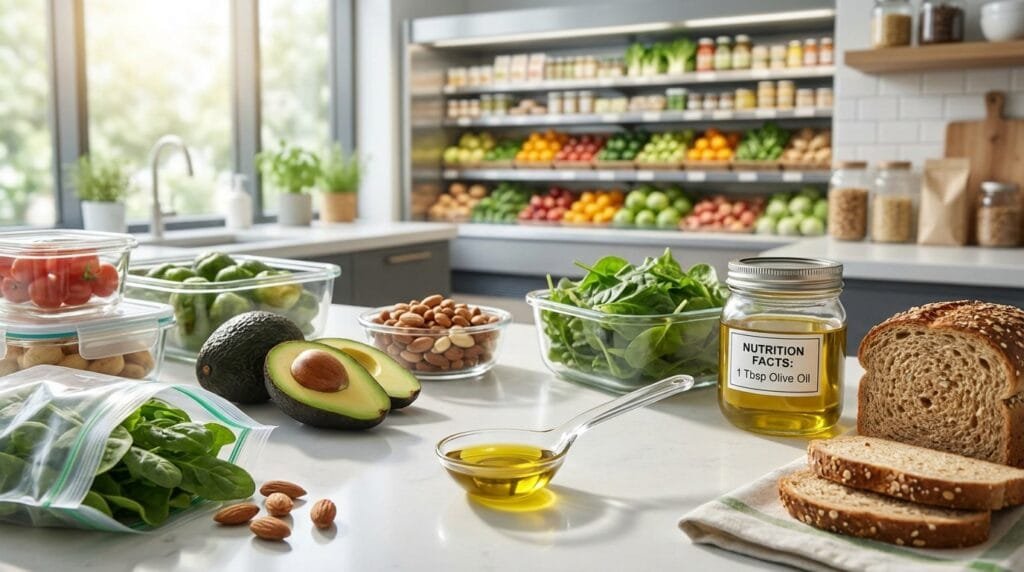
One US tablespoon (15 mL or 13.5 g) of olive oil contains 119 calories, 13.5 grams of total fat (9.9 g monounsaturated, 1.9 g saturated, and 1.4 g polyunsaturated), 1.9 mg of vitamin E, and zero carbohydrates, protein, or sodium.
Comprehensive Lipid Composition and Micronutrient Breakdown of One Tablespoon
According to standard reference data from the United States Department of Agriculture (USDA) FoodData Central (FDC ID: 171413), a single metric tablespoon of pure olive oil measures approximately 14.9 millilitres, weighing roughly 13.5 to 13.7 grams depending on ambient temperature and oil density. This single tablespoon yields precisely 119.3 kilocalories (commonly rounded to 119 kcal in nutritional databases and 120 kcal on commercial product panels). Because olive oil is an extracted plant lipid, 100% of these calories originate from dietary fat. It contains strictly 0.0 grams of dietary fiber, total carbohydrates, digestible sugars, and dietary proteins. Its sodium, potassium, and water content are practically zero, making it a pure macronutrient energy source defined by its complex fatty acid composition.
The fat matrix of one tablespoon of olive oil consists predominantly of monounsaturated fatty acids (MUFAs), accounting for approximately 73% of the total lipid volume (roughly 9.85 to 10.0 grams). The primary constituent is oleic acid (cis-18:1 n-9), an omega-9 monounsaturated fatty acid known for its structural stability against peroxidation. Saturated fatty acids (SFAs) constitute roughly 14% of the volume, delivering approximately 1.86 to 1.95 grams per tablespoon, largely made up of palmitic acid (C16:0) and stearic acid (C18:0). Polyunsaturated fatty acids (PUFAs) make up the remaining 11%, providing roughly 1.42 grams, which splits between linoleic acid (an omega-6 fatty acid, ~1.31 g) and alpha-linolenic acid (an omega-3 essential fatty acid, ~0.11 g). Aligning dietary fat intake to favor monounsaturated fats over saturated alternatives reflects the foundational recommendations established in the World Health Organization Guidelines on Healthy Diets & Saturated Fats, which emphasize keeping saturated fats below 10% of total daily energy intake.
Beyond macronutrients, a tablespoon of extra virgin olive oil provides notable lipid-soluble micronutrients and minor bioactive compounds. Chief among them is alpha-tocopherol (Vitamin E), delivering 1.94 milligrams per tablespoon, which accounts for roughly 13% of the daily recommended dietary allowance (RDA) for adults. Vitamin K (specifically phylloquinone) is present at approximately 8.1 micrograms per tablespoon, fulfilling approximately 7% to 9% of daily adult requirements. Virgin and extra virgin grades also contain an array of phenolic compounds—such as oleocanthal, oleuropein, and hydroxytyrosol—averaging between 2 and 5 milligrams per tablespoon. The physiological efficacy of these minor polar components has been recognized in official evaluations, meeting criteria outlined in European Food Safety Authority (EFSA) Additive Safety Regulations and health claim frameworks that acknowledge olive oil polyphenols for contributing to the protection of blood lipids from oxidative stress when consumed at a minimum threshold of 5 mg of hydroxytyrosol and its derivatives per 20 g of oil daily.
Interpreting Real-World Labels: US Nutrition Panels vs. European Standards
When reading commercial packaging in the grocery aisle, shoppers encounter noticeable mathematical discrepancies dictated by international labeling laws. In the United States, under Food and Drug Administration (FDA) regulation 21 CFR 101.9, the Reference Amount Customarily Consumed (RACC) for cooking oils is officially defined as 1 tablespoon (15 mL). FDA rounding mandates dictate that any calorie count between 50 and 140 calories must be rounded to the nearest 10-calorie increment. Consequently, major commercial brands like California Olive Ranch (100% California Extra Virgin), Pompeian (Smooth Extra Virgin), and Bertolli (Original Rich Taste) list 120 Calories per serving on their Nutrition Facts panels rather than the laboratory figure of 119 kcal. Furthermore, the FDA mandates rounding total fat to the nearest 0.5 gram below 5 grams and the nearest whole gram above 5 grams; thus, total fat appears as 14g, while saturated fat (analytically 1.86g–1.95g) is rounded up to 2g per serving.
In contrast, products bottled and labeled in the European Union and the United Kingdom follow Regulation (EU) No 1169/2011, which does not base its primary nutrition declaration on subjective portion sizes like tablespoons. Instead, European labels mandate nutritional values per 100 grams or per 100 milliliters. Because olive oil has a specific gravity (density) of roughly 0.913 to 0.918 g/cm³ at 20°C, a 100 mL volume weighs only 91.5 grams. European bottles of Filippo Berio or Monini therefore state roughly 824 kcal (3,389 kJ) per 100 mL, or 900 kcal (3,700 kJ) per 100 g. When an EU brand includes a voluntary serving size icon for 1 tablespoon (15 mL), the values are derived via linear division rather than heavy rounding, showing 124 kcal (508 kJ) based on 100 mL, or 122 kcal based on mass. Consumers checking both domestic and imported packaging frequently misinterpret these differences as formulation variations, when in reality the physical commodity inside the bottle is identical.
Another label complexity involves co-packaging and facility cross-contamination warnings. Pure single-ingredient olive oils contain no tree nuts, peanuts, or seeds; however, industrial bottling lines often handle sesame, walnut, or soybean oils. Rigorous compliance under Food Allergy Research & Education (FARE) Clinical Standards dictates that manufacturers disclose potential cross-contact risks on the back panel when shared equipment is utilized. For shoppers tracking microscopic dietary parameters or verifying whether a domestic bottle includes adulterated seed oils or misaligned serving measurements, using the Food Scan Genius mobile app provides an immediate verification check by parsing the universal product code (UPC) and highlighting precise database-verified nutritional breakdowns directly against FDA and international regulatory thresholds.
| Nutrient / Metric | 1 Tablespoon (15 mL / ~13.7 g) | 100 Milliliters (~91.5 g) | 100 Grams (~109.3 mL) | % Daily Value per 1 Tbsp* |
|---|---|---|---|---|
| Energy (Kilocalories) | 119.3 kcal (120 FDA) | 824 kcal | 884 – 900 kcal | 6.0% |
| Total Fat | 13.5 g – 14.0 g | 91.5 g | 100.0 g | 17.9% |
| — Monounsaturated (Oleic) | 9.85 g | 66.8 g | 73.0 g | N/A |
| — Saturated Fat | 1.86 g (2.0g FDA) | 12.6 g | 13.8 g | 9.3% |
| — Polyunsaturated Fat | 1.42 g | 9.6 g | 10.5 g | N/A |
| — Trans Fatty Acids | 0.0 g | 0.0 g | 0.0 g | 0% |
| Cholesterol | 0.0 mg | 0.0 mg | 0.0 mg | 0% |
| Sodium | 0.0 mg | 0.0 mg | 0.0 mg | 0% |
| Total Carbohydrates | 0.0 g | 0.0 g | 0.0 g | 0% |
| Protein | 0.0 g | 0.0 g | 0.0 g | 0% |
| Vitamin E (alpha-tocopherol) | 1.94 mg | 13.1 mg | 14.3 mg | 12.9% |
| Vitamin K (phylloquinone) | 8.13 mcg | 55.1 mcg | 60.2 mcg | 6.8% |
| Total Biophenols (EVOO only) | 2.0 – 8.0 mg | 15.0 – 55.0 mg | 18.0 – 60.0 mg | N/A |
*Percent Daily Values (% DV) are based on a standard 2,000-calorie reference diet for adults.
Common Measurement Errors, Grade Variations, and Cooking Myths
A frequent error among home cooks is assuming that different commercial grades of olive oil—such as “Extra Virgin,” “Virgin,” “Pure Olive Oil,” or “Light Tasting Olive Oil”—contain different calorie levels. Every grade of olive oil delivers precisely the same caloric value: roughly 119 to 120 calories per tablespoon. The label term “Light” refers exclusively to the color, sensory profile, and degree of industrial refining, not a reduction in lipids or energy density. Refined oils have undergone chemical filtration, deodorization, and thermal treatment to remove free fatty acids and volatile aromatics. While refined varieties lack the distinct pungency and phenolic bioactives of cold-extracted extra virgin oil, their core triglyceride framework remains unchanged at 9 calories per gram of fat.
Another common mistake stems from visual estimation rather than volumetric or gravimetric measurement. In unmeasured home cooking, “free-pouring” from a bottle into a frying pan or over a salad dressing bowl consistently leads to significant portion distortion. Laboratory and kitchen trials demonstrate that an uncalibrated five-second pour routinely dispenses between 28 and 42 mL of oil—the equivalent of two to three full tablespoons (240 to 360 calories)—rather than the intended single tablespoon. Because olive oil is an energy-dense fat, an unintended surplus of just 10 mL adds approximately 80 calories to a meal without adding structural satiety. Precise culinary tracking requires using a calibrated 15 mL measuring spoon or a digital kitchen scale tared to zero (target weight: 13.5 to 13.7 grams).
Finally, concerns regarding the destruction of olive oil nutrients at standard culinary temperatures are frequently overstated. Extra virgin olive oil possesses an average smoke point between 190°C and 210°C (375°F to 410°F), comfortably above the threshold of gentle sauteing and typical pan roasting. While extended heating above 200°C gradually degrades heat-sensitive biophenols and causes minor evaporation of aromatic esters, the monounsaturated oleic acid backbone remains chemically stable. Unlike heavily industrialized seed oils with elevated polyunsaturated ratios, minimally processed olive oil resists rapid thermal oxidation, avoiding the lipid degradation pathways highlighted in PubMed Research on Ultra-Processed Foods & Gut Microbiome Disruption that link heavily degraded, re-heated industrial vegetable fats to intestinal inflammation and cellular stress.
Frequently asked questions
Does extra virgin olive oil have fewer calories than regular or light olive oil?
No. All culinary grades of olive oil—including extra virgin, virgin, pure, and light olive oil—contain identical energy densities of approximately 119 to 120 calories and 13.5 to 14 grams of fat per tablespoon. The descriptor ‘light’ refers strictly to sensory properties like neutral taste and light color, not a reduction in fat or caloric content.
How much vitamin E is provided by 1 tablespoon of olive oil?
One tablespoon of olive oil contains approximately 1.94 milligrams of alpha-tocopherol (Vitamin E). This volume supplies roughly 13% of the established adult Recommended Dietary Allowance (RDA) of 15 milligrams per day.
Why do US nutrition labels list 120 calories when chemical analysis shows 119?
Under FDA 21 CFR 101.9, food manufacturers must round caloric values above 50 calories to the nearest 10-calorie increment. Because analytical tests show pure olive oil yields roughly 119.3 kcal per 15 mL serving, US brands are legally mandated to round this figure to 120 Calories.
Does 1 tablespoon of olive oil weigh 15 grams on a digital food scale?
No. Olive oil is less dense than water, possessing a specific gravity of roughly 0.913 to 0.918 g/mL at room temperature. Therefore, a volumetric tablespoon of 15 mL weighs approximately 13.5 to 13.7 grams on a calibrated digital scale.
Does olive oil contain any carbohydrates, sugars, or sodium?
No. Olive oil is an extracted 100% lipid product. It contains zero grams of carbohydrates, zero dietary sugars, zero dietary fiber, zero protein, and zero milligrams of sodium per serving.
References
- Food Allergy Research & Education (FARE) Clinical Standards
- European Food Safety Authority (EFSA) Additive Safety Regulations
- PubMed Research on Ultra-Processed Foods & Gut Microbiome Disruption
- World Health Organization Guidelines on Healthy Diets & Saturated Fats
Related guides
- Best Food Allergy Scanner App – Scan Food Labels Instantly — Food Allergy & Sensitivity Scanner Hub
- The 7 Best Free Food Scanner Apps of 2026 — best free food scanner apps
- Choosing the Best Barcode Scan App for Your Health — guide to choosing a barcode scanner app
- Food Scan Genius: World’s #1 Food Ingredient Scanner App — Food Scan Genius scanner app
Check Any Label Against 5 Million Products — Free
Never second-guess confusing grocery labels again. Download Food Scan Genius to uncover hidden additives, toxic dyes, and allergens for the whole household before you buy.