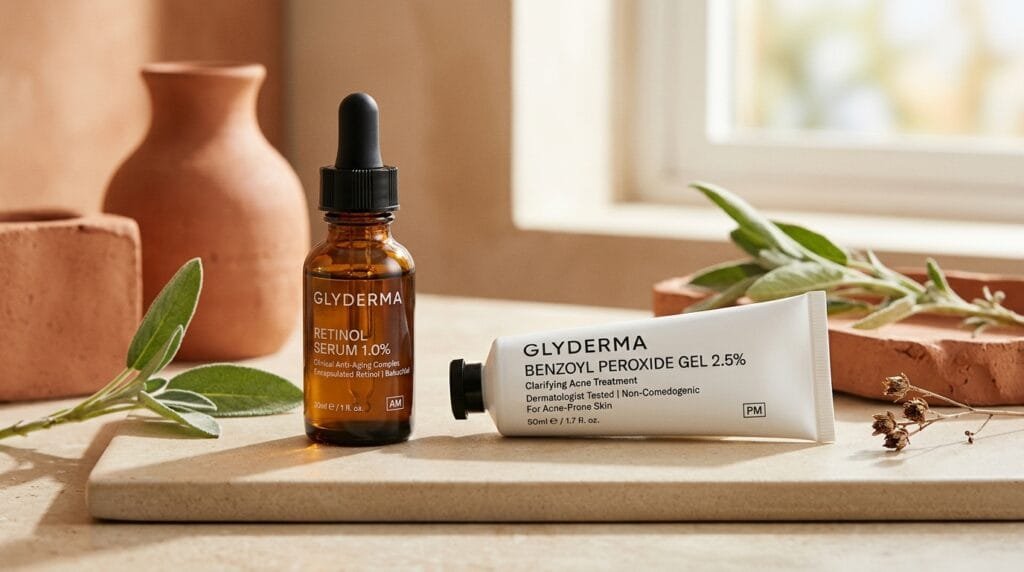
For anyone battling adult acne, hormonal breakouts, or persistent closed comedones, the urge to combine the two most potent acne-fighting ingredients in dermatology—Benzoyl Peroxide (BPO) and Retinol—is completely understandable. Benzoyl Peroxide is the unmatched king of eradicating acne-causing bacteria without inducing bacterial resistance, while Retinol regulates follicular hyperkeratinization and prevents pore blockages from forming in the first place.
However, mixing traditional Retinol and Benzoyl Peroxide in the same routine creates a biochemical phenomenon known as the Oxidation Trap. Instead of delivering a synergistic acne knockout blow, Benzoyl Peroxide chemically destroys the Retinol molecule on contact, leaving you with an inactivated formula, wasted money, and an acutely inflamed, peeling skin barrier.
In this clinical investigation, we examine the molecular redox chemistry that explains why Benzoyl Peroxide degrades retinoids, why pharmaceutical combinations like Adapalene are an exception to the rule, and the exact clinical protocols approved by dermatologists to treat stubborn acne effectively without barrier sacrifice.
Don't let hidden pH mismatches, ingredient oxidation, or barrier collapse cancel out your anti-aging results. Skin Scan Genius cross-references your AM & PM shelfie against 2,800+ cosmetic actives in seconds.
The Chemistry of the Oxidation Trap: How BPO Inactivates Retinol
To understand why this pairing fails, one must examine the fundamental chemical nature of both compounds. They exist on polar opposite ends of the oxidation-reduction (redox) spectrum.
1. Benzoyl Peroxide: A Potent Free-Radical Oxidizer
Benzoyl Peroxide ($C_{14}H_{10}O_4$) is an organic peroxide consisting of two benzoyl groups bridged by a peroxide bond. When applied to the skin, the peroxide bond undergoes homolytic cleavage, releasing benzoic acid and reactive oxygen free radicals:
- Targeting Anaerobic Bacteria: Cutibacterium acnes is an obligate anaerobe that thrives exclusively in an oxygen-deprived follicular environment. The deluge of reactive oxygen species generated by BPO destroys bacterial cell membranes through lipid peroxidation. Because this mechanism is oxidative rather than antibiotic, bacteria cannot develop resistance to it.
- Collateral Oxidative Potential: Unfortunately, these reactive oxygen species do not discriminate between bacterial membranes and other vulnerable organic compounds sitting on your skin surface.
2. Retinol: An Oxidation-Sensitive Polyene Hydrocarbon
Retinol is a polyisoprenoid lipid featuring an unsaturated cyclohexenyl ring and a conjugated hydrocarbon side chain terminating in an alcohol group:
- Conjugated Double Bonds: The therapeutic potency of the retinoid molecule resides entirely within its delicate system of conjugated double bonds ($C=C$). These alternating double bonds allow the molecule to interact precisely with cellular retinoic acid receptors (RAR).
- Extreme Susceptibility to Cleavage: These exact conjugated double bonds make retinol notoriously unstable. They are hyper-reactive toward light, atmospheric oxygen, and especially oxidizing agents.
3. The Destruction Reaction
When you apply a Benzoyl Peroxide gel and layer a Retinol serum over it, an instantaneous redox reaction takes place. The oxygen radicals generated by Benzoyl Peroxide attack the conjugated double bonds of the retinol molecule, breaking its backbone into inactive degradation fragments (such as 5,6-epoxyretinol and other biologically inert oxidation products).
A benchmark study published in the National Center for Biotechnology Information (NCBI) on retinoid-peroxide stability demonstrated that when unformulated tretinoin or retinol is exposed to Benzoyl Peroxide, up to 80% to 95% of the retinoid is degraded and deactivated within 2 to 4 hours of application. You receive virtually none of the cellular anti-aging or pore-regulating benefits of the retinoid, while simultaneously enduring the additive drying and barrier irritation of both agents.
Biochemical Breakdown: Retinol vs. Benzoyl Peroxide
| Parameter | Benzoyl Peroxide (BPO) | Retinol (Vitamin A) |
|---|---|---|
| Primary Target | Cutibacterium acnes bacterial proliferation | Follicular hyperkeratosis & epidermal gene transcription |
| Chemical Nature | Potent oxidizing agent (Releases free radical ROS) | Delicate polyunsaturated alcohol (Easily oxidized) |
| Optimal Routine Timing | Morning (AM) or Wash-Off short-contact therapy | Evening (PM) exclusively (Photolabile in sunlight) |
| Cutaneous Side Effects | Erythema, stratum corneum dryness, clothing bleaching | Retinoid dermatitis, micro-flaking, transient purging |
| Direct Layering Result | CHEMICAL DESTRUCTION: BPO rapidly oxidizes the retinoid molecule into inactive metabolites, causing severe barrier inflammation with zero retinoid efficacy. | |
Why Does Epiduo (Adapalene + BPO) Exist? The Third-Generation Exception
Skincare consumers frequently ask a perceptive question: "If Benzoyl Peroxide destroys Retinol, why do dermatologists prescribe Epiduo, which contains Benzoyl Peroxide (2.5%) and Adapalene (0.1%) in the exact same tube?"
The answer lies in molecular engineering. Adapalene is not Retinol. It is a third-generation synthetic retinoid derived from naphthoic acid:
- Rigid Aromatic Backbone: Chemists replaced the flexible, oxidation-vulnerable polyene chain of natural retinol with a rigid, aromatic adamantyl benzene ring structure.
- Resistance to Free Radicals: Clinical trials published in the Journal of the American Academy of Dermatology (JAAD) proved that Adapalene is completely stable in the presence of Benzoyl Peroxide, even under high ambient light and oxygen exposure.
- Tretinoin vs Adapalene: While Adapalene resists BPO oxidation, conventional Retinol, Retinaldehyde, and Tretinoin lack this rigid aromatic architecture and will be rapidly degraded if layered with Benzoyl Peroxide.
For more details on protecting your skin barrier with non-comedogenic ingredients while using acne actives, review our guides on non-comedogenic ingredient screening and silicone occlusion and moisture retention.
Don't let hidden pH mismatches, ingredient oxidation, or barrier collapse cancel out your anti-aging results. Skin Scan Genius cross-references your AM & PM shelfie against 2,800+ cosmetic actives in seconds.
Dermatologist-Approved Protocols: How to Safely Combine BPO and Retinol
Because Benzoyl Peroxide and Retinol attack acne from two complementary angles (bacterial eradication vs pore clearance), combining their therapeutic power is the gold standard in acne management—provided they are separated physically.
Protocol 1: Diurnal AM/PM Separation (The Most Popular Approach)
Separating the two actives by 12 hours ensures that Benzoyl Peroxide clears acne bacteria during the day, while Retinol accelerates cellular remodeling during the night.
- Morning Routine:
- Cleanse with a gentle, hydrating foaming wash.
- Apply a thin layer of 2.5% Benzoyl Peroxide gel to breakout-prone zones. (Clinical evidence demonstrates that 2.5% BPO provides identical bacterial kill rates to 10% BPO, but with a fraction of the barrier irritation).
- Apply a lightweight, ceramide-rich oil-free moisturizer.
- Apply broad-spectrum mineral or chemical SPF 50+ (crucial to prevent post-inflammatory erythema from darkening into permanent pigmentation).
- Evening Routine:
- Cleanse thoroughly with a gentle cleanser to remove sunscreen and daytime sebum.
- Ensure skin is completely dry for at least 3 minutes.
- Apply a pea-sized amount of Retinol or Tretinoin over the entire face.
- Seal with a barrier-replenishing night cream rich in squalane, ceramides, and cholesterol.
Protocol 2: Short-Contact BPO Wash Therapy (Best for Sensitive Skin)
If leave-on Benzoyl Peroxide causes dryness, itching, or bleaches your pillowcases, dermatologists recommend Short-Contact Therapy:
- In the evening, apply a 4% to 5% Benzoyl Peroxide foaming cleanser to the face.
- Gently massage and leave it in contact with the skin for 2 to 3 minutes.
- Rinse thoroughly with lukewarm water and pat dry. Because BPO’s antibacterial mechanism acts within minutes, the bacteria are neutralized while the compound is completely rinsed off the stratum corneum.
- Wait 10 minutes until skin is dry, then apply your Retinol treatment safely without fear of chemical degradation.
If you are also navigating direct exfoliating acids or Vitamin C in your broader routine, consult our sister guides on Retinol and AHA skin cycling and Retinol and Vitamin C timing protocols.
What to Do If You Accidentally Mixed Them
If you layered Benzoyl Peroxide and Retinol together and are now experiencing intense burning, tight flaking, or rash-like redness, your skin is experiencing acute chemical irritation as classified by DermNet NZ's irritant contact dermatitis research:
- Cease All Actives: Immediately pause Benzoyl Peroxide, Retinol, salicylic acid, and vitamin C. Give your skin a 7 to 10 day reset.
- Support the Acid Mantle: Use only a gentle non-soap cleanser and replenish intercellular lipids with a physiological barrier balm containing Ceramides 1, 3, and 6-II as detailed by the National Institutes of Health (NIH) epidermal lipid studies.
- Protect Against Scars: Broken, inflamed skin is prone to hyperpigmentation under UV exposure. Shield your skin daily with a pure zinc oxide sunscreen. Discover how formulation choices affect barrier recovery in our report on clean beauty marketing vs scientific skincare.
Frequently Asked Clinical Questions (FAQ)
Does Benzoyl Peroxide bleach skin?
No. Benzoyl Peroxide does not bleach human melanin or lighten natural skin tone. However, it is an aggressive textile bleacher that will permanently discolor towels, pillowcases, and colored shirts. Wash hands thoroughly after application.
Can I spot-treat with BPO while using Retinol all over?
Applying Retinol all over and then dabbing BPO on active blemishes will still deactivate the Retinol underneath that spot and cause severe localized peeling. If you need targeted spot treatment, use BPO in the morning and reserve nighttime for all-over retinoid therapy.
Can I use Salicylic Acid instead of Benzoyl Peroxide with Retinol?
Salicylic Acid is a beta-hydroxy acid that dissolves sebum inside pores. It does not chemically oxidize Retinol the way BPO does. However, concurrent layering can still trigger excessive dryness and barrier breakdown. Alternating routines remains best practice.
Is 10% Benzoyl Peroxide more effective than 2.5%?
Clinical studies have proven that 2.5%, 5%, and 10% Benzoyl Peroxide formulations demonstrate equivalent efficacy in eradicating C. acnes colonies. However, the 10% concentration causes significantly greater scaling, burning, and barrier disruption. Stick with 2.5% whenever possible.
How can I verify if my other skincare products conflict?
Skincare collision risks extend beyond retinoids and peroxides—comedogenic esters, incompatible pH levels, and silicone occlusives all impact efficacy. Use the Skin Scan Genius routine auditor to scan your entire routine and catch collisions automatically.
Never Guess Active Compatibility Again
Navigating the biochemical nuances of cosmetic actives, molecular oxidation states, and skin barrier tolerances is complex. One misstep can lead to weeks of redness, peeling, and interrupted progress. Skin Scan Genius takes the guesswork out of clear skin. By analyzing your entire shelfie against 2,800+ cosmetic ingredients, the Skin Scan Genius routine auditor maps your complete routine, prevents disastrous chemical clashes, and customizes a clinical regimen tailored specifically to your skin concerns.