One cup (245g) of hot and sour soup averages 95 to 110 calories, 4 to 6 grams of protein, 3 to 4 grams of fat, and 10 to 12 grams of carbohydrates, but delivers 800 to 1,100 milligrams of sodium.
Macro Breakdown: Ingredients, Thickeners, and Sodium Drivers
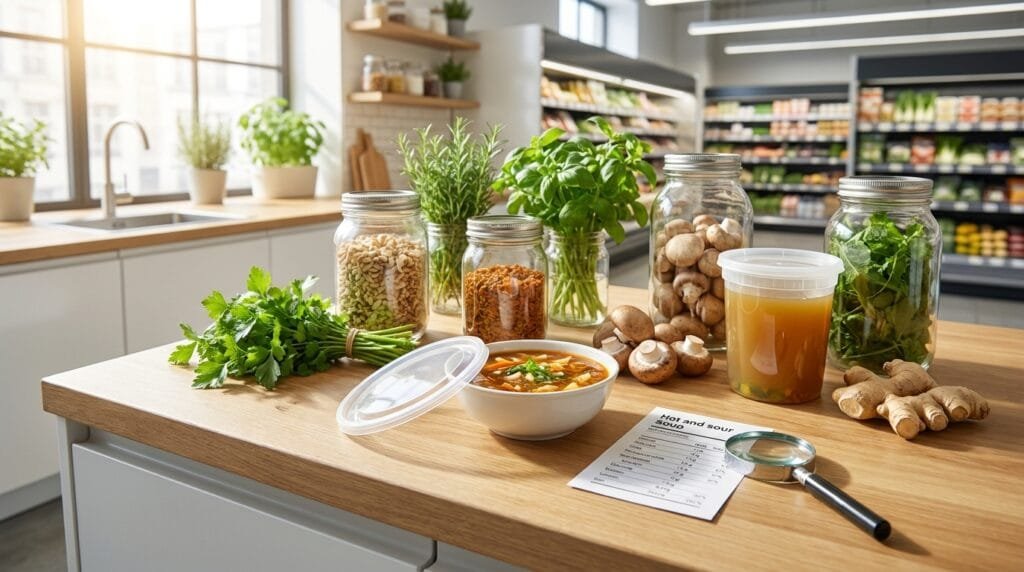
Hot and sour soup (suānlà tāng) is traditionally built from a rich, savory poultry or pork stock, seasoned heavily with Chinkiang vinegar or white vinegar for tartness and white pepper for heat. Solid components typically include firm tofu strips, wood ear mushrooms, bamboo shoots, lily buds (daylily), and beaten eggs drizzled in at the end to create delicate egg ribbons. Meat versions often incorporate slivers of lean pork or pork blood curd. From a macronutrient standpoint, these whole ingredients yield a low-energy-density profile: a standard 245-gram serving (roughly one standard measuring cup or small restaurant bowl) contains just 95 to 110 calories, 4 to 6 grams of protein, and 3 to 4 grams of fat, aligning comfortably with caloric targets defined in the World Health Organization Guidelines on Healthy Diets & Saturated Fats.
However, the carbohydrate and sodium profiles diverge sharply from plain broths. The soup’s signature glossy, viscous texture requires a gelatinized starch slurry, almost universally cornstarch or potato starch. This starch suspension adds 7 to 10 grams of refined, rapidly digestible carbohydrates per cup without providing dietary fiber. While wood ear mushrooms and bamboo shoots contribute roughly 1 gram of insoluble fiber per cup, the overall glycemic impact is dominated by the dissolved starch binder. Restaurant formulations frequently incorporate a small amount of sugar (1 to 2 grams per cup) to cut the sharp edge of the vinegar and balance the dark soy sauce, contributing marginally to the total carbohydrate count.
The principal nutritional variable of concern is sodium. Traditional recipes require dark soy sauce for color, light soy sauce for salinity, and monosodium glutamate (MSG) or commercial chicken bouillon paste for umami depth. Consequently, a single cup delivers between 800 and 1,100 milligrams of sodium—roughly 35% to 48% of the United States Food and Drug Administration’s (FDA) Daily Value (DV) of 2,300 mg. When ordering an entrée-sized takeout portion (often 24 to 32 fluid ounces or 3 to 4 cups), sodium ingestion frequently exceeds 2,500 to 3,200 milligrams in a single meal, completely surpassing daily adult limits.
For individuals managing clinical conditions, allergen declaration rules are critical. Traditional hot and sour soup contains soy (tofu, soy sauce), wheat (fermented wheat in brewed soy sauce), and eggs. Diners with celiac disease, non-celiac gluten sensitivity, or severe food allergies must verify preparation standards against established clinical protocols, such as the Food Allergy Research & Education (FARE) Clinical Standards, because commercial kitchens routinely cross-contaminate cornstarch slurries and use hydrolyzed wheat-derived seasonings.
Reading Real Labels: Packaged Cans vs. Restaurant Portions
Evaluating hot and sour soup nutrition on commercial packaging requires distinguishing between retail canned versions, shelf-stable dehydrated packets, and restaurant takeout containers. A standard US Nutrition Facts panel uses an FDA-mandated Reference Amount Customarily Consumed (RACC) of 245 grams (approximately 1 cup) for prepared soups. For example, a 15-ounce (425g) retail can of ready-to-serve Asian-style hot and sour soup contains approximately 1.7 servings. If a consumer consumes the entire can, the printed label numbers must be multiplied by 1.7. On such a label, an innocent-looking 90 calories and 890 mg of sodium per serving expands to 153 calories and 1,513 mg of sodium for the actual container consumed.
In the European Union and the United Kingdom, Regulation (EU) No 1169/2011 mandates that nutrition information appear per 100 grams or per 100 milliliters alongside voluntary per-portion disclosures. A dehydrated hot and sour soup mix—such as Knorr or Batchelors—will display values per 100g of dry mix alongside the “as prepared” reconstituted figures. In dry form, the mix might show an alarming 340 calories and 8,000 mg of sodium per 100 grams, but when dissolved in 800 ml of boiling water, the per-100ml reconstituted soup falls to roughly 35 calories and 380 mg of sodium. Shoppers scanning barcodes in supermarkets can use the Food Scan Genius app to quickly verify whether a dry packet’s listed sodium threshold refers to the powder itself or the rehydrated volume.
Commercial formulations also differ fundamentally from restaurant broths in their additive composition. Factory-canned soups utilize chemically modified food starches (such as hydroxypropyl distarch phosphate, E1442) rather than native cornstarch to withstand the high temperatures and pressures of canning retorts without separating or retrograding into water. Shelf-stable dry mixes rely heavily on maltodextrin, disodium inosinate, disodium guanylate, caramel color (Class III or IV), and silicon dioxide as an anti-caking agent. These additives adhere to safety thresholds evaluated under the European Food Safety Authority (EFSA) Additive Safety Regulations, yet they represent highly refined formulations that differ functionally from simple domestic broths. Emerging gastroenterology literature, including PubMed Research on Ultra-Processed Foods & Gut Microbiome Disruption, highlights the physiological distinction between whole-food stocks and additive-dense ultra-processed alternatives containing concentrated emulsifiers and thickeners.
| Nutrient / Parameter | Per 1 Cup (245g, Homemade / Typical) | Per 1 Cup (245g, Typical Restaurant) | Per 1 Can (425g Commercial Ready-to-Serve) | Per 100g (Reconstituted Mix) |
|---|---|---|---|---|
| Calories (kcal) | 90–100 | 110–140 | 150–190 | 32–42 |
| Total Fat (g) | 3.0 | 4.5 | 4.0 | 1.1 |
| Saturated Fat (g) | 0.5 | 1.0 | 0.8 | 0.2 |
| Cholesterol (mg) | 25 | 35 | 20 | 8 |
| Sodium (mg) | 780–920 | 1,050–1,350 | 1,480–1,820 | 380–460 |
| Total Carbohydrates (g) | 9.0 | 12.0 | 22.0 | 6.0 |
| Dietary Fiber (g) | 1.0 | 1.2 | 2.0 | 0.4 |
| Total Sugars (g) | 1.5 | 2.5 | 4.0 | 1.2 |
| Protein (g) | 5.5 | 6.5 | 7.0 | 1.8 |
| Potassium (mg) | 180 | 210 | 260 | 75 |
Common Misconceptions: Fat, Carbohydrates, and Portion Realities
A widespread assumption among consumers is that hot and sour soup is inherently low-carbohydrate or keto-compliant because it features clear broth, tofu, and egg. In reality, the liquid base is not a thin bone broth; it is a suspension held together by refined cornstarch. A standard small cup contains 10 to 12 grams of net carbohydrates, and a larger restaurant bowl can contain 30 grams of pure starch-based carbohydrates. Individuals tracking glycemic loads or adhering to strict ketogenic diets must account for the thickening agent, which behaves physiologically like flour or white rice.
Another common mistake is treating restaurant takeout containers as single portions. Chinese restaurant takeouts commonly pack hot and sour soup in 16-ounce (pint) or 32-ounce (quart) plastic containers. A 32-ounce quart contains four standard 8-ounce cups. Consuming a quart container under the assumption that a bowl of soup is an innocuous 100-calorie appetizer actually introduces 400 to 500 calories and up to 4,200 milligrams of sodium—almost double the recommended maximum intake for an entire 24-hour period.
Finally, many assume the soup’s fiery heat stems from capsicums (chili oil), assuming high oil and lipid content. Authentic northern Chinese hot and sour soup derives its heat primarily from ground piperine-rich white pepper (*Piper nigrum*), not chili seeds or excessive chili oil. While some Westernized restaurants float a ladle of red chili oil over the top—which can add 5 to 10 grams of unneeded fat—traditional preparation relies on white pepper and vinegar for sensory impact, keeping baseline fat levels modest (3 to 5 grams per cup) unless modified by heavy finishing oils.
Frequently asked questions
Is hot and sour soup high in sodium?
Yes. A single 1-cup (245g) serving averages 800 to 1,100 milligrams of sodium, which is 35% to 48% of the daily 2,300 mg limit. Takeout portions frequently exceed 2,500 milligrams per bowl.
Can I eat hot and sour soup on a keto or low-carb diet?
Hot and sour soup is generally not keto-friendly because it relies on cornstarch or potato starch as a thickener. Each cup provides 10 to 12 grams of carbohydrates, mostly from refined starch, which can disrupt ketosis.
Is hot and sour soup gluten-free?
Most traditional and commercial hot and sour soups are not gluten-free because they contain soy sauce brewed with wheat. Celiac diners require versions made explicitly with tamari or certified gluten-free soy sauce.
Does hot and sour soup contain MSG?
Many restaurant recipes and dry retail mixes utilize monosodium glutamate (MSG) to enhance savory flavor. However, high-quality traditional kitchens may rely instead on rich meat stocks and naturally occurring glutamates from dried mushrooms.
What provides the sour flavor in hot and sour soup?
The sour profile is produced by vinegar. Traditional Chinese recipes specify aged Chinkiang black rice vinegar, while commercial and takeout versions in North America often use standard distilled white vinegar or rice vinegar.
References
- Food Allergy Research & Education (FARE) Clinical Standards
- European Food Safety Authority (EFSA) Additive Safety Regulations
- PubMed Research on Ultra-Processed Foods & Gut Microbiome Disruption
- World Health Organization Guidelines on Healthy Diets & Saturated Fats
Related guides
- Best Food Allergy Scanner App – Scan Food Labels Instantly — Food Allergy & Sensitivity Scanner Hub
- The 7 Best Free Food Scanner Apps of 2026 — best free food scanner apps
- Choosing the Best Barcode Scan App for Your Health — guide to choosing a barcode scanner app
- Food Scan Genius: World’s #1 Food Ingredient Scanner App — Food Scan Genius scanner app
Check Any Label Against 5 Million Products — Free
Never second-guess confusing grocery labels again. Download Food Scan Genius to uncover hidden additives, toxic dyes, and allergens for the whole household before you buy.