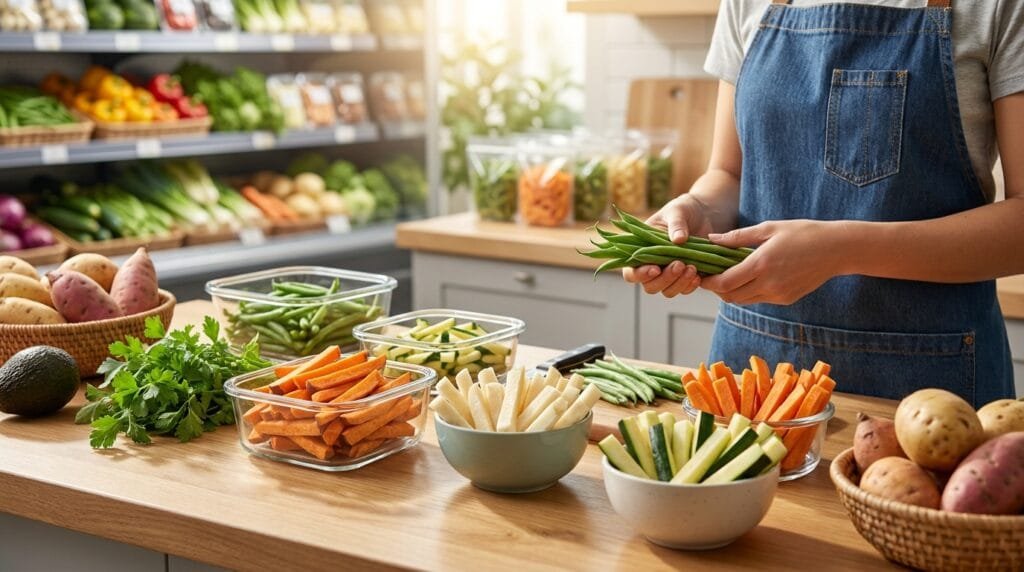
A standard 100-gram serving of fast-food French fries contains 312 calories and 15 grams of fat. A medium restaurant order (117g) averages 365 calories, whereas homemade air-fried or oven-baked vegetable alternatives yield between 40 and 140 calories per 100 grams.
Caloric Density of Traditional Fries vs. Low-Calorie Swaps
The caloric density of traditional French fries is primarily governed by moisture loss and lipid absorption during the deep-frying process. Raw Russet potatoes are relatively low in calories, providing approximately 77 calories and 0.1 grams of fat per 100 grams. However, when submerged in oil heated to 175°C to 190°C (350°F to 375°F), cellular water rapidly vaporizes, creating capillary voids that draw in cooking oil. This displacement increases the fat content to roughly 15 to 17 grams per 100 grams, quadrupling the caloric load to 312–365 calories depending on the cut thickness and frying duration. Thinner cuts, such as shoestring fries, have a higher surface-area-to-volume ratio, absorbing significantly more oil than thicker steak-cut potatoes.
Understanding this absorption mechanism reveals why whole-food vegetable swaps provide substantial caloric reductions. Low-starch root vegetables and non-starchy produce possess different cellular structures and significantly lower baseline carbohydrate levels. For example, raw jicama contains only 38 calories per 100 grams, rutabaga yields 37 calories, and celeriac (celery root) provides 42 calories. Even when prepared with a measured application of monounsaturated fats—such as tossing 200 grams of sliced jicama in 5 grams of olive oil (44 calories) before convection roasting—the resulting dish yields less than 65 calories per 100 grams. This provides an 80% caloric reduction compared to conventional fast-food equivalents while retaining a desirable crisp texture.
Limiting high-temperature oil uptake aligns directly with the World Health Organization Guidelines on Healthy Diets & Saturated Fats, which recommend capping total fat intake below 30% of daily energy and restricting industrial trans and saturated fats to prevent metabolic disease. Furthermore, commercially par-fried and reheated potato preparations frequently introduce oxidized lipids. These degraded fatty acid profiles, alongside chemical additives, are evaluated in ongoing PubMed Research on Ultra-Processed Foods & Gut Microbiome Disruption, highlighting how industrial processing methods alter both energy bioavailability and digestive health compared to whole vegetable alternatives prepared at home.
Real-World Label Breakdown: US Nutrition Facts vs. EU/UK Declarations
Evaluating commercial frozen fries requires careful analysis of regulatory labeling disparities between North America and Europe. In the United States, brands such as Ore-Ida (e.g., Extra Crispy Fast Food Fries) display a serving size calibrated to the frozen state—typically 84 grams (3 oz), reporting roughly 130 to 150 calories and 5 to 7 grams of fat. However, consumer cooking methods introduce drastic weight shifts. When baked or air-fried, the product loses 15% to 25% of its mass through water evaporation without shedding the industrial par-frying oil. Consequently, weighing an 84-gram portion after cooking means consuming roughly 105 grams of frozen-equivalent product, quietly increasing real calorie intake by 25% to 30% above what the panel indicates.
Conversely, in the United Kingdom and European Union, Regulation (EU) No 1169/2011 mandates that nutritional declarations must be expressed per 100 grams, typically showing values “as sold” and, in many cases, “as prepared according to instructions.” A brand like McCain European Home Chips lists standard per-100g data (e.g., 185 kcal oven-baked), making cross-product comparison straightforward. European formulations must also comply with strict additive restrictions overseen by the European Food Safety Authority (EFSA) Additive Safety Regulations, which monitor processing aids, color retention agents like sodium acid pyrophosphate, and acrylamide formation thresholds.
Ingredient transparency also extends to allergens and hidden flavor enhancers. Under the FDA Food Allergen Labeling & Consumer Protection Act (FALCPA), US manufacturers must disclose major food allergens such as wheat or dairy. This is critical for processed fries, as many frozen and restaurant varieties apply wheat flour or hydrolyzed wheat protein batters to produce exterior crunch. When evaluating store-bought frozen alternatives or seasoned vegetable fries, scanning the barcode with Food Scan Genius instantly clarifies whether the reported calories reflect frozen weight or oil-absorbed prepared weight, while cross-referencing allergen disclosures.
| Product / Alternative | Preparation Method | Energy (kcal/100g) | Total Fat (g/100g) | Carbohydrates (g/100g) | Dietary Fiber (g/100g) |
|---|---|---|---|---|---|
| Fast-Food French Fries | Commercial Deep Fry (par-fried) | 312 | 15.1 | 41.4 | 3.8 |
| Commercial Frozen Fries (e.g., Ore-Ida) | Home Oven-Baked | 178 | 7.1 | 26.2 | 2.4 |
| Sweet Potato Fries (Commercial) | Deep Fried | 324 | 16.2 | 42.5 | 4.1 |
| Homemade Russet Potato | Air-Fried (5g oil total / 200g) | 115 | 2.6 | 21.0 | 2.1 |
| Jicama “Fries” | Air-Fried (light spray oil) | 48 | 1.2 | 9.2 | 5.1 |
| Rutabaga / Swede “Fries” | Oven-Roasted (light spray oil) | 46 | 1.3 | 8.6 | 2.3 |
| Celeriac (Celery Root) “Fries” | Oven-Roasted (light spray oil) | 52 | 1.4 | 9.5 | 1.8 |
| Zucchini / Courgette Batons | Air-Fried (unbreaded, light spray) | 27 | 1.1 | 3.6 | 1.2 |
| Carrot Batons | Oven-Roasted (light spray oil) | 54 | 1.2 | 10.2 | 3.0 |
Common Misconceptions: Sweet Potatoes, Air Fryers, and Hidden Oils
A widespread assumption among consumers is that sweet potato fries are inherently a low-calorie alternative to white potato fries. In practice, restaurant-prepared sweet potato fries frequently match or exceed standard fries in caloric density, delivering between 320 and 380 calories per 100 grams. Sweet potatoes contain more natural simple sugars and higher moisture levels than Russets, which causes them to absorb equal or greater volumes of oil to achieve crispness. Without controlled preparation methods, swapping regular fries for sweet potato fries provides more vitamin A, but does not reduce caloric or fat intake.
Another frequent error involves the misuse of “zero-calorie” cooking oil sprays. Under US Food and Drug Administration guidelines, a manufacturer can round nutritional figures to zero if a designated serving contains fewer than 0.5 calories or less than 0.5 grams of fat. To qualify, brands set serving sizes to unrealistic durations—frequently a 0.25-second spray (roughly 0.25 grams). A typical domestic coating lasting two to three seconds delivers 2 to 3 grams of pure fat, introducing 20 to 30 hidden calories per application. Spraying both the basket and the vegetable slices multiple times can inadvertently add 80 to 120 unmeasured calories to an otherwise lean vegetable dish.
Finally, consumers often miscalculate the impact of seasonings and coatings. Non-starchy vegetables like zucchini, parsnip, and eggplant possess higher water content and lack the amylose starch matrix that makes Russet potatoes crisp. Home cooks routinely compensate by adding breading, grated parmesan, cornstarch, or mayonnaise-based dipping sauces. Adding two tablespoons of standard garlic aioli introduces 180 calories and 20 grams of fat, completely neutralizing the 150-calorie deficit achieved by choosing a vegetable base.
Frequently asked questions
How many calories are in a small vs. large order of fast-food fries?
A typical fast-food small fry (roughly 75 to 80 grams) contains between 220 and 240 calories. A standard large order (roughly 150 to 170 grams) ranges from 450 to 510 calories, depending on cut thickness and frying oils.
Which vegetable provides the lowest-calorie fry swap with a crisp texture?
Rutabaga (swede) and jicama offer the lowest caloric density for fry swaps, providing roughly 37 to 48 calories per 100 grams roasted. Both maintain structural integrity during air-frying without collapsing into excess moisture.
Why do homemade air-fried fries have fewer calories than restaurant fries?
Commercial restaurants submerge fries continuously in oil, resulting in 15% to 17% oil absorption by weight. Homemade air-frying relies on high-velocity convection heat and requires only 2% to 4% oil by weight to develop crispness.
Does soaking cut potatoes in water lower their calorie content?
Soaking cut potatoes removes excess surface starch (amylose), which prevents sticking and promotes crisping, but its impact on total calories is negligible (typically less than 2% to 3% of the potato’s total carbohydrate content).
Are frozen store-bought French fries already fried?
Yes. Nearly all commercially sold frozen fries undergo an industrial par-frying step in vegetable oil before freezing to set the exterior starch matrix. Because of this, they already contain added dietary fats before home preparation.
References
- FDA Food Allergen Labeling & Consumer Protection Act (FALCPA)
- European Food Safety Authority (EFSA) Additive Safety Regulations
- PubMed Research on Ultra-Processed Foods & Gut Microbiome Disruption
- World Health Organization Guidelines on Healthy Diets & Saturated Fats
Related guides
- Best Food Allergy Scanner App – Scan Food Labels Instantly — Food Allergy & Sensitivity Scanner Hub
- The 7 Best Free Food Scanner Apps of 2026 — best free food scanner apps
- Choosing the Best Barcode Scan App for Your Health — guide to choosing a barcode scanner app
- Food Scan Genius: World’s #1 Food Ingredient Scanner App — Food Scan Genius scanner app
Check Any Label Against 5 Million Products — Free
Never second-guess confusing grocery labels again. Download Food Scan Genius to uncover hidden additives, toxic dyes, and allergens for the whole household before you buy.