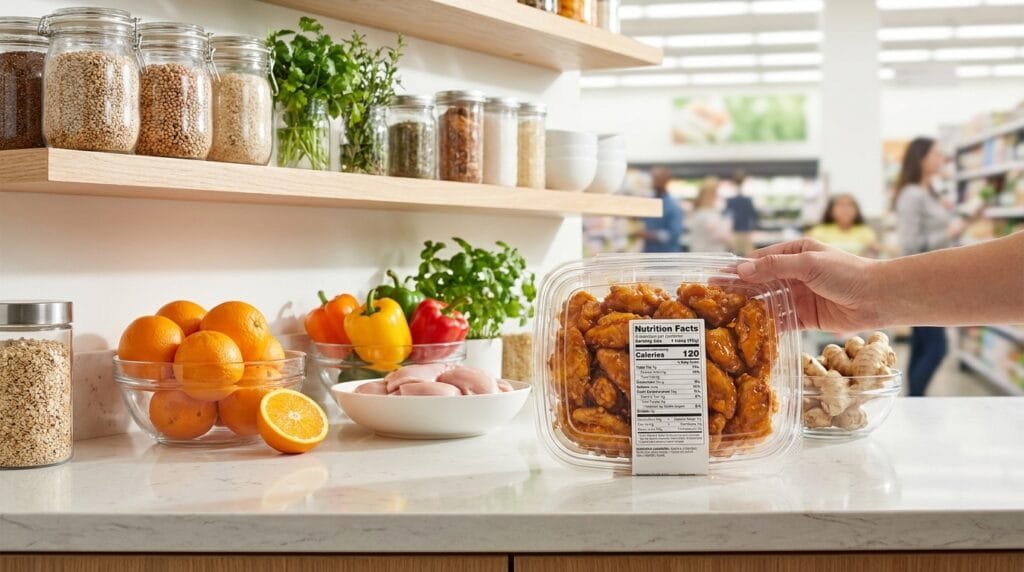
A standard 160-gram (5.7 oz) serving of restaurant orange chicken averages 490 calories, 23 grams of fat (5g saturated), 51 grams of carbohydrates (19g sugar), 820 milligrams of sodium, and 25 grams of protein.
Deconstructing the Macronutrient Profile and Caloric Composition of Orange Chicken
Orange chicken is an energy-dense entrée characterized by battered, deep-fried poultry morsels enrobed in a thickened, sweet-and-sour citrus glaze. From a macronutrient perspective, a standard restaurant serving of approximately 160 grams (roughly 5.7 ounces) supplies 490 kilocalories, distributed across 23 grams of total lipid fat, 51 grams of total carbohydrates, and 25 grams of protein. Because the preparation relies on dark-meat chicken (typically thigh meat) enveloped in a wheat- or cornstarch-based dredge and flash-fried in commercial vegetable oils, approximately 42% of its total caloric value is derived directly from fats. Of these 23 grams of lipids, 5 grams are saturated fatty acids, while the remainder consists of monounsaturated and polyunsaturated fats introduced during the submersion frying phase.
The carbohydrate profile is dominated by simple sugars and refined starches. Of the 51 grams of total carbohydrates in an average portion, only 1 gram represents dietary fiber, leaving 19 to 23 grams classified as total sugars, virtually all of which are categorized as added sugars. The culinary glaze relies heavily on sucrose, high-fructose corn syrup, brown sugar, or honey to achieve its mirror-like viscosity, alongside concentrated orange puree or citrus essential oils. These sugar levels represent roughly 40% of the recommended daily limit for free sugars set under the World Health Organization Guidelines on Healthy Diets & Saturated Fats, which advises capping free sugar intake at under 10% of total dietary energy, and ideally below 5% for enhanced cardiometabolic outcomes.
Sodium concentration is another defining element of orange chicken’s baseline nutrition. A single serving delivers between 750 and 950 milligrams of sodium, primarily sourced from traditional soy sauce (shoyu), hydrolyzed vegetable proteins, monosodium glutamate (MSG), and leavening agents present in the coating batter (such as sodium bicarbonate and sodium acid pyrophosphate). The combination of high glycemic starches, extracted vegetable oils, and salt makes commercial formulations a classic archetype of an ultra-processed food matrix. Clinical investigations, including published PubMed Research on Ultra-Processed Foods & Gut Microbiome Disruption, demonstrate that such combinations bypass natural satiety cues, accelerating energy intake relative to minimally processed lean poultry alternatives.
Reading Real Commercial Labels: US Nutrition Facts Panels vs. EU/UK Formats
When reading nutrition labels on commercial retail products—such as Trader Joe’s Mandarin Orange Chicken, InnovAsian Orange Chicken, or Crazy Cuizine—shoppers encounter significant discrepancies between restaurant estimations and packaged goods. Under United States Food and Drug Administration (FDA) Title 21 CFR 101.9 guidelines, the Reference Amount Customarily Consumed (RACC) for prepared chicken entrées is 140 grams. For Trader Joe’s Mandarin Orange Chicken, a 140-gram serving (roughly 1 cup of chicken with sauce) yields 380 calories, 16 grams of total fat (3.5 grams saturated), 590 milligrams of sodium, 38 grams of carbohydrates, 14 grams of sugar (including 13 grams of added sugar), and 21 grams of protein. In contrast, InnovAsian lists a 156-gram serving that delivers 430 calories, 18 grams of fat, and 43 grams of carbohydrates with 20 grams of sugar, highlighting how brand-specific coating thicknesses directly skew the macronutrient ratio.
A critical divergence emerges when comparing US Nutrition Facts panels to UK and European Union mandatory nutrition declarations governed by Regulation (EU) No 1169/2011. In the EU and UK, manufacturers must display figures normalized per 100 grams of product, alongside or in lieu of subjective serving sizes. On a per-100g basis, commercial orange chicken typically reveals an energy density of 240 to 270 kcal, 11 to 13 grams of fat, 24 to 28 grams of carbohydrates (of which 9 to 13 grams are sugars), and 13 to 15 grams of protein. Salt is reported directly as sodium chloride equivalents rather than elemental sodium; an 800mg sodium serving translates to approximately 2.0 grams of salt per serving, which instantly activates red front-of-pack traffic-light thresholds under UK public health standards.
Label comprehension is further complicated by product preparation states and ingredient disaggregation. Many frozen commercial products package the fried chicken pieces and the sauce packet separately inside the outer bag. The primary nutrition panel usually represents the product “as packaged” assuming uniform sauce distribution. If an individual uses only half the sauce sachet, the actual sugar intake drops by roughly 50%, while protein and fat remain static. Furthermore, commercial sauces frequently contain thickeners and stabilizing additives evaluated under European Food Safety Authority (EFSA) Additive Safety Regulations, including modified food starches (E1422, E1442), xanthan gum (E415), and caramel colorings (E150c or E150d). When evaluating complex products containing unmixed glaze sachets, running the barcode through Food Scan Genius allows consumers to parse the combined ingredient matrix and verify whether the printed values account for the sauce as consumed.
| Product / Preparation Type | Serving Size | Calories (kcal) | Total Fat (g) | Saturated Fat (g) | Carbohydrates (g) | Total Sugars (g) | Protein (g) | Sodium (mg) |
|---|---|---|---|---|---|---|---|---|
| Panda Express Orange Chicken (Restaurant Standard) | 160 g (5.7 oz) | 490 | 23.0 | 5.0 | 51.0 | 19.0 | 25.0 | 820 |
| Trader Joe’s Mandarin Orange Chicken (Frozen Retail) | 140 g (4.9 oz) | 380 | 16.0 | 3.5 | 38.0 | 14.0 | 21.0 | 590 |
| InnovAsian Orange Chicken (Frozen Retail) | 156 g (5.5 oz) | 430 | 18.0 | 3.5 | 43.0 | 20.0 | 23.0 | 680 |
| Standard Commercial Retail (Normalized EU Baseline) | 100 g (3.5 oz) | 265 | 11.8 | 2.6 | 26.5 | 11.2 | 14.5 | 480 |
| Homemade Air-Fried Breast Meat (Minimal Glaze) | 160 g (5.7 oz) | 270 | 6.0 | 1.0 | 22.0 | 8.0 | 32.0 | 420 |
Hidden Allergens and Critical Reading Errors on Orange Chicken Labels
Consumers scanning orange chicken packages frequently mistake the entrée for a simple poultry-and-fruit preparation, overlooking the fact that it ranks among the most complex multi-allergen profiles in the frozen and prepared food aisles. The standard batter requires wheat flour (gluten) and often incorporates dried whole egg or egg whites to achieve structural crispness during frying. The sauce base is universally built upon brewed soy sauce, which introduces both soy and additional wheat. Furthermore, many commercial glazes integrate toasted sesame oil, sesame seeds, or oyster extract to establish an authentic flavor base. Under the Food Allergy Research & Education (FARE) Clinical Standards, individuals managing non-IgE or IgE-mediated reactions must exercise extreme caution: orange chicken routinely cross-contacts four of the top major allergens recognized by global regulatory frameworks—wheat, soy, egg, and sesame.
A widespread reading pitfall involves the assumption of significant micronutrient value—specifically Vitamin C—due to the presence of orange imagery and naming. While whole oranges are rich in L-ascorbic acid, commercial orange chicken sauces use high-temperature cooking, acid hydrolysis, and shelf-stabilization techniques that degrade ascorbic acid rapidly. Consequently, the Nutrition Facts panel almost universally lists Vitamin C content as 0 milligrams (0% Daily Value). Consumers also routinely miscalculate portions because the breading conceals how much actual chicken meat is present: laboratory food separation demonstrates that the meat core often constitutes only 50% to 55% of the total piece weight, with the remaining mass split evenly between refined flour batter and sucrose-dense glaze.
Frequently asked questions
How much sugar is typically found in one serving of orange chicken?
A standard 140g to 160g serving of orange chicken contains between 14 and 20 grams of sugar. This sugar is primarily added sucrose, corn syrup, or honey contained within the thickened basting glaze.
Is orange chicken considered a gluten-free food?
No, standard commercial and restaurant orange chicken is not gluten-free. Wheat flour is used in the fried batter crust, and wheat-containing soy sauce is a primary constituent of the orange glaze.
What accounts for the high sodium level in commercial orange chicken?
The elevated sodium level—averaging 600mg to 850mg per portion—stems from soy sauce, leavening agents in the batter like sodium bicarbonate, MSG added for savory depth, and salt-based shelf preservatives.
Why does frozen orange chicken sometimes show two different serving calculations?
Packaged kits often list separate figures for the chicken pieces alone versus the chicken with sauce included. If consumers discard part of the sauce packet, their caloric and sugar intakes will be significantly lower than the fully prepared panel values.
Does commercial orange chicken provide dietary Vitamin C?
No. Despite the presence of orange peel, zest, or juice concentrate in the glaze, the industrial heat processing and packaging stability requirements destroy natural L-ascorbic acid, typically resulting in 0% of the Daily Value for Vitamin C.
References
- Food Allergy Research & Education (FARE) Clinical Standards
- European Food Safety Authority (EFSA) Additive Safety Regulations
- PubMed Research on Ultra-Processed Foods & Gut Microbiome Disruption
- World Health Organization Guidelines on Healthy Diets & Saturated Fats
Related guides
- Best Food Allergy Scanner App – Scan Food Labels Instantly — Food Allergy & Sensitivity Scanner Hub
- The 7 Best Free Food Scanner Apps of 2026 — best free food scanner apps
- Choosing the Best Barcode Scan App for Your Health — guide to choosing a barcode scanner app
- Food Scan Genius: World’s #1 Food Ingredient Scanner App — Food Scan Genius scanner app
Check Any Label Against 5 Million Products — Free
Never second-guess confusing grocery labels again. Download Food Scan Genius to uncover hidden additives, toxic dyes, and allergens for the whole household before you buy.