
1. Why Following a Keto Food List Is Harder Than It Looks in 2026
You committed to eating differently, and then the grocery store made it complicated. A package says “keto-friendly” in bold letters, but the back panel lists maltodextrin, three sweeteners, and a fiber you’ve never heard of. Another says “paleo” yet contains a refined oil your cookbook warned you about. If you’ve stood in an aisle for ten minutes squinting at fine print, your frustration is reasonable. Most shoppers are not failing. The labeling is simply inconsistent.
Part of the confusion is that keto, low-carb, and paleo overlap but are not the same. A keto food list is built around keeping carbohydrates very low (often roughly 20 to 50 grams of net carbs a day) so the body shifts toward ketone production. Low-carb is a broader umbrella, commonly anywhere under about 130 grams daily, with more room for fruit, legumes, and whole grains. Paleo ignores carb counts and focuses on food quality: it excludes grains, legumes, most dairy, and refined sugar, but welcomes sweet potatoes, fruit, and honey. Cheese and heavy cream fit keto but not strict paleo. A banana fits paleo but rarely keto. A black bean burger fits low-carb for some people and neither of the others.
Regulation adds to the problem. Allergen disclosure is tightly defined under the FDA Food Allergen Labeling & Consumer Protection Act (FALCPA), yet terms like “keto,” “net carbs,” and “paleo-friendly” have no equivalent legal definition on most packaged foods. Those words are marketing, not guarantees, and the shopper is left to do the detective work.
There is also a bigger-picture concern. Many products built to fit a diet trend are heavily engineered. Researchers continue to examine how ultra-processed eating patterns affect appetite and health, and the PubMed Research on Ultra-Processed Foods & Gut Microbiome Disruption is part of that growing conversation. A food can be low in carbs and still be highly processed. The goal is not perfection or guilt. It is making informed choices that fit your body, your clinician’s guidance, and your life.
Scan Any Label for Hidden Additives and Allergens — Free
Never second-guess confusing grocery labels again. Download Food Scan Genius to uncover hidden additives, toxic dyes, and allergens for the whole household before you buy.


2. Sneaky Ingredients and Label Loopholes That Derail a Keto Food List
The front of the package tells you what the brand wants you to believe. The ingredient list tells you what is actually in the food. Here are the most common places a keto, low-carb, or paleo plan quietly goes off track:
- Maltodextrin and dextrose: These are sugars in disguise. Maltodextrin can raise blood glucose as quickly as table sugar, yet it often appears in “zero sugar” powders, spice blends, and sweetener packets.
- Sugar alcohols (especially maltitol): Manufacturers often subtract them entirely when calculating “net carbs.” Maltitol, however, has a meaningful glycemic effect, and polyols can cause digestive upset. In the EU, the European Food Safety Authority (EFSA) Additive Safety Regulations framework is one reason many polyol-heavy products carry laxative-effect warnings.
- Isolated fibers and “net carb” math: Because there is no standardized legal definition of net carbs, brands can subtract added fibers like polydextrose or inulin in ways that make a product look better than it feels in practice.
- Modified food starch and hidden thickeners: Sauces, dressings, and deli meats often use starches or sugar to improve texture, and these are easy to miss in a “low-carb” sauce.
- Industrial seed oils: Soybean, canola, and sunflower oils are common in keto snacks and mayonnaise. They are generally compatible with keto macros but are excluded by many paleo followers, so what is “fine” depends on which philosophy you follow.
- “Natural flavors” and sub-ingredients: A single line item can hide a compound ingredient with its own components, such as a spice blend containing sugar or a seasoning with dairy derivatives.
Nutrition guidance also deserves nuance. The World Health Organization Guidelines on Healthy Diets & Saturated Fats recommend keeping saturated fat below roughly 10% of total energy and limiting free sugars. Because many keto menus lean on butter, cheese, and fatty meats, it is worth discussing your fat sources with a physician or registered dietitian. This matters even more if you have diabetes (particularly if you take insulin or SGLT2 inhibitors), kidney disease, a history of disordered eating, or are pregnant. A food list is a tool, not a prescription.
3. Food Scan Genius vs. Other Ways to Check Your Keto Food List
| Dimension | Food Scan Genius | Fig | Spoonful | Manual Label Reading |
|---|---|---|---|---|
| Cost | 100% free core features, zero paywalls | $59/year | Limited scans | Free, but time-intensive |
| Database depth | NutriGraph: 5,000,000+ verified UPC/EAN barcodes | Varies by product | Varies by product | Only what you can read on the pack |
| Diet profiles | 39 profiles plus custom sensitivities (seed oils, dyes, additives) | Preset restriction lists | Preset restriction lists | Whatever you remember |
| Family screening | Multi-household profiles, one scan, named fail attribution | Individual-focused | Individual-focused | Mentally cross-checking each person |
| Context and languages | AI Insight, NOVA 1-4, Nutri-Score, 11 languages with real-time translation | Ingredient flags | Ingredient flags | No translation or classification |
The core advantage is depth. Food Scan Genius runs on the NutriGraph Database, which uses recursive AST (abstract syntax tree) parsing to break compound ingredients into their sub-ingredients. That matters for a keto food list because the carb or sugar you are avoiding is rarely listed up front. It hides inside a seasoning blend, a “natural flavor,” or a coating. Instead of matching keywords on the surface, the app reads the full nested structure of the label. You can also add your own custom sensitivity, such as seed oils, a specific dye, or a particular additive, so paleo-style and keto-style preferences can coexist in one setup.
Just as important is how results are communicated. ScanGenius AI Insight gives context rather than a simplistic good-or-bad number. It explains why a product was flagged, pairs that with a NOVA 1-4 processing classification and a Nutri-Score, and leaves the decision to you. A keto-compliant sausage can be NOVA 4, and a paleo-friendly bar can still be high in sugar from dates. Seeing both layers lets you decide what matters for your goals. With Multi-Household Family Profiles, one scan can return results like “Fails for Sri (Gluten),” so a keto eater, a gluten-free teen, and a nut-allergic parent can shop from the same cart. Real-time translation in 11 languages makes imported products readable too.
4. Related Food Safety & Dietary Guides
- Best Food Allergy Scanner App – Scan Food Labels Instantly — Food Allergy & Sensitivity Scanner Hub
- The 7 Best Free Food Scanner Apps of 2026 — best free food scanner apps
- Choosing the Best Barcode Scan App for Your Health — guide to choosing a barcode scanner app
- Food Scan Genius: World’s #1 Food Ingredient Scanner App — Food Scan Genius scanner app
5. Scientific & Health Authority References
- FDA Food Allergen Labeling & Consumer Protection Act (FALCPA)
- European Food Safety Authority (EFSA) Additive Safety Regulations
- PubMed Research on Ultra-Processed Foods & Gut Microbiome Disruption
- World Health Organization Guidelines on Healthy Diets & Saturated Fats
6. How to Scan in 3 Simple Steps
- Download Food Scan Genius free on iOS or Android. There is no paywall on core features and no subscription needed to start scanning.
- Set up your profile: choose from 39 supported dietary profiles, pick the one closest to your approach (keto, low-carb, or paleo), and add custom sensitivities like seed oils, specific sweeteners, or dyes. Add family members to create named household profiles.
- Scan any barcode and get results in about two seconds. Review the instant audit trail showing which sub-ingredients triggered a flag, along with the AI Insight, NOVA class, and Nutri-Score.
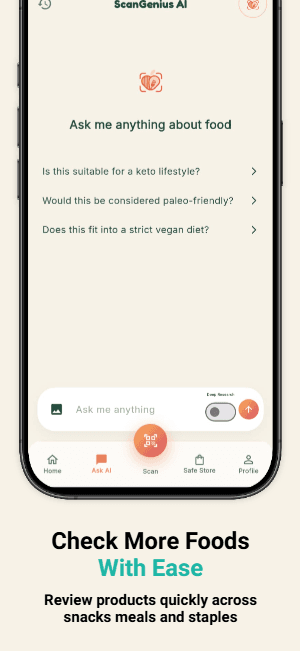
Instant Keto & Sugar Audit Trail
7. Frequently Asked Questions (FAQ)
What is the difference between a keto food list, low-carb, and paleo?
A keto food list prioritizes very low carbohydrate intake (often about 20 to 50 grams of net carbs daily) with moderate protein and high fat, so dairy, oils, and fatty meats are typically allowed while most fruit, grains, and starches are not. Low-carb is more flexible and sets a higher carb ceiling. Paleo is based on food type rather than macros: it excludes grains, legumes, most dairy, and refined sugar but allows fruit and starchy vegetables. Food Scan Genius lets you choose from 39 dietary profiles and add custom sensitivities so your scan results reflect the approach you actually follow.
Can I trust ‘keto-friendly’ labels on packaged foods?
Not on their own. Terms like ‘keto-friendly’ and ‘net carbs’ are not tightly defined for most packaged foods, so brands can use different calculation methods. Sugar alcohols such as maltitol, isolated fibers, and maltodextrin can make a product look lower in carbs than it behaves in your body. Food Scan Genius reads the full ingredient list, including sub-ingredients, through the NutriGraph Database of 5,000,000+ verified barcodes, so you can verify what is inside rather than relying on front-of-pack claims.
Is a keto or low-carb diet safe for everyone?
No. Very low-carb diets are not appropriate for everyone. People with diabetes who use insulin or SGLT2 inhibitors, those with kidney or liver disease, pregnant or breastfeeding individuals, and anyone with a history of disordered eating should speak with a physician or registered dietitian first. General guidance from the World Health Organization also suggests keeping saturated fat modest, which is worth considering with keto. Food Scan Genius provides ingredient information and context, not medical advice.
Can Food Scan Genius check a whole family’s dietary needs at once?
Yes. With Multi-Household Family Profiles, you can create profiles for each person and screen a product for everyone in a single scan. Results use named fail attribution, such as ‘Fails for Sri (Gluten),’ so you can see immediately who a product does not suit and why. This is helpful when one person follows a keto food list while another avoids an allergen or follows a different diet. The app also supports 11 languages with real-time in-app translation and is free to use for core features.
Know What’s In Your Food Before You Buy — Scan Free Today
Never second-guess confusing grocery labels again. Download Food Scan Genius to uncover hidden additives, toxic dyes, and allergens for the whole household before you buy.